ADVERTISEMENT
ADVERTISEMENT



U.S. and India: Partners for Peace and Prosperity
India must broaden its foreign policy horizons to encompass building peace and prosperity throughout the world, not just in its immediate neighborhood.
-
 Raymond E. Vickery, Jr
 - Sat, 15, Aug 2026
- 01:30 EDT
- 17
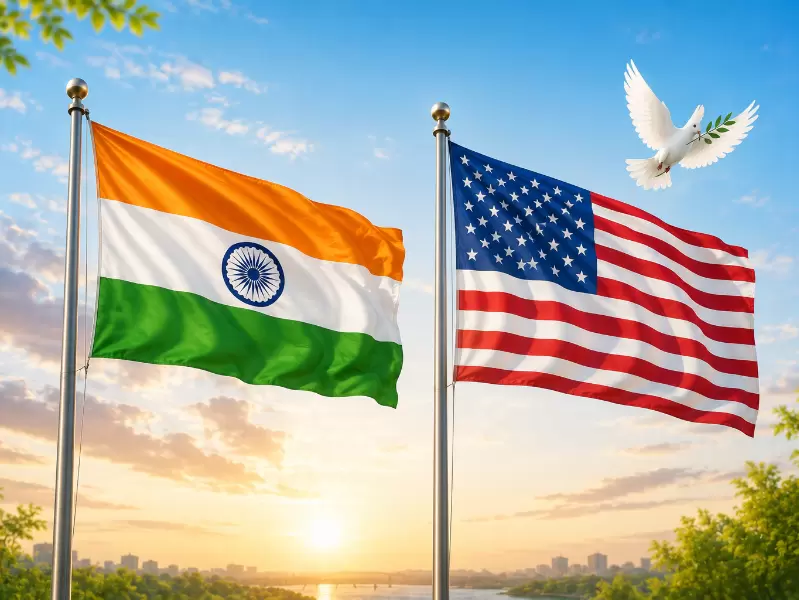 Representative Image / Generated using AI
As India celebrates its 80th anniversary of independence from the British empire and the United States of America its 250th, it is altogether fitting that we take stock of where we have been, where we are now, and where we are going.
The U.S. relationship with an independent India got off to a promising start with America being a chief advocate for Indian independence. India looked to American concepts of freedom and democracy for inspiration in establishing its own constitutional institutions. India and the United States worked together as founding members of all the major institutions established to promote peace and prosperity after the devastation of World War II.
Also Read: Viksit Bharat 2047: A Roadmap to Become a Developed Nation
However, this close US-India friendship deteriorated for almost forty years as India concentrated on its independence from the West, refusing to join in the Cold War to stop the spread of Soviet Communism and adopting a largely top-down, closed economic model. These were the days of the Non-aligned Movement and the License Raj. With few exceptions, these differences, internationally and domestically, led to what the author Dennis Kux referred to as “estranged democracies.”
In the early 1990’s, the limits of the Indian command, closed economic model became apparent. The country was nearly bankrupt with only a couple of weeks’ worth of foreign exchange and a rate of growth far below that necessary to build a modern economy. To make matters worse, India’s chief international patron, the Soviet Union, had dissolved amid economic insufficiency. India changed course. It began to dismantle the License Raj and open its economy to foreign investment.
The Clinton Administration was more than willing to accept the opportunities for this opening and eagerly promoted engagement both economically and strategically with its fellow large democracy. For a time, the push toward partnership was stalled because of the automatic sanctions triggered by Indian nuclear testing. The progression toward partnership was resumed as sanctions were lifted. The nuclear question was finally swept away by the U.S.-India civil nuclear deal brought to finalization in 2005-2008.
For some thirty-five years, the movement to partnership continued to grow regardless of the partisan affiliations of those in charge of government in both the U.S. and India. The rapid upward trajectory of the relationship reached an apex of sorts under the “strategic altruism” policy of the Biden Administration. This policy basically held that it was in the national interest of the United States for India to succeed both economically and strategically regardless of the immediate quid pro quo received by the United States. In 2025, this policy changed.
The policies and actions of the second Trump administration have put extraordinary strains on the U.S.-India partnership. The basic strains center around tariffs and sanctions and the economic difficulties associated with the Iran war. The harm to the U.S.-India partnership wrought by the illegal “liberation day” tariffs was compounded by Russian oil tariffs and sanctions that seemed to treat India unfairly in comparison to other nations. Attempts to impose steep charges on H1B visas and other restrictions on the movement of people rankled the relationship as did statements by the President on the “dead” Indian economy and the claiming of credit for ending hostilities between India and Pakistan. And yet the U.S.-India partnership, which has been growing ever stronger over the past thirty-five years, remains robust.
People-to-people ties have become a bedrock of the relationship in large part because of the size and success of the Indian American community. This community remains fully committed to its American home while passionate about a positive partnership with India. U.S.-India trade and investment, in spite of the Trump headwinds, are presently strong and growing although far less than optimal. The U.S.-India strategic convergence, in view of the threat from China and the necessity of a free and open maritime domain, remains as strong as ever.
The future of the U.S.-India relationship is ripe with the promise of a stronger partnership for peace and prosperity. However, for this promise to be fully realized several conditions must be met. Generalized war must be avoided and the United States must take a path of cooperation rather than domination. India must broaden its foreign policy horizons to encompass building peace and prosperity throughout the world, not just in its immediate neighborhood.
As in the past, economic engagement can be a chief driver of the partnership. The United States and India must reaffirm the synergism between their economies rather than succumbing to the siren song of protectionism. The possibilities for mutually beneficial trade and investment are manifest. They include software and artificial intelligence, energy, defense, and machinery, as well as such traditional areas as textiles and consumer goods. The United States and India can reach a free trade agreement and work to revive a multilateral trading system.
Strategically, the 47-nation Combined Maritime Forces, in which India has taken a leading role and now heads a Combined Task Force, offers the way forward in facing the threats of China, terrorism, and international lawlessness. With its disparate relations with Russia, Western Asia, and the Global South, India can be a stabilizing factor to the mutual benefit of the United States and India rather than an impediment to U.S.-India partnership in building peace and prosperity.
Strengthening the U.S. -India partnership to build peace and prosperity for both nations and the world will require strategy, time, resources and commitment to basic principles. Such a partnership between the world’s largest democracies is the hope of the future.
(The views and opinions expressed in this article are those of the author and do not necessarily reflect the official policy or position of New India Abroad.)
Discover more at New India Abroad.
Leave A Comment
Related


ADVERTISEMENT

ADVERTISEMENT
E Paper
Video

Comments
Start the conversation
Become a member of New India Abroad to start commenting.
Sign Up Now
Already have an account? Login