ADVERTISEMENT
ADVERTISEMENT



UK’s India All-Party Parliamentary Group honors Maharaja of Jodhpur
The celebration also marked the publication of Bapji: The King Who Would Be Man, an intimate account of the emperor's life
-
1747754650.png) Ishani Duttagupta
Ishani Duttagupta - Fri, 17, Jul 2026
- 16:33 EDT
- 40
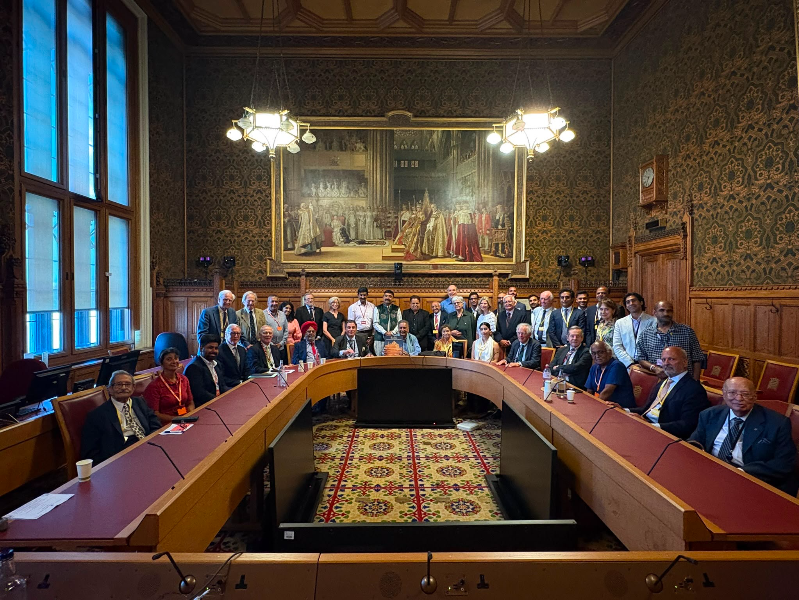 UK’s India All-Party Parliamentary Group / Handout
Earlier this week, parliamentarians, diplomats, and the British Indian community gathered at the House of Lords to celebrate the life and public service of Gaj Singh II the emperor of Marwar-Jodhpur (affectionately known as Bapji).
Hosted on July 13 by British Indian entrepreneur Karan Bilimoria, alongside the India All-Party Parliamentary Group and the 1928 Institute, the event honored Bapji and his wife, queen Hemlata Rajye. Guests from business, culture, and politics attended to recognize Bapji’s lifelong dedication to the people of Jodhpur, the preservation of India's cultural heritage, and the strengthening of UK-India relations.
Also Read: Indian-origin psychiatrist nominated for UK life peerage
Born in 1948, Gaj Singh II succeeded his father as head of the House of Marwar at four years old. He was educated at Eton College and the University of Oxford, where he studied Philosophy, Politics, and Economics (PPE).
As a custodian of Rajasthan's cultural inheritance, he led the preservation of Mehrangarh Fort and established the Mehrangarh Museum. He also converted a section of Umaid Bhawan Palace into a hotel and museum to showcase the region's history and royal heritage.
Beyond Jodhpur, he served as India’s High Commissioner to Trinidad and Tobago, with concurrent accreditation to several Caribbean nations. He also served as a member of the Rajya Sabha, the upper house of the Indian Parliament.
Bilimoria said, "Bapji's life reminds us that true leadership is not only about inheritance, but about service. He has carried the weight of history with grace, humility and humanity, transforming a remarkable legacy into something living, generous and relevant to his people. “He has been an outstanding guardian of India’s heritage, a distinguished public servant and a steadfast friend of the United Kingdom. The warmth and affection in the room reflected the enormous respect in which he is held across generations and across both our countries.”
The celebration also marked the publication of Bapji: The King Who Would Be Man, an intimate account of a sovereign born into grandeur but shaped by the democratic and social transformations of post-independence India.
The book tells the story of a royal figure who did not cling to former power, but instead channelled his inheritance into service, cultural preservation and public purpose. It presents Bapji not only as the custodian of palaces, traditions and institutions, but as a “king of conscience”, a man who reconciled the solemnity of history with the responsibilities of the present.
The evening offered an opportunity to the guests to celebrate a legacy of duty without distance, tradition without nostalgia, and leadership rooted in humanity.
Leave A Comment
Related







ADVERTISEMENT

ADVERTISEMENT
E Paper
Video

Comments
Start the conversation
Become a member of New India Abroad to start commenting.
Sign Up Now
Already have an account? Login