ADVERTISEMENT
ADVERTISEMENT



Trump to draw down 700 immigration agents in Minnesota, thousands remain
U.S. President Donald Trump has deployed thousands of armed immigration enforcement agents in and around Minneapolis this year to detain and deport migrants.
-
 Reuters
 - Wed, 04, Feb 2026
- 14:30 EST
- 126
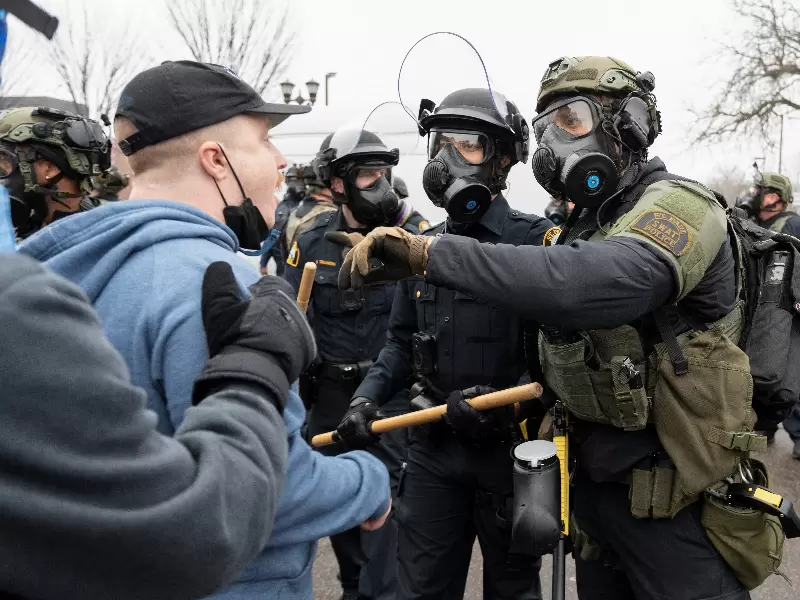 A protester faces law enforcement officers after federal immigration agents raided a home in St. Paul, Minnesota, U.S., November 25, 2025. / REUTERS/Tim Evans
The Trump administration is withdrawing some 700 federal immigration enforcement agents from Minnesota, although about 2,000 agents will stay in place, White House border czar Tom Homan announced on Feb. 4, a number the state's Democratic leaders say is still too high.
In an unprecedented surge, U.S. President Donald Trump has deployed thousands of armed immigration enforcement agents in and around Minneapolis this year to detain and deport migrants, resulting in angry and sometimes violent confrontations with residents and street protests across the nation.
Also Read: U.S. judge declines to halt Trump's Minnesota immigration agent surge
Homan said the deportation campaign was in the interest of public safety. He was partially reducing the deployment because he was seeing "unprecedented" cooperation from Minnesota's elected sheriffs who run county jails, although he did not give more details.
"Let me be clear, President Trump fully intends to achieve mass deportations during this administration, and immigration enforcement actions will continue every day throughout this country," Homan said at a press conference. "President Trump made a promise. And we have not directed otherwise."
Homan also said there had been "a gap" in giving agents body-worn cameras, which he was hoping to fix with Congress.
The deportation sweeps, dubbed Operation Metro Surge, have been opposed and denounced since early January by Minnesota Governor Tim Walz, Minneapolis Mayor Jacob Frey and other elected Democrats. They have sued the Trump administration in federal court, demanding the restraining or withdrawal of a federal deployment that was about 20 times the normal number of immigration enforcement agents in the state, outnumbering local police forces.
Both Walz and Frey, in separate statements, called Homan's announcement encouraging but insufficient.
"The drawdown and body-worn cameras are a step in the right direction, but 2,000 ICE officers still here is not de-escalation," Frey said. "My message to the White House has been consistent – Operation Metro Surge has been catastrophic for our businesses and residents. It needs to end immediately."
Grappling with one of the thorniest political crises of his tenure, Trump sent Homan to Minnesota in late January with a mission to talk with Walz and Frey and temper the outrage seen in Minneapolis' streets, which intensified after immigration agents twice fatally shot U.S. citizens.
The president's aggressive deportation efforts, part of a nationwide campaign, have triggered protests, drawn criticism even from some of his fellow Republicans and stern rebukes from some federal judges asked to rule on the legality of migrants' detentions, who say their orders are being defied.
'LARGEST IMMIGRATION OPERATION EVER'
The reduction announced on Feb. 4 still leaves in place an extraordinary number of immigration agents in Minnesota, a figure Trump officials were calling unprecedented only a few weeks ago.
In early January, the Trump administration sent in around 2,000 federal agents to the Midwestern state. Todd Lyons, acting director of U.S. Immigration and Customs Enforcement, described Operation Metro Surge as the "largest immigration operation ever" on Jan. 6, a day before Renee Good, a U.S. citizen, was fatally shot by an ICE officer in her car in Minneapolis.
A little more than two weeks later, federal agents fatally shot another U.S. citizen in a city street, Alex Pretti. As January continued, hundreds of more agents were deployed, reaching 3,000 by the month's end.
Homan said his goal was to return to the usual force of about 150 federal immigration agents in Minnesota, but did not say when that would be possible.
He said his meetings with Walz and Frey had been productive: "While we had our differences, one thing was clear - we are all committed to public safety," he said.
Trump has said that many migrants must be deported, blaming them, often in sweeping terms, for financial fraud and violent crimes.
Homan wants more jails in Minnesota to allow in immigration agents to question or take custody of detained migrants. Some already do, although only seven sheriffs out of Minnesota's 87 counties have signed formal cooperation agreements with ICE.
Others, including the main jail in Minneapolis run by the Hennepin County sheriff, do not cooperate. Minneapolis and some other cities prohibit their employees, including police, from asking about citizenship or cooperating with federal immigration enforcement, saying it threatens public safety if migrants who are victims of or witnesses to crime fear coming forward.
Homan, a former Border Patrol officer, also accused protesters of "impeding" immigration agents, whom he lauded as patriots upholding the law, doing a difficult job while being unfairly vilified.
Beyond the gates of the federal field office outside Minneapolis where Homan was speaking, more than a dozen protesters rallied against ICE in temperatures well below freezing.
Duane Olberding, a 70-year-old psychotherapist from Kansas City, said he was happy to hear of any agents leaving.
"These 700 people, I'm glad that Minnesotan people were able to get rid of them," he said, "but I'm guessing where they're going next is Kansas City, which is my home, which I don't like."
Asked if he thought Operation Metro Surge had been a success, Homan replied that he thought it had improved public safety. "Was it a perfect operation? No," Homan said.
Discover more at New India Abroad.
Leave A Comment
Related










ADVERTISEMENT

ADVERTISEMENT
E Paper
Video

Comments
Start the conversation
Become a member of New India Abroad to start commenting.
Sign Up Now
Already have an account? Login