ADVERTISEMENT
ADVERTISEMENT



The New Food Pyramid: Healthy or Harmful?
The new pyramid departs visually from previous federal nutrition guidelines by inverting the traditional hierarchy of foods.
-
 Ritu Marwah
 - Tue, 31, Mar 2026
- 18:16 EDT
- 121
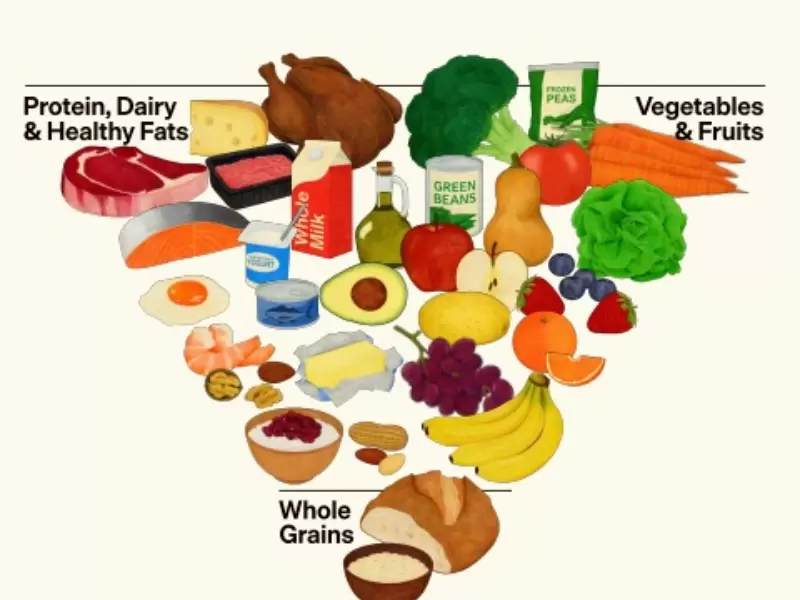 New food Pyramid / realfood.gov
The U.S. Department of Health and Human Services, together with the U.S. Department of Agriculture, has unveiled a new food pyramid as part of the latest Dietary Guidelines for Americans. But not everyone is convinced the update represents meaningful change. Speaking at an American Community Media briefing, Christopher Gardner, professor of medicine at Stanford University, dismissed some of the revisions as more sensational than substantive.
The new pyramid departs visually from previous federal nutrition guidelines by inverting the traditional hierarchy of foods. Rather than placing grains at the base, the updated model prioritizes protein, full-fat dairy, healthy fats, fruits, and vegetables, while relegating whole grains to the bottom tier. It also discourages refined carbohydrates, added sugars, and highly processed foods, and significantly increases recommended protein intake compared to earlier versions.
Old Wine in New Bottles
The current administration has framed the update as a once-in-a-generation effort to “clean up” the American food system. Gardner, however, expressed skepticism, arguing that the most striking feature—the flipped pyramid—leans more toward symbolism than science.
“I actually take the flipping of the pyramid as being a sensationalist approach,” he said, noting that the inverted design creates the impression of a dramatic overhaul. In practice, he argued, the visual may confuse more than clarify. Fruits and vegetables appear across multiple levels, while whole grains—still recommended at two to four servings a day—are positioned at the base, potentially implying they should be minimized.
“If you actually look at all the different domains of recommendations, most of them are consistent with old recommendations,” he added.
Protein at the Top
Marion Nestle, who served on the Dietary Guidelines Advisory Committee in 1995, described the pyramid as visually effective but conceptually problematic. In her view, it is heavily meat-centric.
“Protein is understood by the public as a euphemism for meat, and whole-fat dairy is understood as a euphemism for raw milk,” she said. “So this pyramid, without saying so explicitly, is about eating more meat and high-fat dairy products.”
Nestle noted that the updated guidelines appear to nearly double long-established recommendations for protein intake relative to body weight. For decades, protein was not considered a nutrient of concern in federal guidance. However, the explosion of protein-fortified products—from snack bars to beverages—has reshaped public perception, leading many to believe higher intake is necessary.
“This shift risks reinforcing a misconception,” she said, noting that earlier recommendations were not deficient to begin with.
Fat Is Back
Nestle also pointed to the messaging surrounding the rollout. “The pyramid has a big steak in the upper left-hand corner,” she said, referencing social media reactions, including those from Robert F. Kennedy Jr., who declared, “beef is back, butter is back, meat is back.”
Now the Paulette Goddard Professor of Nutrition, Food Studies, and Public Health at New York University, Nestle argued that the emphasis on protein and full-fat dairy makes it difficult to stay within the recommended limit of 10% of calories from saturated fat.
She also raised concerns about accessibility. The guidelines, she said, overlook the realities facing low-income families, who may lack the time, resources, or equipment to prepare the “real food” the pyramid promotes.
Gardner echoed similar concerns about the policymaking process. He noted that a year-long advisory committee report—one that emphasized legumes such as beans, peas, and lentils, and recommended reducing red and processed meat—was “largely thrown out” in favor of a model that places a “big steak at the very top.”
“We have really powerful lobbyists in dairy and beef,” said Dr Spencer. “There is no legume lobbying component here.”
Who’s Following These Guidelines?
Experts also question how widely such guidelines are followed in practice. Historically, Americans have struggled to meet federal dietary recommendations, particularly in institutional settings like school meal programs.
While there is broad consensus on reducing ultra-processed foods and added sugars, some specialists worry that prioritizing protein in school lunches could divert attention from more urgent nutritional gaps. They also point to a lack of funding and policy clarity to support meaningful change.
Recent federal decisions have further complicated the situation. Cuts to pandemic-era programs, reportedly totaling around $1 billion, that once supported access to fresh, locally sourced produce have left schools with fewer resources, even as expectations for healthier meals continue to rise.
Education Is Not Enough
For his part, Kennedy has made clear that regulation is not on the table. He recently argued that legislative action would amount to a “nanny state,” instead emphasizing public education and personal responsibility.
But critics say that approach is unlikely to succeed on its own. Decades of dietary guidance, from food pyramids to updated plate models, have done little to shift public behavior in a meaningful way.
If education alone were enough, they argue, those efforts would already have worked.
The message remains familiar: eat less sugar, make healthier choices, and trust the food industry to follow suit. Yet without stronger policy intervention, many experts say, there is little reason to believe the outcome will be any different this time.
Leave A Comment
Related












ADVERTISEMENT

ADVERTISEMENT
E Paper
Video

Comments
Start the conversation
Become a member of New India Abroad to start commenting.
Sign Up Now
Already have an account? Login