ADVERTISEMENT
ADVERTISEMENT



The diaspora disconnect: Why exuberance for India’s leadership must be grounded in data
Admiration becomes problematic when it transforms into a certainty unmoored from data
-
 Meda Parameswara Reddy
 - Tue, 12, May 2026
- 14:05 EDT
- 423
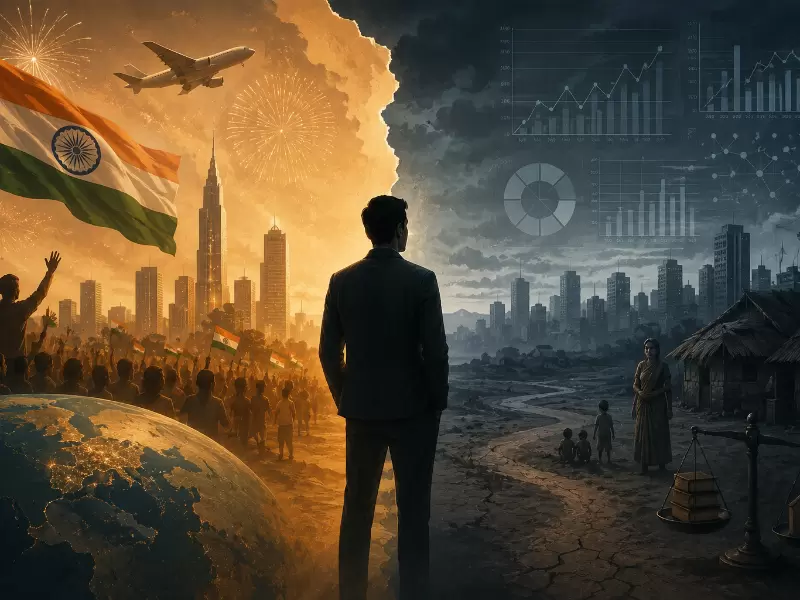 Representative Image / Generated using AI
For many Indians living abroad, the story of India today is a story of pride, confidence, and national resurgence. When members of the diaspora return home, they encounter gleaming airports, modern highways, and thriving technology corridors.
This emotional uplift is understandable. However, as a scientist trained at the Indian Institute of Science and Johns Hopkins University, I know that a system’s "perceived performance" rarely matches its "actual output" without a rigorous audit.
Admiration becomes problematic when it transforms into a certainty unmoored from data. This "Diaspora Euphoria" is often shaped by a calibration error: we are comparing India today not to its global peers, but to the India of our youth—a period of scarcity and constrained opportunity. When a country is evaluated only against its own past, we miss the reality of its global trajectory.
Also Read: Counting a billion people: Inside India's mega census drive
The Selection Bias of the Visitor The diaspora remains largely insulated from India's comparative reality because their visits are filtered through a significant "Selection Bias." Their impressions are shaped by stays with affluent relatives and time spent in modern IT hubs like Bangalore, Hyderabad, or Gurugram, where earnings are five to ten times the national median. They see the top 15 percent and mistake it for the whole.
This disconnect is further amplified by emotional symbolism. Many Indians abroad feel a surge of pride when they see Prime Minister Modi projected as a strong leader on the global stage—often citing instances of him "standing up" to figures like Donald Trump as evidence of a new, assertive India. But in the cold math of systems analysis, diplomatic optics are high-visibility, low-cost gestures.
They do not feed a billion people. A statesman’s primary responsibility is not to impress foreign audiences; it is to improve the lived reality of the ordinary citizen. When we move past these optics and look at the measurable indicators, a more complex picture emerges.
What the Data Actually Shows To understand India’s trajectory, we must look beyond impressions. While India’s GDP per capita has risen to roughly $2,400 today, during the same period, peers like Vietnam surged to ~$4,300 and Indonesia to ~$4,700. India’s growth is real, but it is not extraordinary relative to its peers.
In the fundamental metrics of human utility—life expectancy and infant mortality—India continues to lag. For instance, India’s infant mortality rate remains at ~26 deaths per 1,000 births, nearly double that of Vietnam (~14) and significantly higher than China (~6). Perhaps most sobering is the Global Hunger Index, where India consistently ranks near the bottom (recently 105th out of 127 countries). Malnutrition is a structural "debt" that affects cognitive development and long-term productivity for decades to come.
Also Read: Indian Americans urged to engage next generation
Furthermore, we cannot claim economic health when youth unemployment estimates remain stubbornly high, or when female labor participation sits at a meager 20 percent—significantly lower than Bangladesh (38 percent) or Vietnam (70 percent). A nation cannot achieve sustained prosperity while excluding half its population from the engine of growth.
Reality vs. Speculation When presented with these indicators, diaspora supporters often respond with a familiar argument: "Strategic investments will pay off later." In the world of R&D and systems analysis, this is speculation, not analysis. National progress must be evaluated based on current outcomes, not future hopes. Infrastructure projects are important, but they do not automatically translate into better health, higher incomes, or stronger institutional integrity. Systems do not improve because we believe they are improving; they improve because we measure them honestly.
The Median Indian as the Benchmark The true measure of India’s progress is not the number of expressways or the global visibility of its leaders. The true measure is the life of the median Indian:
- Can she access quality healthcare without falling into debt?
- Can her children receive an education that prepares them for the modern world?
- Can she find stable employment that offers dignity and security?
If the answer to these questions is uncertain, then the nation’s progress is incomplete. India deserves a form of patriotism that is mature and evidence-based—not blind celebration, but a patriotism that loves the country enough to tell the truth about its challenges.
A strong India will not emerge from euphoria. It will emerge from honest assessment, rigorous data, and a commitment to uplifting the ordinary citizen. The world will respect India not because of emotional narratives, but because of measurable outcomes. The exuberance of the diaspora is understandable, but for the sake of India’s future, the reality must match it.
The writer is a retired scientist with 30 patents and the Director of the Reddy Center for Critical and Integrated Thinking.
(The views and opinions expressed in this article are those of the author and do not necessarily reflect the official policy or position of New India Abroad.)
Discover more at New India Abroad.
Leave A Comment
Related











ADVERTISEMENT

ADVERTISEMENT
E Paper
Video

Comments
Start the conversation
Become a member of New India Abroad to start commenting.
Sign Up Now
Already have an account? Login