ADVERTISEMENT
ADVERTISEMENT



Stanford’s Sayantani Sindher advances child food allergy care
Food allergies affect roughly eight to 10 per cent of children in the United States.
-
 Rwittika Chakraborty
 - Sun, 01, Mar 2026
- 00:00 EST
- 77
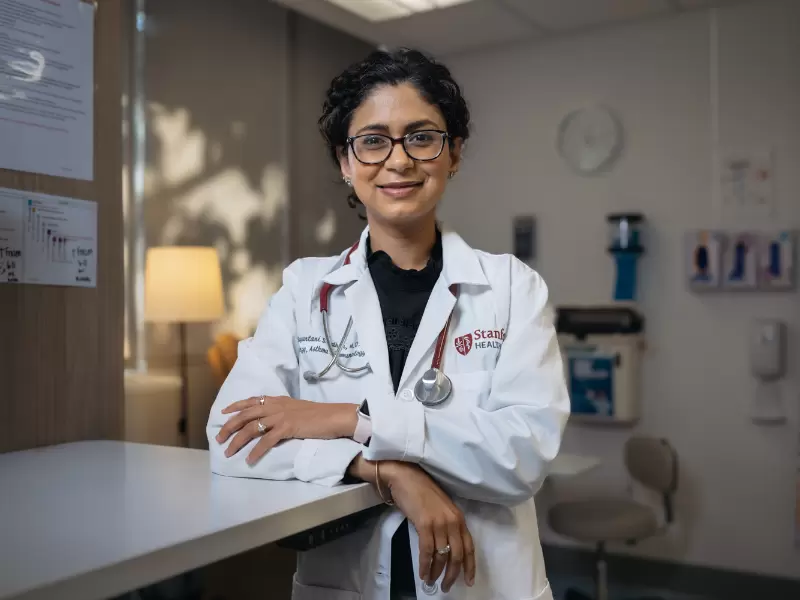 Indian-origin Stanford University clinical associate professor, Sayantani ‘Tina’ Sindher. / Stanford University
At the forefront of childhood food allergy research and care, Indian-origin Stanford University clinical associate professor, Sayantani ‘Tina’ Sindher, is reshaping how clinicians and families understand and manage one of the most common chronic conditions affecting children in today’s world.
Sindher is a clinical associate professor of Medicine and Pediatrics - Allergy and Clinical Immunology and a member of the Maternal & Child Health Research Institute (MCHRI).
ALSO READ: Stanford scientist creates color-shifting adaptive material
Based at Stanford University’s Sean N. Parker Center for Allergy and Asthma Research, Sindher brings commitment and a scientific drive to her work on food allergy prevention, diagnosis, and treatment.
Food allergies affect roughly eight to 10 per cent of children in the United States, demanding constant vigilance around meals and snacks. In the Stanford Report’s “Research Matters” series, Sindher explains that the hassle goes far beyond medical risk.
Highlighting the chronic stress and anxiety experienced by families navigating everyday life with food allergies, Sindher told Stanford,
“Living with food allergy has a bigger quality-of-life toll than we realise.”
“Our primary goal is to do better for kids with food allergies and their families,” she added, with regard to work aimed at early intervention.
Current clinical trials at Stanford are investigating whether treating severe eczema in infants, a condition linked to later allergy development, can reduce the likelihood of food allergies later in childhood.
A major focus of Sindher’s work is improving how food allergy is diagnosed and monitored. Traditional methods like skin prick and IgE blood tests are limited, often unable to determine how severe an allergy is or whether a treatment is working effectively.
This makes clinicians rely on controlled food challenges, which is a stressful and potentially risky process for patients and families.
Sindher and her colleagues are also exploring new treatment strategies.
She also mentioned that the promise and development of medications like omalizumab, an FDA-approved injectable that can significantly reduce allergic reactions in children one year and older, either alone or in combination with oral immunotherapy.
Sindher underscored the real-world impact these advances can have on young lives and told the University,
“It’s so nice to hear patients telling us, 'I went to an ice cream shop … and I was not worried.”
She also acknowledged that no single solution will fit every child, clarifying that some don’t respond to current therapies, and factors like needle phobia make injections challenging for many.
With a focus on these subjective variables, Stanford researchers are exploring alternative approaches such as sublingual immunotherapy and allergen patches, as well as identifying biomarkers that could offer less invasive ways to monitor treatment progress.
Speaking about her dual role as clinician and researcher, Sindher mentioned how this blend of research and patient care drives her mission forward and said,
“I feel lucky to be able to straddle both worlds.”
Discover more stories on NewIndiaAbroad.
Leave A Comment
Related









ADVERTISEMENT

ADVERTISEMENT
E Paper
Video

Comments
Start the conversation
Become a member of New India Abroad to start commenting.
Sign Up Now
Already have an account? Login