ADVERTISEMENT
ADVERTISEMENT



Rise of the AI scientist: A new era for global discovery
AI agents are becoming increasingly powerful partners in science, and before long, may even start taking the lead in studies.
-
1777299558.jpeg) Mayank Kejriwal
Mayank Kejriwal - Mon, 27, Apr 2026
- 10:20 EDT
- 588
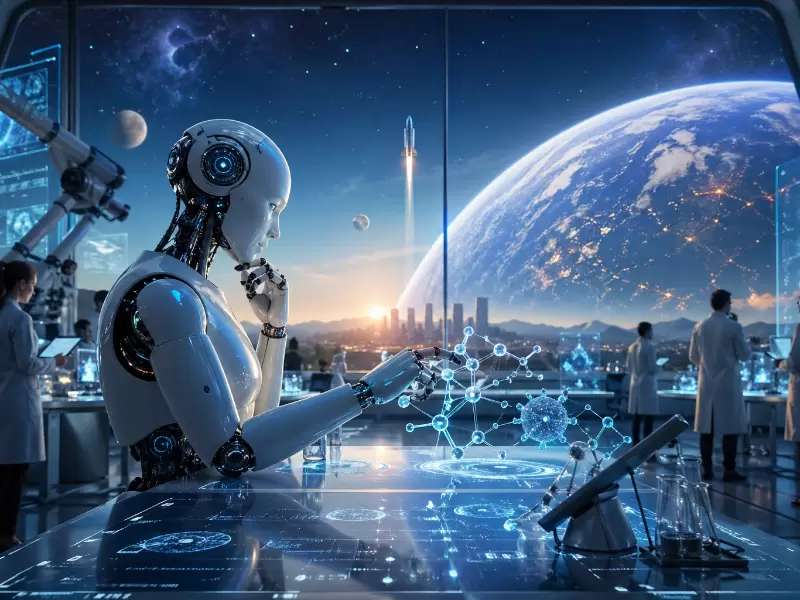 Representative Image / Generated using AI
For centuries, the image of scientific discovery has remained remarkably consistent: a lone researcher or a dedicated team laboring over hypotheses, conducting experiments, and meticulously drafting manuscripts. It is a process defined by human intuition, persistence, and, quite often, the limitations of human bandwidth. Some scientific breakthroughs, such as penicillin, came about literally through serendipity.
Can we do better? A new, and somewhat controversial, movement promises to do so, and is now starting to take shape rapidly before our eyes: the integration of Artificial Intelligence (AI) into scientific workflows. AI agents are becoming increasingly powerful partners in science, and before long, may even start taking the lead in studies, with human scientists handing off long-running, complex experiments to their agentic counterparts.
Also Read: India can power global AI workforce: Cybersecurity entrepreneur
The recent publication of a study in Nature serves as a potent signal of this shift. Researchers demonstrated an 'AI agent' that showed early promise in autonomously navigating the entire research lifecycle, ranging from initial ideation and coding to experimental execution and even peer review. In theory, such systems can generate novel insights that have already begun to pass the standards of machine learning workshops, which publish preliminary, but interesting, work. But the question remains open as to whether such agents will be capable of the type of top-tier research that gets published in journals like Science or Nature.
Nevertheless, the movement is gaining significant institutional momentum. Last year, the Agents for Science conference, organized by leading scholars from Stanford University and other premier institutions, brought together the world’s foremost experts to discuss how agentic AI can accelerate discovery. The consensus from such gatherings is clear: we are moving past AI as a tool and toward AI as a collaborator. In this new framework, the role of the human scientist shifts from manual executor to high-level architect, steering autonomous agents that can explore vast hypothesis spaces far more quickly than any human could.
My own journey in this field, both through my academic research group at the University of Southern California and the development of the GRAIL platform, is deeply rooted in this transition. We are trying to use AI to free up tasks like formatting, code-writing and documentation so that the scientist can focus on designing solutions to hard, high-impact problems. Recently, based on cutting-edge research, we also launched a 'science bot' that can design and run detailed experiments - all based on a few simple natural language prompts. Evidence on the rapid advent of such tools suggests that it is only a matter of time before it becomes a mainstream capability for most scientists worldwide.
But while AI leading to exponential scientific progress is a heady vision, it also raises some questions and concerns. The ability to generate research at scale brings risks, including the potential to overwhelm the peer-review system and add noise to the scientific literature. The global scientific community must work to establish new norms for transparency and disclosure.
The objective is not to replace the scientist, but to extend the reach of human curiosity. If a researcher in New Delhi or Los Angeles can use an AI agent to cut down the time it takes to move from a raw idea to an initial set of experiments, the pace of global innovation could accelerate dramatically.
We are at a tipping point. When autonomous agents can help us find new materials, suggest cures for diseases, or refine our understanding of the universe, the definition of a scientist expands. Rather than hiding behind credentials like a PhD or a government grant, our brightest scientists will now be expected to effectively partner with machine intelligence to solve the world’s most pressing problems. If we do this right, we tap into the promise of a more efficient, high-speed discovery engine. The next penicillin may very well be discovered by an AI.
The writer is a research associate professor at the University of Southern California and CEO of GRAIL.
(The views and opinions expressed in this article are those of the author and do not necessarily reflect the official policy or position of New India Abroad.)
Discover more at New India Abroad.
Leave A Comment
Related









ADVERTISEMENT

ADVERTISEMENT
E Paper
Video

Comments
Start the conversation
Become a member of New India Abroad to start commenting.
Sign Up Now
Already have an account? Login