ADVERTISEMENT

ADVERTISEMENT



Rubio says U.S. plan for Venezuela is stability, recovery, then transition
Rubio and Defense Secretary Pete Hegseth held classified briefings on Wednesday for the full Senate and House of Representatives on the Trump administration's plan for the Latin American country.
-
 Reuters
 - Wed, 07, Jan 2026
- 15:44 EST
- 21
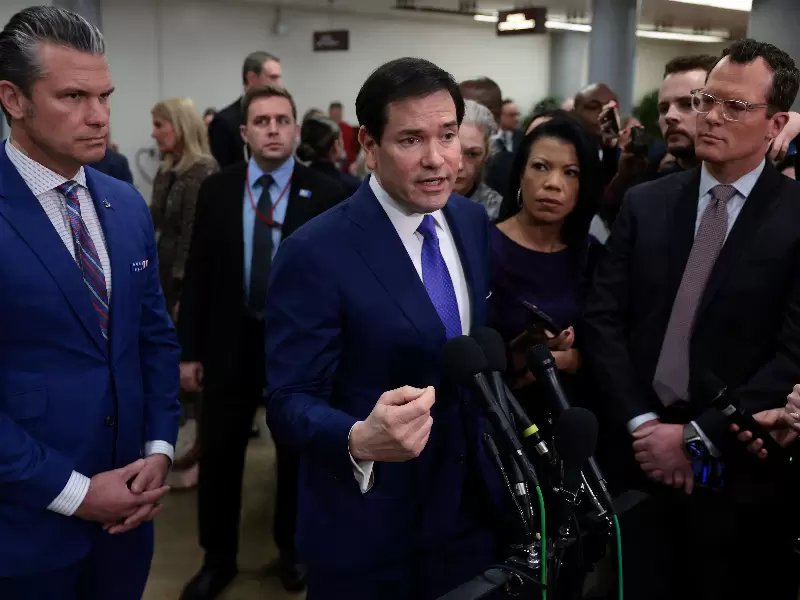 U.S. Secretary of State Marco Rubio speaks to the members of the media on the day of a briefing for the House of Representatives on the situation in Venezuela, on Capitol Hill in Washington, D.C., U.S., January 7, 2026. / REUTERS/Evelyn Hockstein
The U.S. has a three-step plan for Venezuela that will begin with stabilizing the country after U.S. forces seized leader Nicolas Maduro on Jan. 10, ensuring U.S. oil companies have access to the country during a recovery phase and finally overseeing a transition, Secretary of State Marco Rubio said on Jan. 7.
President Donald Trump has warned of further military operations against Venezuela if members of Maduro's inner circle who have stepped in to lead the country do not cooperate with his demands, which largely focus on obtaining Venezuelan oil. The Republican president said the U.S. would refine and sell up to 50 million barrels of Venezuelan crude, as U.S. forces continued seizing oil tankers linked to Venezuela on Jan. 7.
"The bottom line is that there is a process now in place where we have tremendous control and leverage over what those interim authorities are doing and are able to do," said Rubio.
Also Read: Trump links immigration enforcement to crime drop
Rubio and Defense Secretary Pete Hegseth held classified briefings on Wednesday for the full Senate and House of Representatives on the Trump administration's plan for the Latin American country.
"But obviously, this will be a process of transition. In the end, it will be up to the Venezuelan people to transform their country," Rubio told reporters, standing beside Hegseth between the two briefings.
Rubio said the Trump administration is close to executing a deal to take 30 million to 50 million barrels of Venezuelan oil and sell it "at market value," using the proceeds to for Venezuela’s transition to a new government.
"That money will then be handled in such a way that we will control how it is disbursed in a way that benefits the Venezuelan people, not corruption, not the regime, so we have a lot of leverage to move on the stabilization front," he said.
DEMOCRATS SAY PLANS AMOUNT TO STEALING OIL
Democrats expressed shock at the plans, which they said amounted to stealing oil, and questioned why the plans could not be discussed in public hearings.
"We have yet to hear from them about what the cost of this operation was, and this is about oil," Representative Nancy Pelosi, a California Democrat and former House Speaker, told reporters after the House meeting.
Rubio told reporters the Senate briefing had included operational details that could not be made public. He said after stopping Venezuela from "descending into chaos," the U.S. would begin a "recovery" phase that would mean "ensuring that American, Western and other companies have access to the Venezuelan market in a way that's fair."
"Also, at the same time, begin to create the process of reconciliation nationally within Venezuela, so that the opposition forces can be amnestied and released from prisons or brought back to the country, and begin to rebuild civil society," Rubio added. "And then the third phase, of course, will be one of transition."
Democratic Senator Chris Murphy of Connecticut called it "an insane plan."
"They are talking about stealing the Venezuelan oil at gunpoint for a period of time undefined as leverage to micromanage the country. The scope and insanity of that plan is absolutely stunning," Murphy told reporters.
Representative Don Bacon, a Republican from Nebraska, praised the removal of Maduro, but said the U.S. must install Venezuela's rightfully elected leaders, not work with Maduro's vice prseident, Delcy Rodriguez.
In an opinion piece published in the New York Times on Wednesday, Bacon also said the focus on Venezuela's oil could be problematic.
"America needs to show that we have altruistic goals, not just a desire to grab oil resources by propping up illegitimate leaders. Otherwise, Mr. Trump’s decision to invade Venezuela will end in failure, with consequences for the United States and the world," Bacon said.
Related




.jpg)



ADVERTISEMENT
ADVERTISEMENT
E Paper
Video

Comments
Start the conversation
Become a member of New India Abroad to start commenting.
Sign Up Now
Already have an account? Login