ADVERTISEMENT
ADVERTISEMENT


Rathna Kumar: A life in Dance, featured in consulate’s ‘Texas Diaries’
Houston dancer reflects on 75 years in the arts and decades of cultural bridge-building
-
 Malvika Choudhary
 - Thu, 20, Aug 2026
- 18:53 EDT
- 55
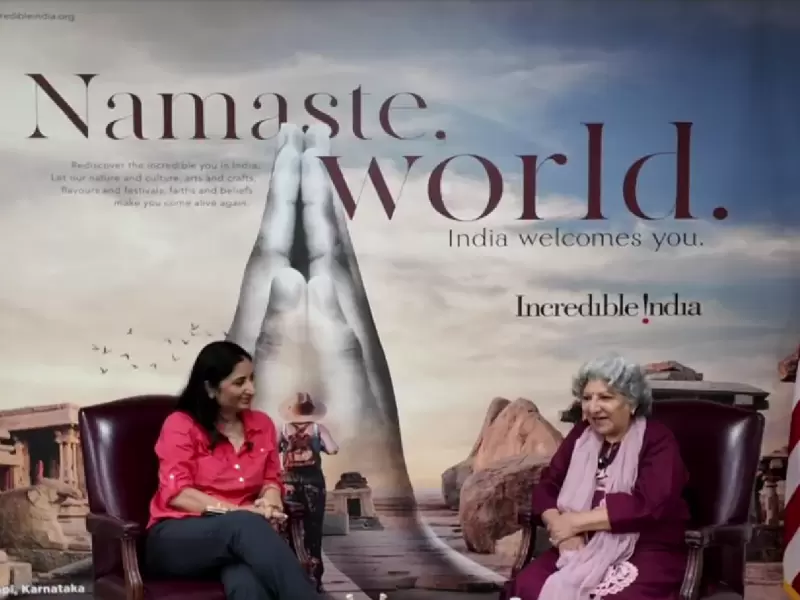 Rathna Kumar during the interview / X/@cgihou
The Consulate General of India in Houston featured veteran dancer Rathna Kumar in the fourth episode of its “Texas Diaries” series, highlighting her decades-long work promoting Indian classical dance in Texas.
Kumar, who moved to Houston in 1975, established the Anjali Center for Performing Arts that year, bringing Indian classical dance to a city where she said there was little infrastructure or access to the materials needed to teach the art form.
Also Read: Kentucky’s Indian community celebrates Independence Day
She has since trained thousands of students, performed and lectured across the United States and helped bring Indian classical and cross-cultural performances to diverse Houston audiences. Her work has also earned recognition in both India and the United States.
The episode, released by the Indian Consulate in Houston, traces Kumar’s journey from Chennai, where she began formal dance training at age four, to her emergence as one of Houston’s prominent Indian American cultural figures.
The consulate described her as an artist, educator and cultural leader whose work has empowered women, strengthened community institutions and connected Indian heritage with American audiences.
Kumar said her decision to devote herself to dance in Houston came unexpectedly.
After arriving in the city, she performed during a visit by the Indian ambassador. She recalled that Indian families approached her afterward asking her to teach their children.
At the time, Kumar had been considering graduate studies in theater or English. She had been accepted to Rice University but ultimately chose dance.
Her husband, Anil Kumar, helped her make the decision, she said, asking what she loved most. Her answer was dance.
That decision led to the establishment of the Anjali Center for Performing Arts, which the University of Florida’s Center for the Study of Hindu Traditions describes as Texas’ first Indian dance institute. Kumar remains associated with the center decades after its founding.
Expanding Indian dance in Houston
Kumar said she quickly realized that introducing Indian classical dance to Houston would require more than teaching Indian American students.
One of her early opportunities came through Houston’s Main Street Festival. She approached organizers herself and asked to perform Indian classical dance.
“There were a whole lot of people, Americans coming and saying, ‘Oh, this is beautiful,’” Kumar said in the Consulate interview.
“I felt so happy that I was able to do something that was very new,” she said.
That approach became a defining part of her work. Kumar said she tried to participate in Houston’s broader cultural life while making Indian dance visible to audiences who had little previous exposure to it.
“As a citizen of a new place, as someone in a country that has become my new home, it was incumbent upon me to not only integrate the local culture but also to show them, hey, you know, we have a fantastic artistic and cultural heritage,” she said.
Her work subsequently extended into Houston’s wider arts establishment. She served on the advisory board of Miller Outdoor Theatre and has presented Indian dance to audiences beyond the Indian American community.
Kumar has also worked extensively in arts education. Young Audiences of Houston lists her Indian performing arts program as an educational offering in which she demonstrates Indian dance, teaches audience members basic elements of the form and incorporates folk dance into the program.
Samskriti in Houston
In 1995, Kumar became a founding member and artistic director of Samskriti, an Indian performing arts organization based in Houston. The organization was created, she said, partly because professional artists from India were appearing in Houston only occasionally.
“I don't want to be selfish. I want everyone to share in this joy,” Kumar said, explaining why she wanted to bring more performances to local audiences.
Samskriti has since presented Indian classical and folk traditions as well as multicultural collaborations. Its programs have included artists from India, the United Kingdom, Malaysia and Singapore, according to Kumar and the organization’s biography.
The organization’s work has also extended beyond traditional Indian-only programming. In 2024, for example, Kumar conceived and choreographed “Transcending Borders: The Ramayana Project,” a cross-cultural production presented with the Asia Society Texas Center that brought together Indian, Indonesian, Sri Lankan and Thai artistic traditions.
That broader approach reflects Kumar’s view that the arts can serve as a bridge across communities.
“Art is the perfect bridge,” she said during the Consulate interview.
Sangeet Natak Akademi recognition
Kumar’s career has also been recognized by the Government of India. She received the Sangeet Natak Akademi Award for 2010 for her contribution to dance, an honor that her Anjali Center biography describes as the first such recognition for an artist based outside India.
Contemporary reporting at the time described Kumar as the first non-Indian citizen to receive the award.
Kumar recalled in the interview that she initially did not believe the news when dance scholar Sunil Kothari called to congratulate her.
“When I got the official letter, I almost fainted,” she said.
She said the recognition was particularly meaningful because it came from the country whose artistic traditions she had spent decades preserving and teaching abroad.
Her other recognitions have included Congressional recognition, a nomination to the Texas Women’s Hall of Fame, Houston Metro’s Distinguished Asian Award, Houston Community College’s Asian Legacy Award and honors from Houston’s arts community.
In 2023, Dance Source Houston named Kumar an Artistic Honoree, citing her role in establishing the Anjali Center and her contribution to Houston’s dance community.
Passing the tradition to a new generation
A central theme of the Consulate interview was Kumar’s work with children born and raised in the United States.
She said teaching Indian classical dance to them requires more than demonstrating movements. Many students, she said, have limited familiarity with Indian mythology, history and cultural traditions, so she incorporates storytelling into her lessons.
“Children by nature love stories,” Kumar said. “I made it sure that there is storytelling involved because many of these kids do not know anything about our history, our mythology, anything about our background, our heritage.”
Her teaching has produced multiple generations of students. Kumar said some of her earliest students from the 1970s returned for the Anjali Center’s 50th anniversary celebrations, while some former students have brought their own children to learn from her.
Kumar said she sees that continuity as the most important part of her legacy.
“I am so grateful that for all that they have given me that I'm able to do this in their honor, to pass on something to the next generation so that this will never die,” she said.
The Consulate’s “Texas Diaries” series presents oral histories of members of the Indian diaspora in Texas. The fourth episode places Kumar’s career within that broader diaspora story – from establishing one of Texas’ earliest Indian dance institutions in 1975 to using dance, education and cultural programming to connect Indian traditions with generations of American audiences.
Discover more at New India Abroad.
Leave A Comment
Related


ADVERTISEMENT

ADVERTISEMENT
E Paper
Video

Comments
Start the conversation
Become a member of New India Abroad to start commenting.
Sign Up Now
Already have an account? Login