ADVERTISEMENT
ADVERTISEMENT


Prez Trump, PM Modi will settle tariff row: White House adviser Peter Navarro
His remarks came as Washington and New Delhi continued negotiations over trade.
-
 IANS
IANS - Tue, 11, Aug 2026
- 17:37 EDT
- 278
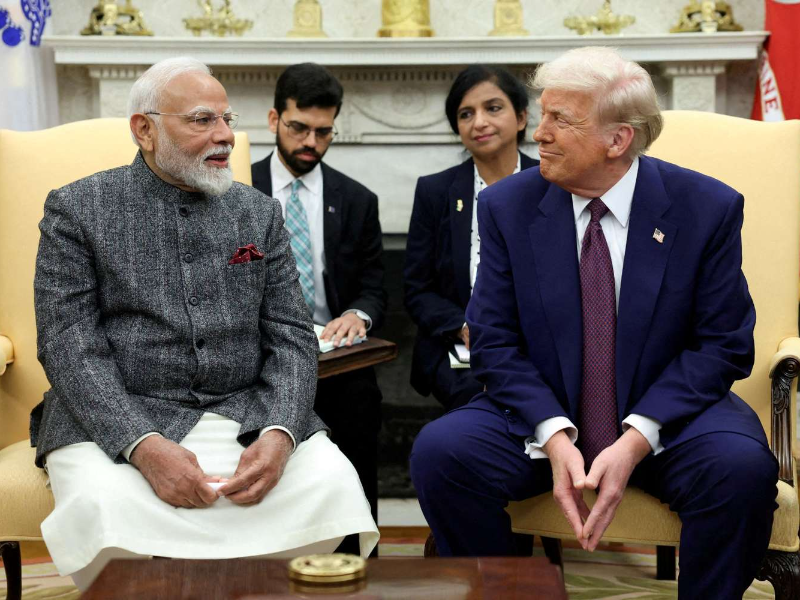 FILE PHOTO: U.S. President Donald Trump meets with Indian Prime Minister Narendra Modi at the White House in Washington, D.C., U.S., February 13, 2025. / REUTERS/Kevin Lamarque
White House trade adviser Peter Navarro said on Aug. 11 that US President Donald Trump and Prime Minister Narendra Modi would work directly to resolve differences over India’s purchases of Russian oil and the threat of steep US tariffs.
"The President and your prime minister have a very good working relationship,” Navarro told reporters at the White House. “They are going to work that out amongst themselves, and it’s not for me in any gaggle to get between that."
Also Read: US envoy Gor, NSA Doval discuss deepening strategic cooperation
Navarro was responding to a question about legislation associated with the late Republican senator Lindsey Graham. The measure could lead to tariffs of up to 100 per cent on countries buying Russian energy.
The reporter asked whether the proposed tariff, combined with continuing trade negotiations, could further strain India-US relations.
Navarro did not address the possible tariff directly. He instead referred to an opinion article he had written for the Financial Times several months ago about India’s energy trade with Russia.
Navarro said he had argued in the article that India’s Russian oil purchases expanded after Moscow invaded Ukraine.
“Prior to the Russian invasion of Ukraine, India was not involved in the oil trade with Russia, but afterwards it got heavily involved,” he said.
Navarro also accused India of selling products linked to Russian oil and said the trade had helped finance Moscow’s war effort. He offered no supporting figures during the exchange.
He said the issue had since been resolved but did not explain what action had been taken or whether he was referring to India’s oil purchases, the sale of petroleum products or another aspect of the trade.
"And that issue has been resolved," he said. "Maybe I had a little bit to do with that with that op-ed."
His remarks came as Washington and New Delhi continued negotiations over trade.
Earlier in the gaggle, Navarro defended the Trump administration’s broader tariff policy. He said tariffs were encouraging foreign companies to build factories in the United States and were also stimulating domestic investment.
"The signature there are the tariffs, which are bringing onshore both dollar investment from foreigners when they’re building here to avoid the tariffs, but also indigenous investment here," he said.
Navarro acknowledged that Americans continued to face economic hardship because of inflation. But he argued that the administration’s tax, trade and deregulation policies were beginning to produce results, particularly in construction and manufacturing.
"We all understand that we’re grappling with inflation and problems that are creating hardship for Americans; we understand that," he said.
The Senate passed the Lindsey O. Graham Sanctioning Russia and Iran Act of 2026 last week by an 86-11 vote. The legislation authorises tariffs of up to 100 per cent on goods from the five largest purchasers of Russian oil and gas, as well as the five leading countries involved in sanctions evasion. It does not name India as an automatic tariff target.
Discover more at New India Abroad.
Leave A Comment
Related
ADVERTISEMENT

ADVERTISEMENT
E Paper
Video

Comments
sam
2026-08-12 00:00:00
Trump thinks his Presidential Powers will push Modi to sign a deal.
If I were Modi, I would have Trump visit India for negotiations on multiple issues linked with trade deal.
1) India's national security.
a) If a NATO country helps an invading military (read Turkey in Pakistan and Middle East Defense Agreement), NATO and USA will stay out of that war with Turkey
b) If a US spy or CIA is caught in India, USA will be OK in hanging the spy
c) US Govt. will stop meddling and making comments of India's operations in India
d) US govt. will not fund or equip or train the Pakistani Military. Or any other military that has attacked India or will attack India. Any arms sales to (any country other than Pakistan, which will be under total ban) to others will restrict use of those arms against India
2) India's economic interests
a) any deal made is OFF if subsequent governments or Trump change the agreement
3) India and Indians will not be charged tariffs or fees or restricted any more than any other country
3) All items agreed to will be made public and signed before a tariff deal is signed. No Zelenski Hanky Panki.