ADVERTISEMENT
ADVERTISEMENT



PM Modi-Trump meeting seen as first positive step to improve ties
Singer Mary Millben stressed that the success of the meeting would ultimately be measured by actions rather than words.
-
 IANS
IANS - Thu, 18, Jun 2026
- 03:15 EDT
- 21
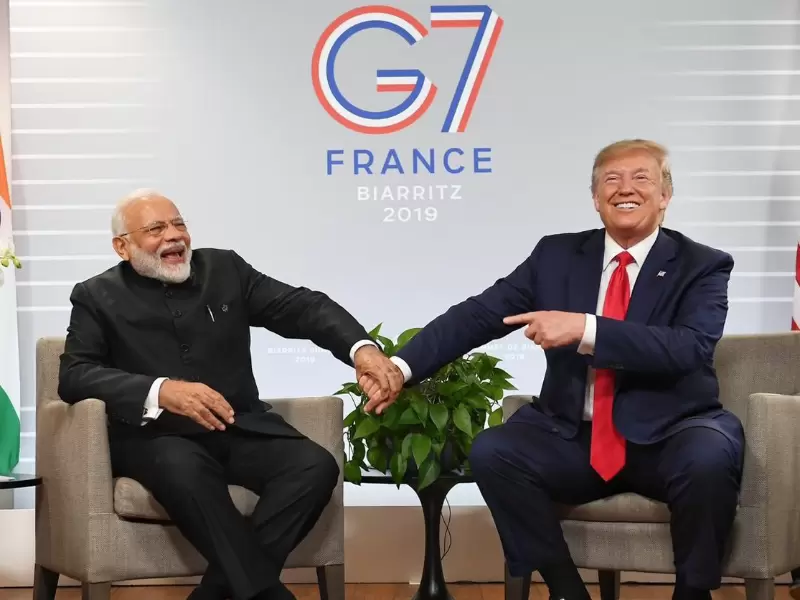 PM Modi with President Donald Trump / IANS
The Trump-Modi meeting in France has reassured some supporters of the India-U.S. partnership, but analysts said the future of the relationship will depend less on the leaders' public exchanges and more on whether Washington and New Delhi can rebuild mutual trust.
The meeting between Prime Minister Narendra Modi and U.S. President Donald Trump on the sidelines of the G7 Summit in France drew a range of reactions from academics, former officials and community leaders, reflecting both optimism about renewed engagement and concern over lingering strains in the bilateral relationship.
"It was wonderful to see the two leaders in the room together," singer and commentator Mary Millben told IANS.
"It's been over a year since we've seen President Trump and Prime Minister Modi physically in the same room together. So that in itself was a positive and, by imagery, a natural reset to the U.S.-India relationship," she said.
Millben said she welcomed Trump's remarks during the meeting, which she described as reassurance that "India is our strongest democratic ally," that the United States remains "a close friend to India," and that Trump continues to be "a close friend to the Prime Minister."
However, she stressed that the success of the meeting would ultimately be measured by actions rather than words.
"We'll see what happens when he returns home," she said. "It's my hope that there will be a different approach to India after this summit."
Millben argued that rebuilding confidence should be the central objective going forward.
"The Prime Minister said it best at the Summit. Mutual Trust is the most important strategic asset today," she said. "The future of the U.S.-India relationship really is gonna rely on rebuilding trust."
Others were more cautious in their assessment.
Raymond Vickery, a former U.S. assistant secretary of commerce for trade development, said the meeting was important because relations had experienced what he described as "a standard kind of malaise" over the past 16 months.
"It was good that there was a meeting," Vickery told IANS. "There was good chemistry between the leaders."
But he warned against expecting immediate results.
"No one half-hour meeting at the end of a three-day summit, even if there's a press conference effort, is going to remedy the damage which has been done to the trust between the two greatest democracies," he said. "That's gonna take a lot of work, a lot of follow-through on promises."
Atman Trivedi, partner at Albright Stonebridge Group, offered a similarly measured view.
"The meeting was not a reset in U.S.-India relations," he said. "If anything, the response was one of skepticism from a number of Indian observers."
However, he added that the leaders' interaction likely helped reduce concerns in India following the deaths of Indian sailors last week.
Academic leaders highlighted areas where cooperation continues to deepen regardless of political differences.
Gurdip Singh, divisional dean of the School of Computing at George Mason University, said collaboration between universities, industries and research institutions remains strong because both countries recognize the benefits of working together.
"There is a desire to collaborate and those things are happening," Singh said. He added that U.S.-India relations are "bound to improve" because of shared interests and the growing influence of the Indian diaspora.
Singh identified emerging technologies as a particularly promising area for future cooperation.
"Whether it's semiconductors, whether it's quantum, whether it's AI, there is a lot of potential for collaboration there," he said. "Emerging tech is the area to focus on."
Former Ohio State Sen. Niraj Antani was more upbeat, describing the encounter as "a positive step forward in the U.S.-India relationship." He pointed to Trump's support for a bilateral trade agreement and stronger economic engagement with India.
India and the United States have steadily expanded cooperation over the past two decades in defense, trade, technology, energy and education. Successive governments in New Delhi and Washington have described the partnership as one of the most consequential bilateral relationships of the 21st century.
Discover more at New India Abroad.
Related

.jpg)
ADVERTISEMENT

ADVERTISEMENT
E Paper
Video

Comments
Start the conversation
Become a member of New India Abroad to start commenting.
Sign Up Now
Already have an account? Login