ADVERTISEMENT
ADVERTISEMENT


Ladies who changed Bollywood
From the early decades of Indian cinema to the contemporary era, these actors reshaped how women were portrayed on screen.
-
 Bollywood Insider
 - Sun, 19, Apr 2026
- 01:34 EDT
- 318
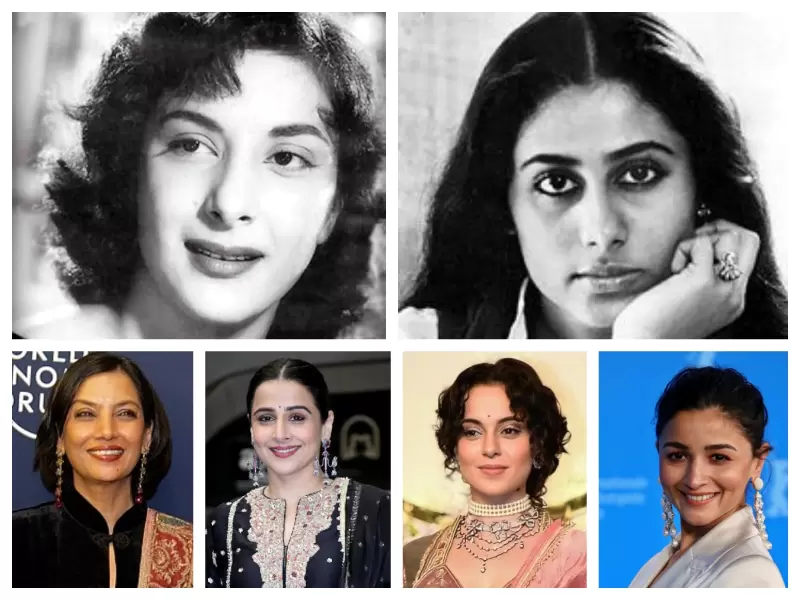 Clockwise: Nargis, Smita Patil, Alia Bhatt, Kangana Ranaut, Vidya Balan, Shabana Azmi. / Wikipedia/IMDB
For decades, the female protagonist in Hindi cinema was often confined to predictable archetypes: the dutiful wife, the sacrificial mother, the love interest whose primary function was to complement the hero's journey. Yet, at crucial moments in the history of Indian cinema, a handful of actresses broke away from these molds and altered the narrative. Through powerful performances and bold film choices, they pushed filmmakers to create richer, more complex female characters.
From the early decades of Indian cinema to the contemporary era, these actors did more than entertain audiences — they reshaped how women were portrayed on screen. Their work proved that the Hindi film heroine could be layered, flawed, courageous, and central to the story itself.
The Strength of Motherhood: Nargis
In the 1950s, when Indian cinema was still defining its identity, Nargis delivered one of the most iconic performances in film history with Mother India (1957). Directed by Mehboob Khan, the film told the story of Radha, a rural woman who battles poverty, social injustice, and personal tragedy while raising her sons with unwavering moral strength.
Radha was not merely a symbolic mother figure; she was a portrait of resilience and ethical conviction. The film culminates in one of the most powerful moments in Hindi cinema, when Radha chooses justice over maternal attachment, ultimately shooting her own rebellious son to uphold the law.
Nargis's portrayal elevated the image of the Indian mother from passive sufferer to moral anchor. In doing so, she created a cinematic archetype that influenced generations of filmmakers and performers. The character of Radha became a national metaphor for sacrifice, endurance, and dignity.
The Voice of Realism: Smita Patil
If the 1950s celebrated the idealized Indian woman, the 1970s and 1980s witnessed a wave of parallel cinema that explored social realities with unflinching honesty. Few actors embodied this movement as powerfully as Smita Patil.
With her earthy screen presence and emotionally raw performances, Patil brought a new authenticity to female characters. In films like Bhumika (1977), Manthan (1976), and Mirch Masala (1987), she portrayed women navigating oppressive social structures while asserting their individuality.
Unlike the glamorous heroines of mainstream cinema, Patil's characters were often ordinary women confronting extraordinary circumstances. In Mirch Masala, for instance, she played a village woman who refuses to submit to a tyrannical colonial official, turning a simple narrative into a stirring allegory of resistance.
Through such performances, Smita Patil transformed the Hindi film heroine into a figure capable of expressing anger, defiance, and self-determination.
Cinema with a Conscience: Shabana Azmi
Alongside Smita Patil, Shabana Azmi emerged as one of the most powerful voices of socially conscious cinema. Known for her intellectual approach to acting, Azmi chose roles that confronted uncomfortable truths about gender, class, and social inequality.
Her work in films like Arth (1982), Ankur (1974), and Fire (1996) presented women who refused to remain silent victims of circumstance. In Arth, Azmi played a woman rebuilding her life after her husband's infidelity — a narrative that challenged the traditional expectation that women must endure betrayal in silence.
Azmi's characters were often introspective, self-aware, and emotionally complex. By portraying women who questioned patriarchal norms and sought personal autonomy, she helped bring feminist discourse into mainstream cinematic storytelling.
Her performances not only won critical acclaim but also encouraged filmmakers to craft narratives centered on women's inner lives.
Redefining the Modern Heroine: Vidya Balan
By the early 2000s, Hindi cinema had become increasingly commercialized, often prioritizing spectacle over substance. Yet Vidya Balan emerged as a rare star who demonstrated that female-led stories could succeed both critically and commercially.
Her career-defining role in The Dirty Picture (2011) shattered conventional notions of the Bollywood heroine. Playing a bold and unapologetic film star inspired by Silk Smitha, Balan embraced a character who was ambitious, flawed, and unashamed of her desires.
She followed this with Kahaani (2012), where she portrayed a pregnant woman searching for her missing husband in Kolkata. The film's gripping narrative rested almost entirely on her performance, proving that audiences were willing to embrace a story driven by a female protagonist.
Through films such as Tumhari Sulu (2017) and Sherni (2021), Vidya Balan continued to champion narratives about everyday women navigating professional and personal challenges with quiet strength.
The Era of Unconventional Protagonists: Kangana Ranaut
In contemporary Hindi cinema, Kangana Ranaut has emerged as one of the most unconventional leading actors. Known for choosing roles that defy stereotypes, she has consistently challenged the traditional definition of a Bollywood heroine.
Her breakthrough came with Queen (2014), a coming-of-age story about a young woman who embarks on a solo honeymoon after being abandoned by her fiancé. The film resonated deeply with audiences, presenting a heroine who discovers independence and self-worth through personal exploration.
Ranaut followed this with performances in films such as Tanu Weds Manu Returns (2015), where she played dual roles, and Manikarnika: The Queen of Jhansi (2019), portraying the legendary warrior Queen Lakshmibai.
Her film choices frequently center on strong, complex female characters who challenge social expectations and claim agency over their own lives.
The New-Age Performer: Alia Bhatt
Among the younger generation of actors, Alia Bhatt has played a significant role in reshaping the contemporary Bollywood heroine. Beginning her career with the glamorous teen drama Student of the Year (2012), she quickly moved beyond the stereotype of the star kid by choosing challenging, performance-driven roles.
Her breakthrough came with Highway (2014), where she portrayed a young woman who discovers an unexpected sense of freedom after being kidnapped. The emotionally demanding role revealed a vulnerability and depth rarely associated with mainstream heroines at the time.
Bhatt continued to expand her range with films such as Udta Punjab (2016), in which she played a migrant worker trapped in Punjab's drug crisis, and Raazi (2018), where she portrayed an Indian spy navigating the emotional turmoil of espionage during the Indo-Pak war. Both performances demonstrated her ability to anchor intense narratives with nuance and conviction.
In Gangubai Kathiawadi (2022), Bhatt delivered perhaps her most commanding performance, portraying a young woman who rises from victimhood to become a powerful figure within Mumbai's underworld. The film positioned her squarely at the center of the narrative, reaffirming the growing space for female-led stories in Hindi cinema.
Through her choices, Alia Bhatt represents a generation of actors who combine commercial success with artistic ambition, continuing the evolution of the Bollywood heroine.
A Continuing Transformation
The journey of women in Hindi cinema has been one of gradual but significant transformation. From Nargis's morally resolute Radha to the fiercely independent protagonists portrayed by Kangana Ranaut and the new-age performances of Alia Bhatt, these actors have steadily expanded the possibilities of female representation on screen.
Their contributions demonstrate that the Hindi film heroine is no longer merely a supporting presence in the hero's narrative. She is now capable of carrying the emotional and narrative weight of a story.
As new generations of actors and filmmakers continue to experiment with storytelling, the legacy of these pioneering women remains vital. They did more than deliver memorable performances — they rewrote the very script of how women could exist in Hindi cinema.
And in doing so, they ensured that the stories of women would no longer remain confined to the margins, but stand firmly at the center of the cinematic frame.
Discover more at New India Abroad.
Leave A Comment
Related









.png)
ADVERTISEMENT

ADVERTISEMENT
E Paper
Video

Comments
Start the conversation
Become a member of New India Abroad to start commenting.
Sign Up Now
Already have an account? Login