ADVERTISEMENT
ADVERTISEMENT



Somnath: India’s timeless temple of courage and devotion
The events of January 2026 do not create Somnath’s significance; they reaffirm it.
-
 Dr. Vinay Nalwa
 - Mon, 12, Jan 2026
- 14:18 EST
- 132
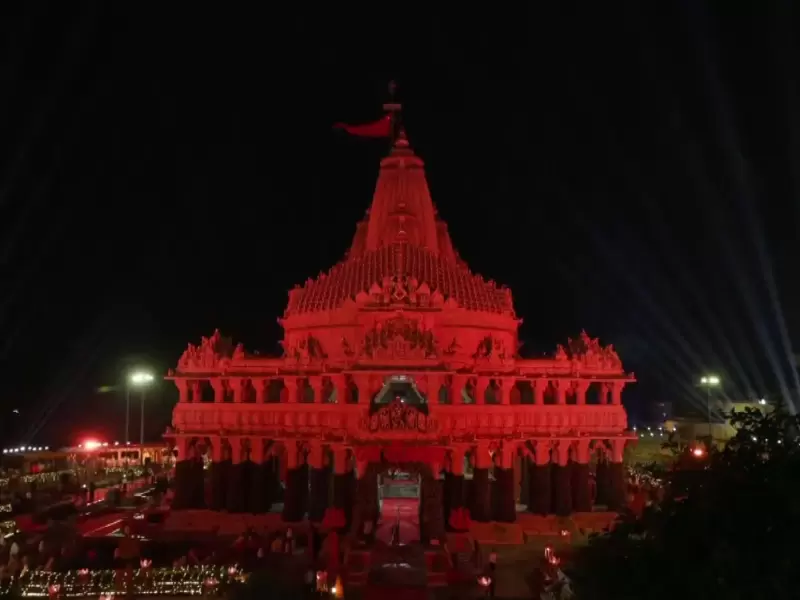 Somnath, a Hindu temple near Veraval, Gujarat / Courtesy: X/@narendramodi
In January 2026, Somnath, the ancient Jyotirlinga of Lord Shiva at Prabhas Patan near Veraval, Gujarat, marked a historic moment. The temple hosted its Swabhiman Parv, the “Festival of Pride and Dignity.” The event commemorated 1,000 years since the first recorded destruction in 1026 CE and 75 years since its post-Independence restoration.
Thousands of devotees participated in special rituals and commemorative events. Omkar mantra chanting filled the temple grounds. A spectacular drone show brought Lord Shiva and temple imagery to life. Ceremonial darshan and pujas were conducted throughout the day.
A highlight was the Shaurya Yatra, a grand procession featuring 108 horses. It honored the warriors and defenders linked to Somnath’s long history of resilience. Prime Minister Narendra Modi, along with cultural performers and large crowds of devotees, joined the celebrations. The festival reaffirmed Somnath’s enduring place in Hindu faith, tradition, and cultural memory.
ALSO READ: A Rediscovery of India
To understand why Somnath continues to matter, it is necessary first to understand the historical role of the Hindu temple itself. Across the Hindu world, temples were not confined to ritual worship. They functioned as institutional centers of civilization, supporting education, sustaining the arts, administering charity, managing land and economic activity, and anchoring pilgrimage networks that connected distant regions into a shared sacred geography.
Temples patronized scholarship and cultural production, provided social welfare, and served as focal points of local governance and community life. Political authority often flowed through temples, with rulers deriving legitimacy as protectors of dharma and temple institutions.
Because of this centrality, temples became deliberate targets during periods of Islamic conquest. Their destruction was not incidental damage of war but intentional iconoclasm combined with plunder, aimed at dismantling the religious and institutional foundations of Hindu society. Contemporary Persian chronicles describing the sack of Somnath by Mahmud of Ghazni explicitly celebrate the breaking of the Shiva linga as a religious triumph.
The first major recorded destruction of Somnath occurred in 1026 CE, when Mahmud of Ghazni attacked the temple, looted its wealth, and desecrated the shrine. In the centuries that followed, Somnath was attacked again by Alauddin Khalji’s forces in 1299 CE, damaged under Muzaffar Shah I of the Gujarat Sultanate in the late 14th century, and later subjected to further destruction under Mughal emperor Aurangzeb in 1706 CE, who ordered the demolition of remaining structures and the cessation of worship.
According to the account of Utbi, upon breaching the sanctum, Mahmud personally struck the idol with his mace, shattering its gilded face and exposing an interior reportedly filled with jewels, diamonds, and rubies. The sack yielded immense plunder, including treasures valued at more than 20 million dirhams, comprising gold and silver idols, gem-encrusted vessels, offerings from across India, sacred chains, bells, and an estimated 2,000 mans, or approximately 1,200 kilograms, of gold used in temple rituals.
The floating appearance of the idol, attributed by some observers to a magnetic mechanism or hidden supports beneath a lodestone canopy, was dispelled when Mahmud ordered the canopy dismantled, causing it to collapse. Surviving priests and devotees were either killed or enslaved, marking the culmination of the raid’s military phase.
After each act of destruction, Somnath was rebuilt by Hindu rulers, local communities, and devotees. While popular tradition speaks of 16 or 17 cycles of destruction and reconstruction, what is historically indisputable is that Somnath was repeatedly targeted because of its prominence and repeatedly restored by Hindus determined to preserve continuity.
Somnath thus stands not as a monument that survived untouched, but as one that endured through renewal. Its history records not collapse, but the repeated reassertion of faith, memory, and civilizational will.
The events of January 2026 do not create Somnath’s significance; they reaffirm it. To understand why Somnath continues to resonate with Hindus worldwide, one must trace its long journey of sacrality, assault, and reconstruction.
Somnath: Sacred origins, scripture, and living antiquity
Hindu tradition locates Somnath’s origins in deep sacred time, long before recorded political history. The Shiva Purana and Skanda Purana describe Somnath as the first among the 12 Jyotirlingas, the self-manifested abodes of Lord Shiva, where the divine is believed to be present not merely as an idol but as an eternal column of light, or jyoti. This status places Somnath at the apex of Shaiva sacred geography.
According to the Shiva Purana, the temple derives its name from Soma, the moon god, who established the temple at Prabhas Patan after being freed from a curse through Shiva’s grace. This act of consecration links the temple to cosmic rhythm, time, and renewal, ideas central to Shaiva theology. The Jyotirlinga at Somnath is thus not merely commemorative but cosmological in meaning.
The Skanda Purana, in the Prabhasa Khanda, situates Somnath within the sacred landscape of Prabhas Kshetra, describing it as a powerful tirtha where pilgrimage, ritual bathing, and worship confer spiritual merit. The region is also associated with Lord Krishna’s final earthly moments, giving Somnath a rare confluence of Shaiva and Vaishnava sanctity. This layered sacredness ensured that Somnath was revered not as a regional shrine but as a pan-Hindu pilgrimage center.
For centuries, pilgrims approached Somnath as a threshold between land and sea, mortality and transcendence, and history and eternity. This perception explains why Somnath was never abandoned after destruction. Each reconstruction was understood not as creating something new, but as restoring an already consecrated sacred presence.
The temple that stands today is therefore not simply a modern reconstruction. It represents the continuation of an ancient sacred lineage, carried forward through scripture, ritual memory, and collective resolve. Somnath endures because, in the Hindu understanding, its sanctity was never extinguished, only temporarily obscured.
Looking ahead: Beyond ritual, toward restoration
As Somnath stands renewed once again, firmly rooted in ritual worship and living tradition, many Hindus see in it more than a sacred site alone. Across generations and geographies, there is growing reflection on whether the mandir can, over time, recover the wider civilizational role it once fulfilled, alongside its essential ritual functions.
Historically, Hindu temples integrated worship with education, charity, artistic patronage, and community life. The continued reverence for Somnath, expressed through pilgrimage, commemoration, and renewal, has reopened this conversation not as a rejection of ritual, but as a reminder of a more comprehensive tradition.
In this sense, Somnath remains what it has always been: a living temple of worship today and a reference point for what the mandir has historically represented. The aspiration among Hindus is not to change Somnath’s nature but to allow its legacy to inform a broader reengagement with the temple’s traditional place in Hindu society.
The writer is an author, columnist, and sociologist.
(The views and opinions expressed in this article are those of the author and do not necessarily reflect the official policy or position of New India Abroad.)
Read more stories on New India Abroad.
Leave A Comment
Related





.png)




ADVERTISEMENT

ADVERTISEMENT
E Paper
Video

Comments
Start the conversation
Become a member of New India Abroad to start commenting.
Sign Up Now
Already have an account? Login