ADVERTISEMENT
ADVERTISEMENT



Indian crystallographer Gautam Desiraju receives 14th Ewald Prize
Desiraju was honored Aug. 11, 2026, at the IUCr Congress in Calgary, Canada.
-
 Pranavi Sharma
 - Thu, 13, Aug 2026
- 03:59 EDT
- 17
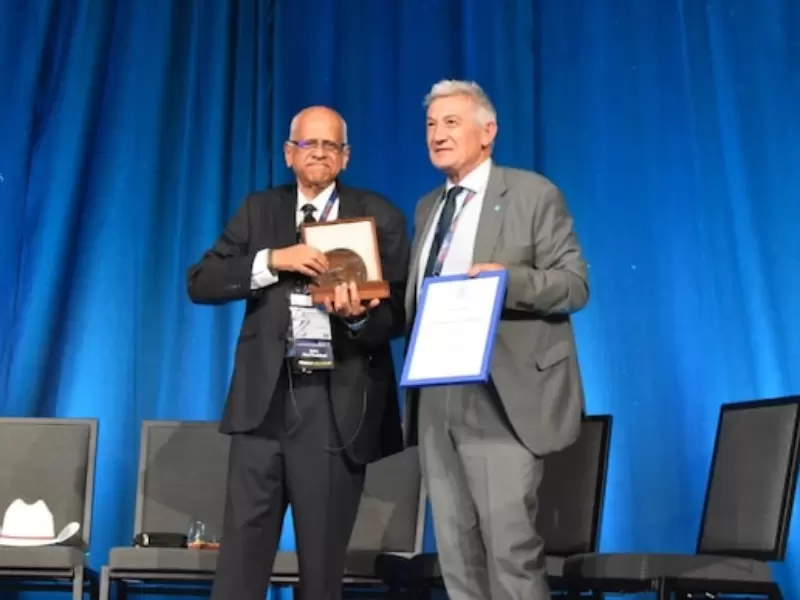 Professor Gautam R Desiraju receiving the arward. / IUCr Congress in Calgary
Professor Emeritus Gautam R. Desiraju has been awarded the 14th Ewald Prize by the International Union of Crystallography (IUCr) for his work in crystal engineering and the supramolecular synthon concept. The award also recognizes his work establishing the structural significance of weak hydrogen bonding and halogen bonding in molecular crystals and biology.
Desiraju was honored Aug. 11, 2026, at the IUCr Congress in Calgary, Canada. The Ewald Prize is presented once every three years during the International Congress of Crystallography and recognizes outstanding contributions to the science of crystallography.
ALSO READ: Naren Ramakrishnan elected to Virginia Academy’s 2026 class
Desiraju, an Emeritus Professor at the Indian Institute of Science in Bengaluru and a Distinguished Professor at IKSMHA, IIT Mandi, described the award as a significant recognition of his field.
“The Ewald Prize is widely considered the highest accolade a structural chemist or biologist can receive, short of the Nobel Prize, singling out the complete professionalism of its rigorous and confidential selection process,” he said.
To mark the award, Desiraju has published a lead article in IUCrJ, Volume 13, Part 5, September 2026, titled ‘Crystal clear. Engineering complexity.’ The open-access, first-person retrospective examines the development of the field and Desiraju’s contributions to it. The paper accompanies the prize and is part of a collection connected to the IUCr 2026 Congress.
The article traces the development of Desiraju’s work from his PhD at the University of Illinois, where he examined why crystals adopt particular structures. His research focused on exceptions to the prevailing view that organic crystals were primarily governed by close packing.
His work examined weak intermolecular forces, including the C—H···O interaction, which he and Thomas Steiner later validated as a weak hydrogen bond in their 1999 book. These interactions are now recognized as structurally and functionally important in molecular crystals and biological systems.
A central concept in his work is the supramolecular synthon, which Desiraju defined in a 1995 review. The concept treats molecular crystals as structures that can be designed using predictable intermolecular interactions.
The article also discusses pharmaceutical cocrystals, which can improve the solubility and bioavailability of poorly water-soluble drugs, as well as polymorphism, crystal structure prediction and mechanically deformable crystals.
Desiraju has more than 475 publications and more than 80,000 citations. He served as president of the IUCr from 2011 to 2014.
Discover more at New India Abroad.
Leave A Comment
Related


ADVERTISEMENT

ADVERTISEMENT
E Paper
Video

Comments
Start the conversation
Become a member of New India Abroad to start commenting.
Sign Up Now
Already have an account? Login