ADVERTISEMENT
ADVERTISEMENT



Rejected 4 times, now US Congressman: Thanedar
The Indian-American lawmaker said he was increasingly concerned by what he described as growing hostility toward immigrants.
-
1759953093.png) Staff Reporter
Staff Reporter - Wed, 24, Jun 2026
- 04:13 EDT
- 32
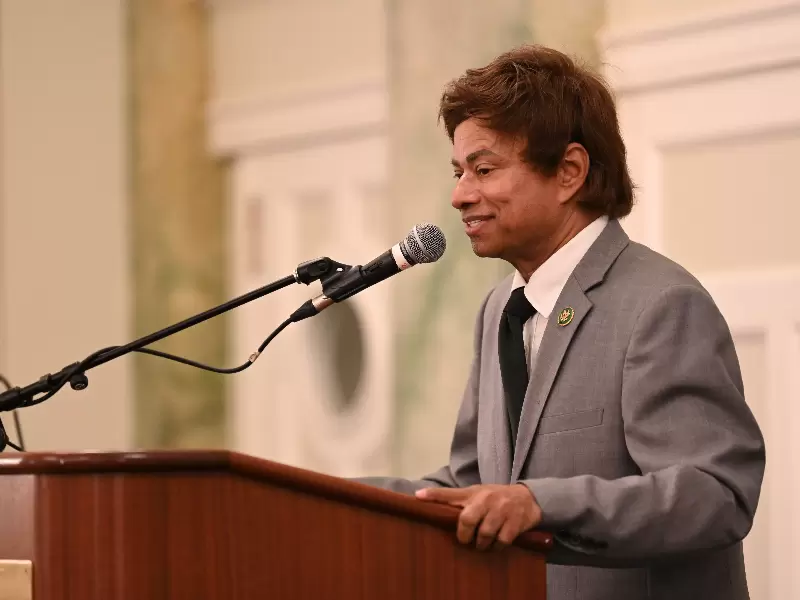 Congressman Shri Thanedar / Wikimedia commons
Congressman Shri Thanedar on June 23 recounted how he was denied a US student visa four times before eventually immigrating to America, building a successful business and winning a seat in Congress, using his personal story to defend immigrants and highlight their contributions to the United States.
Speaking at a Capitol Hill event organised by the Foundation for India and Indian Diaspora Studies (FIIDS), the Michigan Democrat said rising anti-immigrant rhetoric risks obscuring the role immigrants have played in driving American innovation, economic growth and global competitiveness.
“We are a nation of immigrants,” Thanedar told the audience.
“Immigrants have contributed so much to the greatness of America.”
The Indian-American lawmaker, who represents Michigan's 13th Congressional District, said he was increasingly concerned by what he described as growing hostility toward immigrants.
ALSO READ: US losing Indian talent over immigration delays: Suhas
“Today, I am starting to see a lot more hate towards immigrants,” he said.
“And that has to stop.”
Thanedar, who grew up in India and later immigrated to the United States as a student, said his own experience illustrates both the opportunities America offers and the obstacles many immigrants face.
“I grew up in India,” he said. “I was 24 years old living in poverty.”
His fortunes changed when he received admission to a doctoral programme in chemistry at a US university. All he needed, he recalled, was a student visa.
What followed was a series of disappointments.
“I applied for my F-1 student visa, and it got rejected,” Thanedar said.
He applied again with additional supporting documents.
The answer was the same.
“She rejected my visa for the second time,” he said.
A third application also failed.
“Third time, I gave even more documents, and she rejected my visa.”
Determined not to give up, Thanedar obtained a letter from the American professor who had invited him to join the PhD programme and submitted a fourth application.
The visa was rejected again.
“I really didn't know what to do,” he recalled.
After waiting another month, he reapplied for a fifth time using the same paperwork.
This time, the visa was approved.
“I said to the officer there, why did Miss Virginia change her mind?” Thanedar said, referring to the consular officer who had repeatedly denied his application.
The response, he said, was unexpected.
“They said, ‘Oh, she's gone to America for a vacation.’”
The audience responded with laughter.
Thanedar used the story to illustrate how life-changing immigration opportunities can be.
After arriving in the United States, he completed his doctorate, built multiple businesses and became a successful entrepreneur before entering politics.
“I achieved my American dream,” he said.
He later sold his business and entered public service.
“I decided to quit my business, sold my business, took all the money, gave it to all of my employees, and decided to come to public service to help others achieve their American dream,” Thanedar said.
Today, he serves in Congress and is a senior member of the House Homeland Security Committee.
The congressman said his journey demonstrates why immigration remains critical to America's future.
“We got to remember the contribution and the importance of the immigrant community,” he said.
He argued that immigrants are essential to maintaining America's leadership in technology, business and higher education.
“We gotta fight that hate,” Thanedar said.
He also highlighted the importance of the India-US relationship, describing India as a crucial strategic partner for Washington.
“India is essential to the United States to challenge the advances China's making,” he said.
“A US-India strong relationship counters China's aggression.”
Thanedar recalled escorting Prime Minister Narendra Modi to the podium during Modi's address to a joint session of Congress, calling it one of the proudest moments of his public life.
“One of the greatest honors,” he said.
His remarks resonated with many attendees, several of whom have experienced the complexities of the US immigration system firsthand.
The story also reflected a recurring theme throughout the Capitol Hill gathering: that the success of Indian Americans is closely tied to America's historic openness to immigrants and its ability to continue attracting global talent.
Indian Americans today are among the most educated and economically successful communities in the United States. Their growing influence in business, technology, medicine and public service has made them an increasingly important part of the American story.
Thanedar's journey—from a young student repeatedly denied a visa to a member of the US Congress—illustrates both the challenges and opportunities that have shaped generations of immigrants who came to America in search of a better future.
Discover more at New India Abroad
Related


ADVERTISEMENT

ADVERTISEMENT
E Paper
Video

Comments
Start the conversation
Become a member of New India Abroad to start commenting.
Sign Up Now
Already have an account? Login