ADVERTISEMENT
ADVERTISEMENT



US India relationship is the future: State Dept
Morrison said she recently travelled across India with Secretary of State Marco Rubio during a four-city visit that included New Delhi, Kolkata, Agra and Jaipur.
-
1759953093.png) Staff Reporter
Staff Reporter - Wed, 24, Jun 2026
- 00:18 EDT
- 26
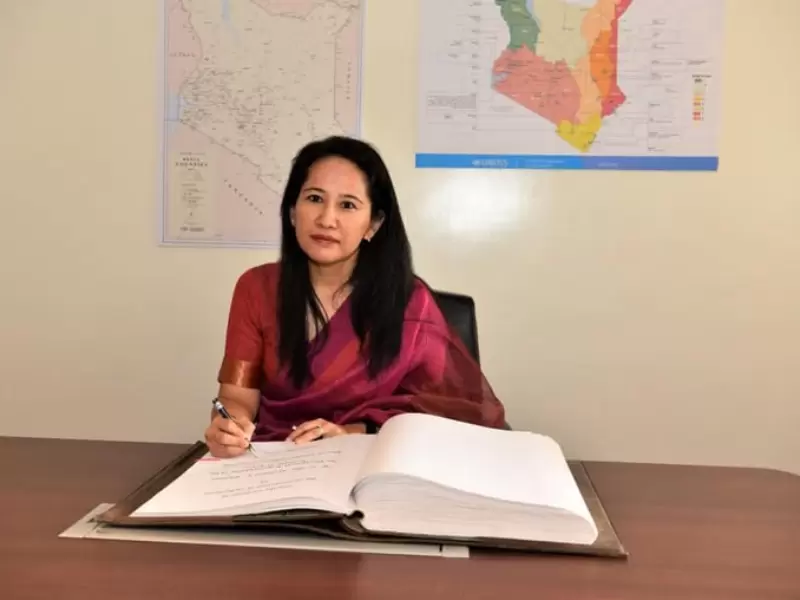
 Bethany Poulos Morrison / Bethany Poulos Morrison via X
A senior U.S. State Department official on June 23 described India as one of America's most important strategic partners and said Washington and New Delhi are moving rapidly to deepen cooperation in trade, technology, energy and defence.
Speaking at a Capitol Hill event organised by the Foundation for India and Indian Diaspora Studies (FIIDS), Deputy Assistant Secretary of State for South and Central Asia Bethany Poulos Morrison said the relationship between the two countries is increasingly focused on delivering tangible outcomes rather than symbolic gestures.
“The US-India relationship is the future,” Morrison said as she outlined the Trump administration's priorities for engagement with New Delhi.
Morrison, who oversees India and South Asia policy at the State Department, said she specifically requested the India portfolio after joining the administration because she viewed it as one of Washington's most consequential foreign policy relationships.
“I thought this was one of the most important relationships that we have,” she said.
She began by highlighting the role of Indian Americans in shaping the United States, calling the community an integral part of the country's story as America prepares to celebrate its 250th anniversary.
“It is a vibrant community. It is one that has contributed immensely,” Morrison said.
She pointed to Indian-American leadership across business, technology and government, citing companies such as Microsoft, Google, IBM and Adobe.
“These leaders, the Indian American leaders in US companies, Microsoft, Google, IBM, Adobe, they are playing key roles in advancing America's economic progress,” she said.
Morrison said she recently travelled across India with Secretary of State Marco Rubio during a four-city visit that included New Delhi, Kolkata, Agra and Jaipur.
“It was an intense trip,” she said, describing it as evidence of the administration's commitment to strengthening ties with India.
She said the visit reflected what she called a “result-oriented relationship” between President Donald Trump and Prime Minister Narendra Modi.
“We're not measuring by meetings, we're measuring by results,” Morrison said.
Trade remains one of the administration's highest priorities, she said.
ALSO READ: Capitol Hill backs stronger India-US partnership
Morrison revealed that Washington and New Delhi are close to concluding a major bilateral trade agreement.
“In February 2026, we announced the intention to finally conclude the historic trade deal. We are very, very close,” she said.
According to Morrison, the agreement would help open India's market of 1.4 billion people to American goods “on terms that are reciprocal and mutually beneficial.”
She also highlighted the administration's support for “Mission 500”, a goal to increase bilateral trade to $500 billion by 2030.
Morrison said bilateral goods trade reached $149 billion in 2025, representing an increase of more than $20 billion over the previous year.
“2025 was a historic year when it comes to trade with the US and India,” she said.
Technology cooperation is emerging as another pillar of the relationship.
Morrison pointed to the Trust Initiative launched by Trump and Modi, describing it as a framework for collaboration in artificial intelligence, semiconductors, critical minerals and other emerging technologies.
“We are focusing on AI, semiconductors, critical minerals and technologies that will define the future,” she said.
“The US-India relationship is the future, and that's why we're so focused on the key technologies that are going to take us there.”
She noted that senior Indian technology officials were scheduled to meet US counterparts in Washington this week to advance cooperation on technology projects.
Energy has also become an increasingly important area of collaboration, Morrison said.
She highlighted growing trade in oil, natural gas and coal and pointed to new opportunities in civil nuclear cooperation following the passage of India's Shanti Act.
“US-India hydrocarbon trade has expanded significantly since 2025, reaching $14.4 billion to date,” she said.
Defence cooperation continues to deepen as well.
“Our defense relationship is moving at rapid speed,” Morrison said.
She cited the 10-year defence framework signed last year, describing it as “a generational commitment” to co-development, co-production and industrial cooperation between the two countries.
Beyond trade and security, Morrison repeatedly emphasised the importance of people-to-people ties.
“The US India relationship is sustained by one of the most remarkable people-to-people connections in the world,” she said.
She noted that more than 330,000 Indian students are currently enrolled in American educational institutions, contributing over $14 billion to the US economy.
“Deals, trade deals can be signed. Defense frameworks can be negotiated. But it's these human connections that make all of this possible,” Morrison said.
Concluding her remarks, Morrison said the relationship was entering a new phase driven by measurable outcomes and strategic convergence.
“At the end of the day, this partnership isn't built on sentiment. It's built on results,” she said.
The Trump administration has made India a key pillar of its Asia strategy, while New Delhi continues to deepen engagement with Washington across emerging technologies, supply chains, defence production and critical minerals.
Morrison's remarks offered one of the clearest indications yet that both sides are preparing to elevate the relationship further through a trade agreement and expanded cooperation in sectors expected to shape the global economy for decades to come.
Discover more at New India Abroad
Related
ADVERTISEMENT

ADVERTISEMENT
E Paper
Video

Comments
Start the conversation
Become a member of New India Abroad to start commenting.
Sign Up Now
Already have an account? Login