ADVERTISEMENT
ADVERTISEMENT



Masters of the kitchen: Leading Indian-American chefs who are rewriting culinary rules
Here’s an inside look at Indian-American chefs blending deep-rooted heritage with modern global techniques.
-
 Pallavi Mehra
 - Thu, 25, Jun 2026
- 17:40 EDT
- 45
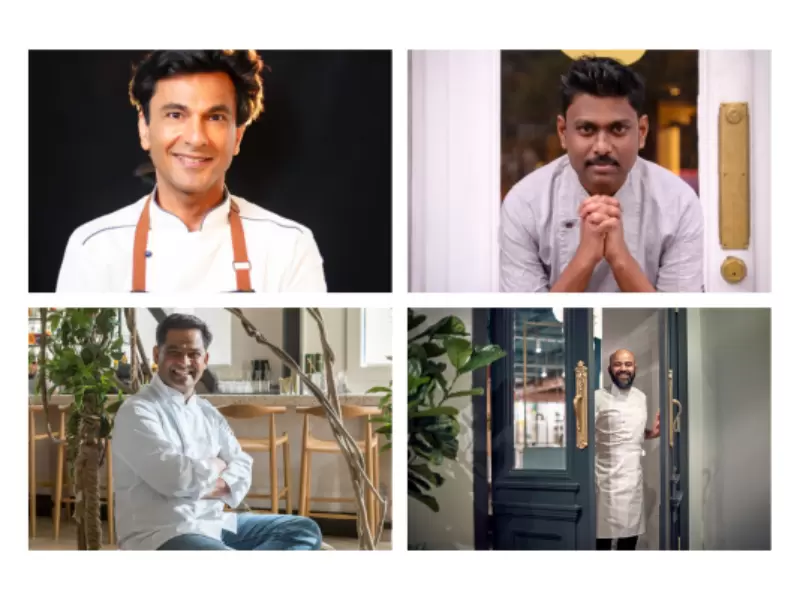 (Top L-R) Vikas Khanna , Vijay Kumar, (Bottom L-R) Sri Gopinathan and Sujan Sarkar / Credit: Bungalow, Vijay Kumar, Neil John Burger, Patricia Chang
For decades, the story of Indian food in America was confined to a predictable script: buffet trays of chicken tikka masala, generic curry powders, and menus shortened to fit Western expectations. But a brilliant group of Indian-American chefs is permanently shattering that mold.
By refusing to compromise on regional authenticity and marrying childhood memories with global techniques, these culinary artists have commanded America’s most decorated kitchens and earned several awards and accolades. Here are the top Indian-American culinary artists driving the Indian food conversation forward.
Also read: Where every 100 days brings a new taste of India
Vikas Khanna: The Cultural Ambassador
Before the current rise of regional Indian dining took hold in America, chef Vikas Khanna was already laying the groundwork. Arriving in New York City tracking a dream, the Amritsar-born chef made global headlines when his flatiron restaurant, Junoon, earned a Michelin star just months after opening and maintained it for six consecutive years.
Khanna’s approach has always been deeply humanistic and cinematic, treating food as a bridge between cultures. At Bungalow, his highly acclaimed New York return, Khanna pays homage to the vintage social clubs of India, serving up nostalgic dishes like Amritsari Shakkarpara and Lucknowi Galouti Kababs that honor the home cooks and grandmothers who shaped his culinary worldview.
Sujan Sarkar: The Progressive Culinary Magician
At Indienne in Chicago’s River North, Chef Sujan Sarkar views Indian cuisine through an objective, contemporary lens. Rather than changing ancestral spice combinations, Sarkar focuses on changing how the food is experienced. His menus offer distinct vegetarian, non-vegetarian, and vegan tasting paths that look like modern art installations.
A prime example of his work is his Chicken Katli, a savory transformation of the traditional diamond-shaped Indian sweet. Sarkar layers a chicken breast with chicken gushtaba (meatball) and an airy chicken mousseline, finalizing the dish with shavings of black truffle. It delivers deeply comforting, familiar flavors but a hyper-refined French culinary visual.
Vijay Kumar: The Unapologetic Traditionalist
If other kitchens seek to modernize Indian food, Chef Vijay Kumar’s mission at Manhattan’s Semma is to preserve it fiercely. Growing up in Tamil Nadu, Kumar spent his childhood foraging for snails and hunting deer on his grandparents’ farm, cooking over open wood fires.
At Semma, the Nathai Pirattal (a spicy, heavily layered snail curry) and the legendary Gunpowder Dosa (doused liberally in ghee and a highly complex 50-ingredient sambar) have proven that global diners crave uncompromising authenticity over diluted adaptations.
Mayank Istwal: The Ayurvedic Nomad
Chef Mayank Istwal made history when Musaafer became the first-ever Indian restaurant in Texas to capture a Michelin star. Born in the Himalayan foothills of Uttarakhand, Istwal’s menu is an ongoing travelogue. He literally spent months traveling through the villages of India to unearth forgotten ancestral recipes.
Istwal’s approach weaves ancient Ayurvedic principles, ensuring dishes harmonize in color, temperature, aroma, and digestibility, with avant-garde presentation. At Musaafer, the dining experience is highly theatrical, engineered to trigger what he calls a sixth sense.
Srijith Gopinathan: The Coastal Trailblazer
No conversation about the American diaspora's culinary revolution is complete without Chef Srijith Gopinathan. As one of the first Indian chefs in the world to secure two Michelin stars during his tenure at San Francisco's Taj Campton Place, he single-handedly forced the global fine-dining crowd to view South Asian cuisine as gourmet.
Now at his celebrated restaurant Copra, Gopinathan focuses on the heavily aromatic legacy of Kerala and the broader South Indian coast, using Northern California produce to bridge his two worlds.
What these chefs share is a shift from defense to offense. They are no longer translating Indian cuisine for an unfamiliar audience, they are inviting the audience to step into their world on their terms. Through precise technique and fierce cultural pride, they are proving that India’s culinary heritage is not static, but an evolving, living art form.
Discover more at New India Abroad.
Related









ADVERTISEMENT

ADVERTISEMENT
E Paper
Video

Comments
Start the conversation
Become a member of New India Abroad to start commenting.
Sign Up Now
Already have an account? Login