ADVERTISEMENT

ADVERTISEMENT



Inside the claim: Why RSS says it has no overseas operations
The idea that HSS is a direct branch of the RSS is wrong. In every country, HSS is a separate legal group.
-
 Madhu Hebbar
 - Mon, 06, Apr 2026
- 15:40 EDT
- 16
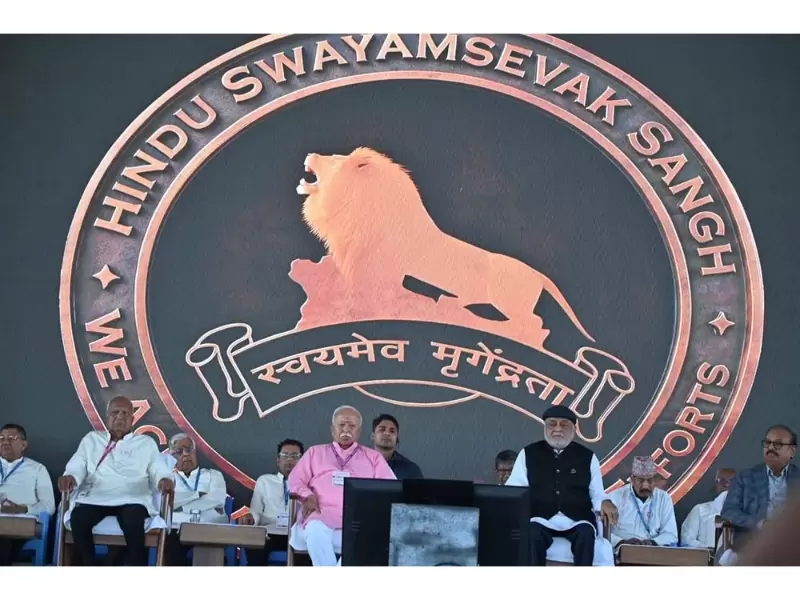 L-R: Banvari lal Purohit (Sarvadhikari of the camp), Mohan Bhagwat (Sarsanghchalak of RSS), Daaji ( Global Chief of Heartfulness movement) and chief guest of the concluding function Krishna Ella, (co-founder of Bharat Biotech of famous Covaxin) / Courtesy: Hindu Swayamsevak Sangh
For the past few years, the Rashtriya Swayamsevak Sangh (RSS)—a 100-year-old group and the world’s largest volunteer organization—has faced unfair criticism from some big U.S. news outlets.
The New York Times called it “far-right” with old “fascist” ideas and said it wants India to be a Hindu-first country. The Washington Post saw its 100-year celebration as a warning sign of rising nationalism. Other reports, like one from Prism, claimed the RSS was secretly lobbying in the U.S. Congress and breaking foreign-agent rules.
These stories heated up during the RSS’s 2025 centenary year, its work in Washington, and calls from the U.S. Commission on International Religious Freedom to freeze its assets over unproven claims that it hurts religious freedom. Similar stories spread quickly on U.S. social media, often pushed by some Indian diaspora groups and self-described human rights activists who demand bans on Hindu organizations.
Also Read: SOAS Leicester Report: A masterclass in academic gaslighting
Recently, article14.com ran a long report by Snigdhendu Bhattacharya. It said the RSS secretly runs groups abroad through the Hindu Swayamsevak Sangh (HSS) in the United States, United Kingdom, and other countries. The story pointed to the RSS’s “Vishwa Vibhag” (World Department) and a big international meeting in December 2025 with people from 79 countries as proof of hidden operations.
But the RSS has always said clearly: it does not operate outside India. The HSS groups in the U.S., U.K., and more than 20 other countries are legally independent cultural organizations run by local Indian communities living abroad.
Critics call the World Department a secret spy agency and claim the HSS is a hidden front. They offer no real evidence. In truth, the RSS shares its ideas around the world through a simple, open model. It does not need tight control from the top. What looks like a giant secret plot is really just ordinary people who choose to join because they share the same beliefs.
Local Groups Run Themselves
The idea that HSS is a direct branch of the RSS is wrong. In every country, HSS is a separate legal group with its own rules, leaders, and money. This is not a trick. It is how the network actually works. It makes the groups stronger than any single boss could.
When the RSS says it does not operate abroad, that statement is true. The RSS is based only in India where it is recognized as the body of individuals. What travels overseas is the shared ideas—not orders or secret money. The RSS gives the basic ideas and values; people abroad build their own groups around them. This is like an open-source recipe: anyone can use it, but each cook makes their own dish.
This setup is normal for big international groups. Think of Oxfam, Greenpeace, or Amnesty International. They share goals and symbols, but each country’s branch is legally independent.
Different Goals
The RSS’s main job is to unite and strengthen Hindu society inside India. It works to build strong character and make India a proud nation that protects its culture.
The HSS has a different mission. It helps Hindus living in other countries keep their heritage, build good character, serve their local communities, and spread peace through Hindu values (called Dharma).
The World Department Only Shares Ideas
Critics paint the Vishwa Vibhag as a secret command center. In reality, it is just a small office that shares information and keeps ideas consistent. It does not give daily orders to HSS groups.
A weekly meeting (shakha) in New Jersey or Sydney uses the same basic books, prayers, and exercises as in India — but changes them to fit local laws and culture. It is like a franchise: the same ideas, but run locally by volunteers.
Scholar Walter Anderson, who has studied the RSS for decades, calls the HSS an “overseas counterpart.” He says “The RSS is the source of ideas, but HSS follows the laws of its own country and focuses on being good citizens there”.
Shared Values, Not Secret Fronts
The words “front organization” suggest hiding a parent group. But HSS groups openly say they draw inspiration from RSS founders. They use the same symbols and daily routines. The legal separation is real and honest.
This model is common. Greenpeace International, based in Amsterdam, sets global campaigns. But Greenpeace USA, Greenpeace UK, and Greenpeace India are each separate legal groups with their own boards and money. They share the brand but do not take direct orders.
The same is true for:
-
Amnesty International (London headquarters coordinates campaigns; national sections are independent).
-
Oxfam (21 separate national Oxfams, each registered locally).
-
Médecins Sans Frontières (Doctors Without Borders) — 20+ national sections that can even disagree publicly but share core principles.
Other groups like World Vision, CARE International, WWF, Save the Children, and Action Aid work the same way. Legal independence is standard for NGOs that cross borders. It is not a lie — it is how international law works.
A Big Public Meeting
The Vishwa Sangh Shibir in Hyderabad in December 2025 was the seventh such public event. More than 1,600 people from 79 countries came. It was like the Indian government’s own Pravasi Bharatiya Divas, but run by volunteers instead of the government. The focus was on Hindu culture, family values, and helping diaspora communities. It was held openly, just as the first one was in 1995. Nothing was secret.
Real Work: Service and Community
The biggest change in the diaspora is not secret plotting. It is steady community service. HSS-inspired groups run food banks, help after disasters like Hurricane Harvey and COVID-19, teach yoga, and offer children’s cultural classes.
These efforts build real trust and help both immigrants and native citizen, by spreading harmony amongst communities
This work creates “social capital” — strong community ties that grow naturally. It is not about power grabs.
No Real Secrecy
The RSS is one of the most extensively documented groups in India and abroad (1,2,3). It publishes its own books and magazines. The claims of secrecy spread in the newspapers and articles like this (by the same author on the same topic 1,2, 3) are simply motivated campaigns to smear the organization. There are no plans for world domination — only a desire to build pride in India’s ancient culture.
Better Questions to Ask
Instead of asking “Does the RSS secretly run things abroad?” we should ask:
-
Why has this 100-year-old Indian idea become so important to many Hindus living overseas, even in places like Silicon Valley?
-
Why do Hindu immigrants do so much helpful service work in their adopted countries?
-
How does a shared set of values create influence without bosses or big money?
The RSS has not changed its basic claim: it does not operate abroad. In today’s connected world, its ideas spread naturally through people’s daily lives, friendships, and choices. There is no hidden headquarters in Nagpur controlling everything. The real story is simpler: a movement built on shared values, personal choice, and volunteer work.
The more critics hunt for a conspiracy, the clearer it becomes that the ideas have real worldwide reach—and that reach is open and honest.
Madhu Hebbar, an engineer, is an IIT graduate, living in the greater Los Angeles area.
Discover more stories on New India Abroad
Related







ADVERTISEMENT

ADVERTISEMENT
E Paper
Video

Comments
Start the conversation
Become a member of New India Abroad to start commenting.
Sign Up Now
Already have an account? Login