ADVERTISEMENT
ADVERTISEMENT



BART is broken. Our candidates hold real power over it. So why isn’t it fixed?
The agency is now facing a $350–$400 million annual budget deficit beginning in the 2027 fiscal year. To close it, BART has warned of potentially closing stations, cutting weekend service, and raising fares significantly
-
 Gaurang D
 - Sat, 02, May 2026
- 11:23 EDT
- 18
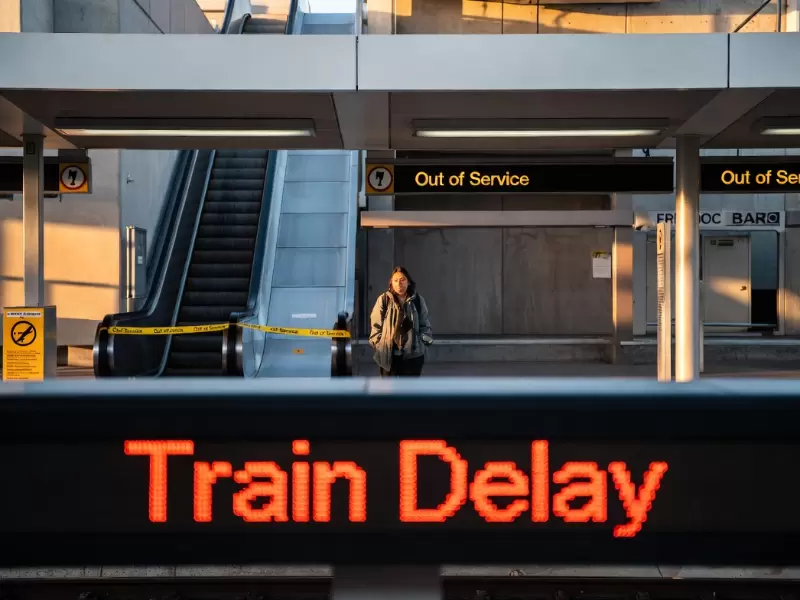 Representative Image / Courtesy Photo
There is a particular kind of exhaustion that sets in not from one bad day, but from years of being told a problem is being handled and watching it get worse anyway.
That’s where a lot of CA-14 residents are with BART right now. Not furious exactly. Just done.
I’ve been commuting from Fremont on BART for years. I used to think of it as a point of quiet pride—less traffic, better for the air, a few minutes to decompress before work. Then somewhere between the systemwide meltdowns of 2025, the escalators that have been ‘temporarily out of service’ for longer than I can remember, and the morning I stood on a platform for 38 minutes watching delay alerts stack up before I gave up and called a rideshare—something shifted. I stopped believing it was going to get better on its own.
What the Numbers Actually Say
Before the pandemic, BART carried roughly 410,000 riders on an average weekday. By April 2020 that figure had cratered to around 25,000. Nobody blames COVID for that.
But by 2025, BART ridership was still more than 50% below 2019 levels. For context, national transit ridership had recovered to roughly 80% of pre-pandemic numbers. BART sits at about half that recovery rate.
The agency is now facing a $350–$400 million annual budget deficit beginning in the 2027 fiscal year. To close it, BART has warned of potentially closing stations, cutting weekend service, and raising fares significantly. For the nurses, custodians, warehouse workers, and retail employees who depend on BART every day, steep fare increases are not an inconvenience. They are a crisis.
BART’s crisis is not just a transportation problem. It is an affordability problem, an equity problem, and a climate problem. When transit fails, people drive. The people who cannot afford to drive are the ones left behind.
In 2025, riders experienced multiple major systemwide disruptions, including the largest outage since 2019. An insulator explosion in August sent smoke into a train car. Two entire lines went down mid-commute in December. An independent Inspector General whose job was to investigate this kind of dysfunction resigned in 2023, publicly stating that BART management had repeatedly blocked her oversight work.
The Irvington Station: Planned Since 1979, Still Not Built
For Fremont residents specifically, the Irvington BART station is the story in miniature of everything wrong with how this region manages transit.
The station has been in planning since it was studied as part of the Warm Springs extension in 1979. Its construction was approved by the BART board in 1992. As of early 2026, the station has full environmental clearance and 14 of 17 required land parcels already acquired - and BART had still not applied for available state funding to build it. A January 2026 KQED report confirmed the delay is not a question of readiness. It is a question of institutional inaction.
Decades of planning. Still not built. Fremont residents keep waiting.
Two Candidates, Two Institutions, One Crisis
Two of the three main candidates running in CA-14 this June do not just have opinions about BART. They hold - or have recently held, formal institutional roles with direct connection to it. That makes the accountability question concrete rather than theoretical.
Aisha Wahab is a sitting California State Senator representing SD-10, which covers Hayward, Fremont, Union City, Newark, and parts of the South Bay - communities that depend on BART daily. She currently chairs the Senate Housing Committee and the Senate Business, Professions and Economic Development Committee, and serves as Assistant Majority Leader. In January 2026, Wahab wrote a public letter to the BART board criticizing the agency’s failure to apply for state funding for the Irvington station, calling it ‘unacceptable.’ She has been vocal about BART’s accountability failures and the
Bay Area’s fragmented network of transit agencies.
The fair question for voters is this: Senator Wahab has had real legislative standing and statewide platform since 2022. The Irvington station remained stalled on her watch as the district’s state senator. A letter in January 2026, after she announced her congressional run, is a start. But what specific legislation did she author or advance in the preceding three years to address BART’s fiscal crisis or unlock this project?
Melissa Hernandez currently serves as President of the BART Board of Directors, the single most direct position of governance over the agency. She was appointed to fill a board vacancy in May 2024, elected to a full four-year term in November 2024, and elected Board President by her fellow directors in December 2025. Her district covers parts of Alameda and Contra Costa counties including Livermore, Dublin, and Pleasanton.
Hernandez has said she believes ‘this year will define BART for decades to come.’ That may be true. But she now sits at the top of the governance structure of an agency in active financial crisis, with a multi-hundred-million-dollar deficit, a major station stalled in her region, and service reliability that has driven riders away in large numbers.
The BART board - which she now leads - is the body that failed to apply for the Irvington funding that Wahab’s letter criticized. What Hernandez does with that board presidency in 2026 is a live accountability question, not a historical one.
Running for Congress while leading the agency in crisis is a choice. Voters are entitled to ask what that leadership has produced, and what it will produce if she wins.
What a Member of Congress Actually Controls
The U.S. Representative for CA-14 does not run BART. But they shape something that matters enormously to its future: access to federal infrastructure dollars and the conditions attached to them.
Federal transit funding built BART originally and has funded major capital projects since. The Infrastructure Investment and Jobs Act of 2021 made tens of billions available for transit. How aggressively a representative pursues those dollars - and whether they attach real accountability conditions or simply pass them through, is a genuine policy choice with direct consequences for riders.
There is also a structural problem no Sacramento figure has resolved: the Bay Area operates dozens of transit agencies with no unified fare system. A commuter crossing multiple systems pays multiple fares, navigates multiple apps, and encounters multiple service gaps. Federal funding policy can either reward regions that fix this fragmentation or continue subsidizing it. That is a decision made at the congressional level.
The Crime Picture: Real Progress, Unfinished Business
BART's December 2025 Chief's Report shows genuine improvement: overall crime down 41%, robberies down 60% (207 to 82), violent crime down 31%, property crime down 43%, auto thefts cut in half, and zero homicides in 2025.
But the per-ride picture is harder. A San Francisco Chronicle data analysis found the rate of violent crimes per ride remains nearly double the pre-pandemic baseline. Before COVID, BART averaged 3.7 violent crimes per million rides. By 2024, robberies alone had reached 4.3 per million rides, and aggravated assaults had nearly tripled from 1 to 2.8 per million rides. With ridership still more than 50% below 2019 levels, fewer crimes are shared among far fewer riders, making every incident more damaging to rider confidence. Aggravated assaults bucked the 2025 trend entirely, rising from 141 to 158.
A 2024 rider survey found 60% would ride more if safety improved, and 73% feel more comfortable when a uniformed officer is present.
The progress is real. The structural causes are not fixed. And the officials who held power while the system deteriorated are now asking for a promotion to Congress.
Who Looked the Other Way: A Record of Institutional Failure
BART's crime crisis rose inside a governance culture that drove out its own watchdog. Inspector General Harriet Richardson resigned in March 2023, citing a documented pattern of obstruction by management, board members, and unions. The 2022 Alameda County Civil Grand Jury confirmed it, finding BART's leadership had sought to undermine her role from the beginning. Her office had three employees. Los Angeles's equivalent had 25. Washington D.C.'s had 45.
BART Director Debora Allen documented the culture publicly: Richardson was "insulted and bullied by a sitting board member, while behind closed doors others worked to openly discredit her work." State Senator Steve Glazer authored legislation to strengthen and protect the Inspector General's office. BART lobbied Newsom to veto it. He did.
The accountability failure ran deeper. A 2025 KQED investigation and OIG audit found BART spent $96 million on overtime in 2023, representing 14% of its entire salary budget, with 57 employees more than doubling their base salaries. When Richardson's successor, Inspector General Claudette Biemeret, audited the overtime, she could not access basic timekeeping data. When she told the board, BART's own CFO contradicted her in the same meeting.
Separately, the OIG substantiated five time theft cases in which employees clocked in and then left their worksites while collecting full pay.
This is the institutional culture that produced BART's crime and fiscal crisis simultaneously. Aisha Wahab represented this district in Sacramento through the Inspector General's forced exit, the overtime scandal, and the Irvington station failure. A letter written in January 2026, timed to her congressional launch, is not a record of accountability. Melissa Hernandez joined the BART board in May 2024 and became Board President in December 2025. Running for Congress mid-crisis while leaving a board seat won less than a year ago raises one fair question: what has changed under her leadership that justifies a promotion?
Can a Different Kind of Candidate Break the Pattern?
The third candidate in the CA-14 race, Rakhi Israni, does not carry a Sacramento legislative record or a BART board history. What she has put on the table publicly is a set of specific policy positions: federal infrastructure dollars tied to delivery milestones rather than promises, federal incentives for regional fare coordination across agencies, and fare relief targeted at essential workers rather than across-the-board increases that fall hardest on low-income riders.
Whether those ideas translate into actual results if she wins is unknown. A fresh record is not automatically a better record. But for voters watching the agency that one candidate leads, and the district that another represents, continue to struggle - the question of whether a different approach produces different outcomes is at least worth taking seriously.
The Question on the Ballot
On June 2, CA-14 voters will choose who represents them in Congress. If transit accountability matters to you, and given what BART has put this community through, it should, the questions are not abstract.
Which candidates have held institutional power with direct connection to BART? What did they do with it? Which are offering specific plans versus general commitments? And is it possible that the officials closest to this crisis are not best positioned to fix it from Washington?
Those are fair questions. The answers are in the public record, and in the positions each candidate has chosen to put forward.
The writer is a Fremont, CA resident and long-time BART commuter.
(The views and opinions expressed in this article are those of the author and do not necessarily reflect the official policy or position of New India Abroad.)
Discover more at New India Abroad.
Related










ADVERTISEMENT

ADVERTISEMENT
E Paper
Video

Comments
Start the conversation
Become a member of New India Abroad to start commenting.
Sign Up Now
Already have an account? Login