ADVERTISEMENT

ADVERTISEMENT



The Hindu woman: A civilizational continuum of shakti, strength and balance
From composing hymns in the Rig Veda to shaping institutions under the Constitution of India, women have remained part of intellectual and public life.
-
 Dr. Vinay Nalwa
 - Thu, 26, Mar 2026
- 05:15 EDT
- 20
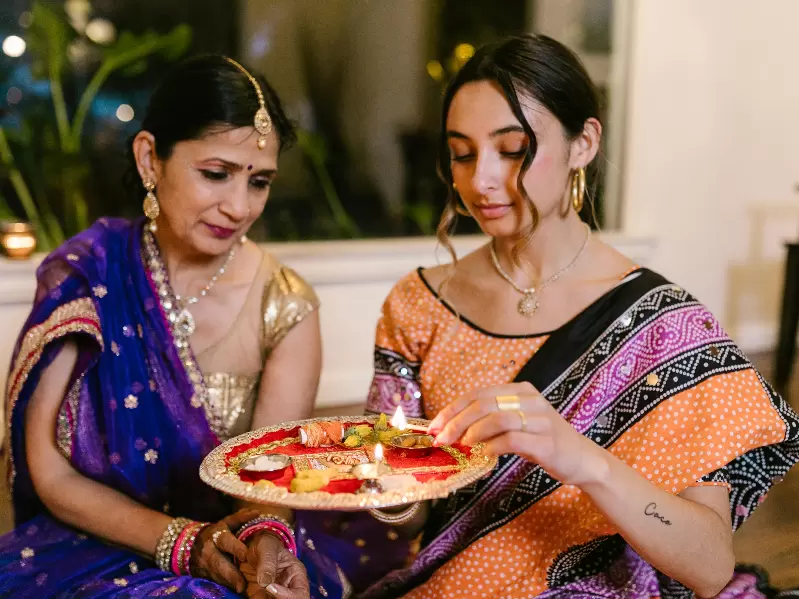 Representative image / Pexels
A line of kumkum on the forehead. A saree draped with quiet familiarity. A lamp lit, hands folded at the altar of the divine feminine during Navratri.
Nothing here asks to be explained.
And yet, in these small acts, the presence of the Hindu woman and the reverence for the feminine become inseparable. What appears simple carries a continuity that stretches across centuries.
To understand the Hindu woman, one must begin here—not in definition, but in lived continuity. Identity is shaped through what is practiced, repeated, and absorbed over time.
In the dharmic view of life, the idea of oneness remains central. The atma, or self, is understood as beyond physical form, without beginning or division, and beyond gender. From this comes a different way of seeing. Man and woman are not opposites. They are complementary expressions of the same reality, equal in essence, connected in purpose.
ALSO READ: The Persian cycle: A scientific and philosophical look at the limits of progress
The Brihadaranyaka Upanishad expresses this simply. Creation is described as one whole appearing as two, like equal halves of the same being. Equality, then, is not constructed. It is inherent.
This idea does not remain philosophical. It appears in social life.
In marriage, the ritual of saptapadi reflects this clearly. Two individuals walk together, step by step, around the sacred fire. Each step carries a shared intent—prosperity, stability, spiritual growth. The language itself reflects partnership: sahadharmini, a partner in dharma; ardhangini, one half of the whole; sahachari, a companion in life. These are not ornamental words. They define a relationship built on alignment, not hierarchy, as also discussed in Indian Woman, Feminism and Women’s Liberation by Saji Narayanan.
In the Vedic period, women studied, debated, and contributed to knowledge traditions with ease. Gargi Vachaknavi and Maitreyi are not exceptions. They represent a culture where participation followed ability.
This position has long been recognized. Nivedita Bhide, in Woman: Yesterday, Today and Tomorrow, examines how this continuity evolved over time. Even early European scholars noticed it. Horace Hayman Wilson observed, “It may be confidently asserted that in no nation of antiquity were women so much esteemed as amongst the Hindus.”
Reverence for the feminine is not confined to thought. It appears in worship and then in daily conduct. The worship of Durga, Lakshmi and Saraswati reflects the feminine as Shakti, the force that sustains existence—not symbolic, but foundational. From there, it enters everyday life almost naturally.
History, however, did not remain constant.
With the arrival of Islamic invasions of India, social conditions began to change. Questions of safety became central. Mobility, education and public presence were affected. Practices such as purdah emerged. These were responses to circumstances, not civilizational ideals.
Later events deepen this understanding. The violence during the Partition of India and the Bangladesh Liberation War, where women faced extreme brutality, reveals how conflict reshapes social realities.
Even today, in regions such as Pakistan and Bangladesh, reports of abduction and forced conversion of minor girls continue to surface. These are not isolated concerns. They offer context to how societies respond under pressure.
And yet, something endured.
The civilizational idea of the feminine did not disappear. It remained within the inner spaces of family and culture.
Motherhood becomes important here—not as sentiment, but as structure. The mother as the first teacher, the one who transmits values, discipline and memory. Quietly, without declaration, but decisively.
That continuity carries forward into the present.
From composing hymns in the Rig Veda to shaping institutions under the Constitution of India, women have remained part of intellectual and public life. The image, however, is not as distant from the present as it may seem. The same woman who carries forward knowledge and responsibility is often still marked by a line of kumkum, a bindi on the forehead, a saree worn with ease.
This continuity is visible even in contemporary spaces. In science, for instance, Ritu Karidhal and Muthayya Vanitha played key roles in Chandrayaan-2, carrying both professional excellence and cultural memory without contradiction. Across the United States, the United Kingdom and beyond, this balance travels with the diaspora. It adapts but does not dissolve.
Swami Vivekananda recognized this early. He observed that Hindu women are “very spiritual and very religious …,” and if this depth is combined with full intellectual development, “the Hindu woman of the future will be the ideal woman of the world.” He also stated, “The idea of perfect womanhood is perfect independence.”
This is not reinvention. It is continuity.
The Hindu woman stands across time—in thought, in family, in faith. Evolving, yet rooted.
A civilization that invokes the feminine as divine understands womanhood differently. Its strength does not announce itself, yet it shapes life.
The Hindu woman is not of the past. She is its living presence.
(The writer is an author and columnist.)
(The views and opinions expressed in this article are those of the author and do not necessarily reflect the official policy or position of New India Abroad.)
Discover more stories on New India Abroad.
Related




ADVERTISEMENT

ADVERTISEMENT
E Paper
Video

Comments
Start the conversation
Become a member of New India Abroad to start commenting.
Sign Up Now
Already have an account? Login