ADVERTISEMENT
ADVERTISEMENT



Choose optimism: Sundar Pichai's message to Stanford Class of 2026
Drawing on his journey from Chennai to Silicon Valley, the Google CEO shared lessons on optimism, ambition and following one's passions.
-
 Malvika Choudhary
 - Mon, 15, Jun 2026
- 12:48 EDT
- 49
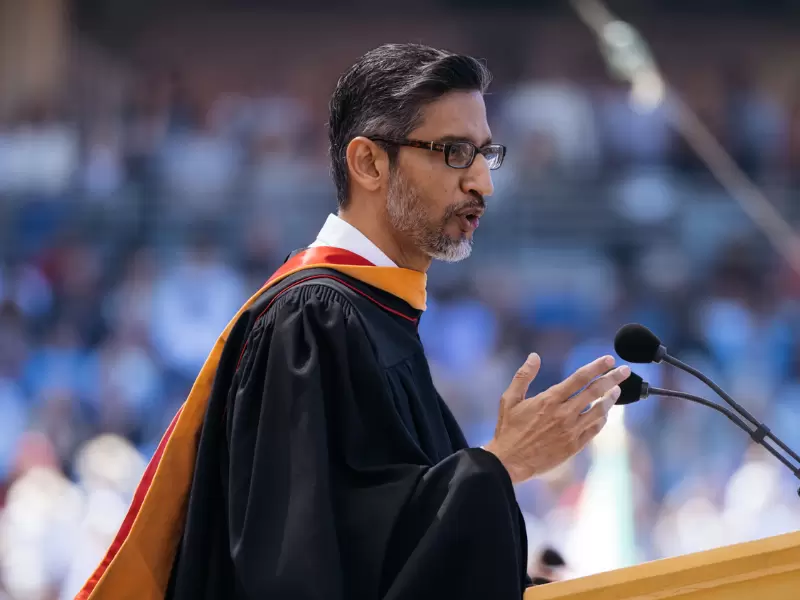 Sundar Pichai / Stanford Report
Google CEO Sundar Pichai urged graduates to "choose optimism" as they navigate a world marked by conflict, economic uncertainty and rapid technological change during Stanford University's commencement ceremony for the Class of 2026.
"This might not ring true to you at this moment. The world is going through a lot: global conflicts, economic anxiety, a rewiring of technology, information overload, all at a fast pace. We don't get to choose the world we graduate into; but we do get to choose how we frame our circumstances," Pichai said.
Also Read: Pichai’s Stanford speech interrupted by Project Nimbus backlash
The Stanford alumnus structured his address around three principles that have guided his life and career: choosing optimism, working on hard things and doing what excites you.
"When the call from Stanford came, my father spent the equivalent of a year's salary to buy my ticket. It was my first time on a plane," he said reflecting on his upbringing in Chennai, India and his family’s hardships.
Pichai recalled arriving in California and remarking that the state's hills appeared brown rather than the lush green landscapes he had expected. His host mother offered said they appeared golden, offering a different perspective that would stay with him throughout his life.
"And that's exactly what I mean by choosing optimism. It's about reframing for the positive: Where I saw brown, she saw golden," he said.
Pichai said optimism helped him navigate major turning points in his life, including leaving Stanford's doctoral program and completing a master's degree instead.
"I could have seen it as the end of a dream. But thanks to Mrs. Earl, I was able to see that particular brown hill as golden. In that moment, I chose optimism," he said.
Work on hard things
The Google chief also reflected on his career, recounting how he joined Google in 2004 and later became part of a small team working on what would become the Chrome web browser.
At the time, he said, there was a broad belief inside the company that building a browser would be extremely difficult and require hundreds of engineers, while the project had only about 10 people working on it.
After Chrome launched in 2008, growth initially stagnated. A year later, the browser held about a 2 percent market share. Pichai recalled then-Microsoft CEO Steve Ballmer dismissing Chrome as "a rounding error."
Rather than seeing the criticism as a setback, Pichai said it reinforced the team's belief that they were making progress.
"Working on hard things has taught me a lot: It typically attracts other great and optimistic people. And even if you miss meeting the high goals you set, you'll still achieve something great. So when you have the choice to work on something hard — say yes," he said.
Do what excites you
Pichai also encouraged graduates to pursue what genuinely excites them rather than following expectations imposed by others.
He said his interest in technology stemmed from growing up with limited access to it and not having much exposure to computers until arriving at Stanford in 1993.
The experience shaped his belief that technology could be a powerful tool for expanding opportunity. He later saw that impact firsthand while meeting women in rural India using Android smartphones to learn new skills and communicate with family members, as well as students in Pittsburgh benefiting from educational technology.
"Seeing computing change people's lives as it had changed mine was the most exciting thing in the world to me," he said.
Pichai urged graduates not to base their decisions on what others expect of them.
"Don't focus on: The thing your parents want you to do, Or the thing all your friends are doing, Or that society expects of you. Instead, think about the things that keep you chatting excitedly with your roommates late into the night. And go do those things," he said.
"You are going to face a lot of moments in your life. Only a few of them are really important and you need to get them right," he said. "However you will face many more moments in your life that only seem really big... Thousands of them, in fact. And very few of them are make or break."
Concluding his address, Pichai encouraged graduates not to obsess over making every decision perfectly.
"You have thousands of moments ahead of you. The important thing isn't to get them all right; it's to find a way to keep moving forward," he said.
Calling the Class of 2026 "the most capable class in history" before jokingly adding "at least until next year's class," Pichai ended with a final message: "You already have the California optimism to see life's golden hills, and a Stanford diploma proving you can do hard things. Now, go out and set your heart ablaze!"
Pichai's address was briefly overshadowed by a student protest. As he took the stage, more than 100 graduates walked out of Stanford Stadium chanting "Free, free Palestine" and waving Palestinian flags in protest against Google's involvement in Project Nimbus, a cloud-computing and artificial intelligence contract with the Israeli government. Pichai did not address the demonstration and continued with his remarks.
Discover more at New India Abroad.
Related









ADVERTISEMENT

ADVERTISEMENT
E Paper
Video

Comments
Start the conversation
Become a member of New India Abroad to start commenting.
Sign Up Now
Already have an account? Login