ADVERTISEMENT
ADVERTISEMENT



From Bondi Beach to the world: Why Islamist terrorism must be named, not softened
From Bondi Beach to Pahalgam, from South Asia to Middle East to Europe to United States, the message is the same: this is not a series of disconnected tragedies.
-
 Hriday Raval
 - Sat, 20, Dec 2025
- 14:32 EST
- 298
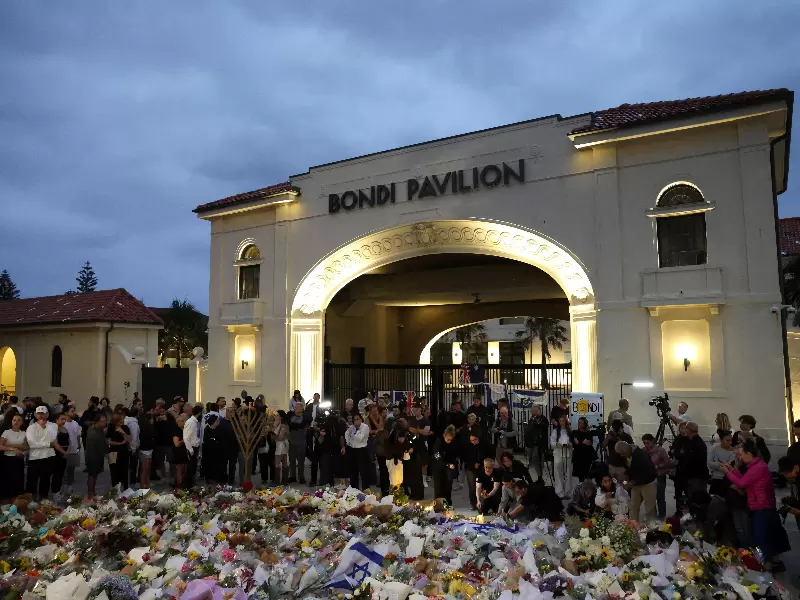 People pay respects at Bondi Pavilion to victims of a shooting during a Jewish holiday celebration at Bondi Beach, in Sydney, Australia, December 15, 2025. / REUTERS/Hollie Adams
The terror attack at Bondi Beach during a Hanukkah celebration in Australia was not an isolated act of violence, nor was it merely another episode of “hate.”
It was a meticulously planned act of Islamist terrorism—one that fits into a growing global pattern stretching from South Asia to the Middle East, from Europe to North America. What makes Bondi Beach especially significant is not only the scale of the tragedy, but the continued global reluctance to call such violence by its proper name.
At Bondi Beach, families gathered peacefully to mark a Jewish religious festival. They were met with gunfire. Subsequent investigations revealed that the attackers were not acting impulsively: improvised explosive devices were also found at the site, underscoring that this was a coordinated terror operation, not a spontaneous crime. Yet even in the face of such evidence, public discourse quickly pivoted to safer, diluted terminology—“anti-Semitic incident,” “extremist violence,” or “hate crime.”
Those terms describe the victims. They do not describe the ideology.
This avoidance is not accidental. It has become a pattern.
In Pahalgam, Jammu and Kashmir, tourists were singled out based on religious identity. Attackers reportedly forced victims to prove their faith before opening fire. This was not random brutality; it was ideological selection.
In Israel, the October 7 attacks saw civilians targeted on an unprecedented scale by Hamas, an Islamist organization that openly frames violence as religious duty.
In Europe, German authorities recently foiled an Islamist plot to attack a Christmas market—yet another reminder that religious festivals across continents are increasingly viewed as legitimate targets by the same ideological current.
These incidents differ in geography and context, but they share a common thread: violence justified through a politicized, absolutist interpretation of Islam.
Cost of Euphemisms
The global habit of mislabeling such attacks carries real consequences. When Islamist terrorism is reduced to “hate” or “phobia,” responsibility becomes abstract and accountability evaporates. Security agencies are forced to respond to symptoms rather than causes. Policymakers speak in condolences instead of consequences. And the public is left confused about why the violence keeps repeating.
It is important to be precise here. Islamist terrorism is not Islam, nor does it represent Muslims as a whole. Millions of Muslims reject this ideology and, in many cases, suffer from it themselves. But denying the ideological component altogether does not protect communities—it shields extremists.
A Necessary Definition
For too long, academics, media organizations, and governments have operated without a clear, shared definition of the threat they claim to oppose. That vacuum has allowed ideological violence to hide behind linguistic ambiguity.
Islamist terrorism, as I define it, is:
acts of terrorism defined under national and international laws, carried out by individuals or groups who claim to act in the name of Islam, motivated by a fundamentalist and extremist interpretation of Islamic teachings and driven by political, religious, or ideological objectives. These acts may include but are not limited to bombings, armed attacks, kidnappings, assassinations, forced conversions, hostage-taking, gang rapes, and instances of violence intended to spread fear, intimidate civilian populations, destabilise societies, and influence political or governmental actions.
This definition does not criminalize belief. It identifies behavior, motivation, and intent. Crucially, it allows institutions to distinguish between faith and fanaticism—something euphemisms fail to do.
Global Pattern, Not Local Failures
Bondi Beach matters because it shatters the illusion that geography offers protection. Australia, often viewed as distant from global conflicts, is now part of the same terror map as Israel, India, Europe, and the United States. The pattern is unmistakable: religious gatherings, public spaces, symbolic locations. Different actors, same ideological logic.
Germany’s foiled Christmas market plot demonstrates another critical point: Islamist terrorism does not always succeed, but it is constantly probing for opportunity. When attacks are prevented, they rarely dominate headlines. When they succeed, the narrative quickly shifts away from ideology toward abstraction.
Why Naming Is the First Step
Calling Islamist terrorism by its name is not about provocation; it is about prevention. Law, policy, and security frameworks depend on accurate diagnosis. You cannot defeat what you refuse to define.
Bondi Beach should have been a moment of global clarity. The discovery of explosives alongside firearms made the intent unmistakable. Yet hesitation persists—not because evidence is lacking, but because naming the ideology is deemed politically inconvenient.
That hesitation comes at a cost paid by civilians—Jewish, Hindu, Christian, and others—who increasingly need armed security simply to practice their faith.
The Way Forward
The world does not need more statements of sympathy. It needs intellectual honesty and policy courage. Governments must act on intelligence warnings. Media must report motivations accurately. Academia must stop outsourcing clarity to ambiguity.
From Bondi Beach to Pahalgam, from South Asia to Middle East to Europe to United States, the message is the same: this is not a series of disconnected tragedies. It is a coherent ideological threat.
If we continue to soften the language, we will continue to harden the consequences. The first step toward confronting Islamist terrorism is simple—and long overdue: name it.
The author is a journalist and international affairs commentator covering global geopolitics and security issues. His experience spans media, technology, and non-profit work focused on conflict, diplomacy, and transnational politics.
(The views and opinions expressed in this article are those of the author and do not necessarily reflect the official policy or position of New India Abroad.)
Leave A Comment
Related










ADVERTISEMENT

ADVERTISEMENT
E Paper
Video

Comments
Start the conversation
Become a member of New India Abroad to start commenting.
Sign Up Now
Already have an account? Login