ADVERTISEMENT

ADVERTISEMENT



U.S. pressure challenges India’s BRICS role
The major challenge to India’s presidency, a report said, will be handling U.S. pressure and the resulting ripple effects within the group.
-
 IANS
IANS - Sat, 10, Jan 2026
- 09:36 EST
- 32
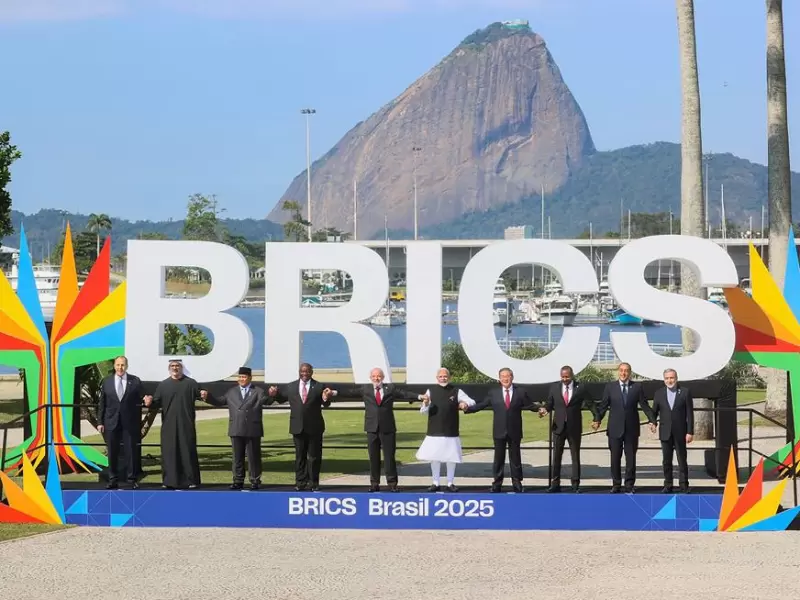 Indian Prime Minister Narendra Modi joins Russian Foreign Minister Sergey Lavrov, Crown Prince of Abu Dhabi Sheikh Khaled bin Mohamed bin Zayed Al Nahyan, Indonesian President Prabowo Subianto, South African President Cyril Ramaphosa, Brazilian President Luiz Inacio Lula da Silva, Chinese Premier Li Qiang, Ethiopian Prime Minister Abiy Ahmed, Egyptian Prime Minister Mostafa Madbouly and Iranian Foreign Minister Abbas Araghchi for the family photo before the 17th BRICS Summit in Rio de Janeiro, B / Courtesy: IANS/PMO
India's primary challenge lies in balancing its foreign policy priorities between the U.S. and BRICS, particularly as several members of the bloc are under increasing scrutiny from Washington.
While India views BRICS as a means to uphold the multilateral world order, other members, such as Russia and China, consider it a geostrategic tool to counterbalance the USA, a report detailed on Jan. 9.
According to a report in the India Narrative, India's current US policy, driven by national interest, differs from that of other BRIC members on this issue.
ALSO READ: EU and India say 'good progress' made towards trade deal
"Amid competing global interests, trade tensions, and the U.S.' tariff onslaught, India is assuming the BRICS presidency this year. During its presidency, India gets the chance to promote the interests of the ‘Global South’ via BRICS, endorsing the demand of the developing world for their ‘rightful place’ in the global financial system and greater voice in world affairs. India has traditionally championed this desire of the neglected world," the report detailed.
“Therefore, it supported strengthening the Global South Cooperation, underlining inclusive and sustainable growth and cooperation as mentioned in the 2025 BRICS Rio de Janeiro Declaration.
India has advocated for the 5 Cs for the Global South: consultation, cooperation, communication, creativity, and capacity building, to promote collective progress,” it added.
The report stated that India's BRICS presidency will focus on promoting multilateralism, with a commitment to reform and improve global governance to create a more just, equitable, effective, and accountable international and multilateral system.
“India underscores the importance of collaboration with diverse partners, showcasing initiatives such as the G20 Presidency, development partnerships, and alliances, including BRICS. Thus, Prime Minister Narendra Modi termed BRICS as India’s greatest strength in boosting confidence in promoting diversity and multipolarity via the platform, which will be a guide in navigating the world through the pressures it faces currently,” it mentioned.
The major challenge to India’s presidency, the report said, will be handling U.S. pressure and the resulting ripple effects within the group.
“The USA initially imposed a 50 percent tariff on India and Brazil, the highest among the BRICS members, triggering grievances in the group. Nevertheless, India avoids taking a confrontational approach with Washington over the issue, unlike Brazil, which threatened retaliation against the ‘tariff blackmail,’” it stated.
“Instead, New Delhi insists that BRICS members address their trade imbalances with New Delhi. Indeed, BRICS appears as an alternative for the non-Western world, relieving developing countries of the need to grovel to the West for economic assistance. It commensurates with India’s traditional policy of empowering the weaker lot in international affairs,” it further noted.
Discover more at New India Abroad.
Related





ADVERTISEMENT
ADVERTISEMENT
E Paper
Video

Comments
Start the conversation
Become a member of New India Abroad to start commenting.
Sign Up Now
Already have an account? Login