ADVERTISEMENT

ADVERTISEMENT



US Chamber of Commerce welcomes trade deal with India
The forum described the reduction of India’s reciprocal tariff from 25 per cent to 18 per cent as “an important and positive first step,” even as it noted that the details of the agreement are still to be finalised.
-
 IANS
IANS - Mon, 02, Feb 2026
- 22:43 EST
- 16
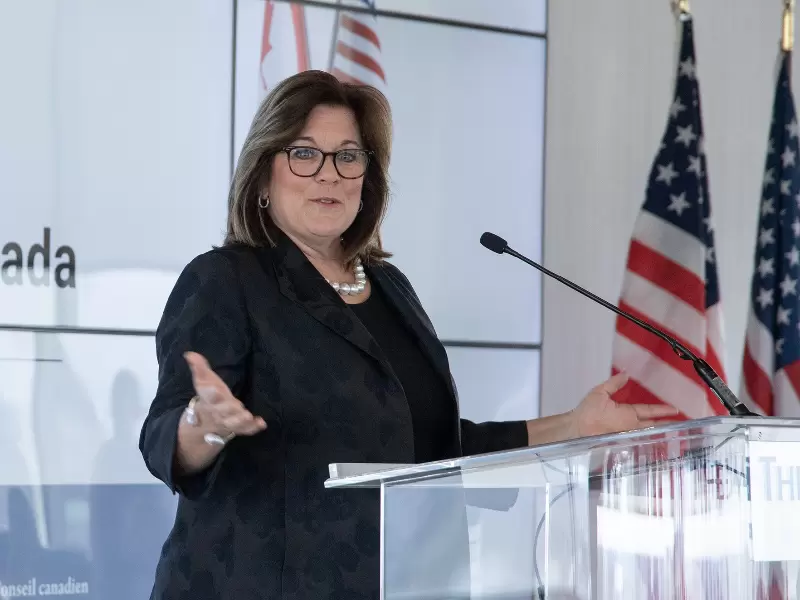 USC President and CEO Suzanne P. Clark / X/@SuzanneUSCC
The U.S. Chamber of Commerce welcomed the announcement of a trade deal between the United States and India, calling it a long-sought step for businesses in both countries.
U.S. Chamber of Commerce president and CEO Suzanne P. Clark said the announcement marked important momentum. “We congratulate the US and Indian governments on their announcement to reduce tariffs and non-tariff barriers that will benefit American and Indian companies and workers in both great nations,” Clark said.
She praised the leadership behind the effort. “We appreciate the efforts of President Trump and Prime Minister Modi, and their officials, including Ambassadors (Vinay) Kwatra and (Sergio) Gor,” she said.
Clark said the Chamber was optimistic the move would lead to more progress. “We are optimistic that this is the first step toward a comprehensive trade agreement that will unlock even more private sector collaboration,” she said, adding that the Chamber looks forward to reviewing the details.
ALSO READ: US lawmakers hail India-US trade deal as strategic reset
Clark said the Chamber and its U.S.-India Business Council strongly support the effort. “The Chamber, our U.S.-India Business Council, and our members are strong champions of this effort,” she said. “We look forward to partnering with both governments to implement today’s announcement.”
Clark traveled to Delhi and Mumbai last year and met Indian officials and business leaders. She had called for a trade deal and said the U.S.-India economic relationship is among the most consequential in the world. She said a deal would benefit both economies and global security.
Economist Steve Hanke offered a mixed reaction on social media. “In exchange for having its tariffs lowered, India commits to buying $500 billion worth of U.S. energy, technology, agriculture, and more,” Hanke wrote.
Hanke said tariffs remain a concern. “U.S. tariffs on India are still way too high,” he said. In a separate post, he noted that the United States would cut tariffs on Indian goods from 25 per cent to 18 per cent, and that India would stop buying Russian oil.
In a statement, USISPF said it “enthusiastically welcomes President Donald J. Trump’s announcement following his conversation with Prime Minister Narendra Modi, which reaffirms their shared commitment to deepen the U.S.–India economic partnership and advance a bilateral trade agreement.”
The forum described the reduction of India’s reciprocal tariff from 25 per cent to 18 per cent as “an important and positive first step,” even as it noted that the details of the agreement are still to be finalised.
“While the agreement’s specifics are pending, today’s announcement signals strong political will on both sides to move toward a comprehensive U.S.–India Bilateral Trade Agreement (BTA) that addresses tariffs, market access, non-tariff barriers, and other trade-related issues across a wide range of sectors,” the statement said.
According to USISPF, a bilateral trade agreement would “deliver meaningful benefits for businesses, workers, and consumers in both countries,” while also strengthening supply chains and improving overall economic resilience.
The forum emphasised that both governments have made clear that the announcement marks the beginning of a longer negotiating process.
“Both governments have made clear that this is only the beginning, with additional phases and negotiations anticipated in the months ahead,” USISPF said, adding that it was encouraged by the “constructive momentum” created by the latest announcement.
USISPF reiterated its commitment to working closely with both the Government of India and the U.S. Government to advance the shared objective of expanding bilateral trade toward the $500 billion target.
“A stronger U.S.–India trade and investment relationship is not only critical to both economies but also central to advancing a stable, resilient, and rules-based Indo-Pacific,” the statement said.
Discover more at New India Abroad.
Related






ADVERTISEMENT

ADVERTISEMENT
E Paper
Video

Comments
Start the conversation
Become a member of New India Abroad to start commenting.
Sign Up Now
Already have an account? Login