ADVERTISEMENT

ADVERTISEMENT



The Texas fuselage: Inside the U.S.-India Chamber’s AI Impact Summit 2026 in Austin
U.S.-India Chamber’s AI Impact Summit 2026 convened 250-plus leaders, spotlighting Texas as AI era’s foundation
-
 Gulshan Singh
 - Mon, 09, Feb 2026
- 07:29 EST
- 336
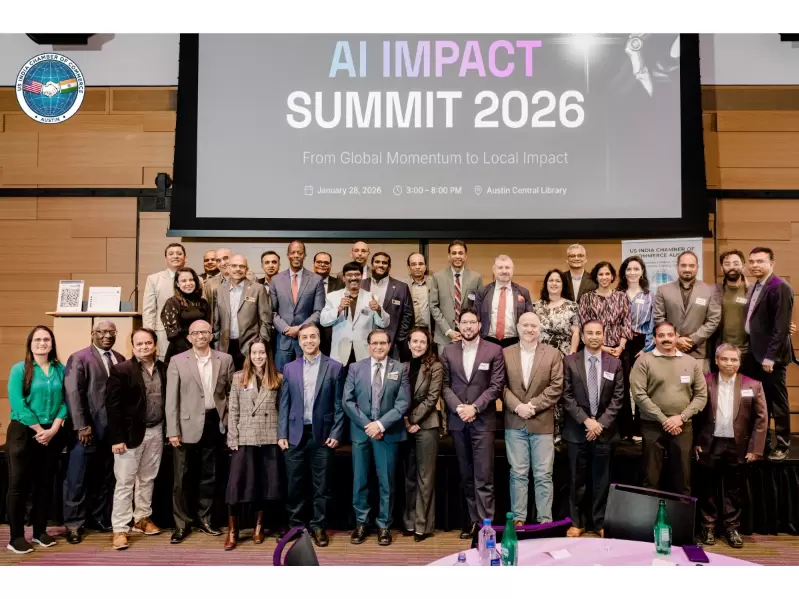 All speakers and board members at AI Summit in Austin. / Courtesy Photo
The air inside the Austin Public Library was thick with more than the aroma of tea and catered bites—it carried momentum. The third annual AI Impact Summit 2026 by the U.S.-India Chamber of Commerce Austin drew more than 250 enterprise executives, founders, investors and technologists for a half-day of high-impact conversations on AI, marking another year of steady growth for the convening.
As tech leaders from Silicon Valley, Minnesota and the burgeoning “Innovation Corridor” of Central Texas got together, the narrative was clear: the world has entered a new era, and Texas is the one building its foundation.
ALSO READ: A spectrum of tech leadership expected at upcoming India AI Summit
I. A Tale of Three Inflections
The day began with a sober yet electric reflection on history. Anupam Govil, chairman of the U.S.-India Chamber of Commerce Austin and managing partner of Avasant, framed the current moment as the third great wave of modern human advancement.
“We've lived through three revolutionary inflection points driven by technology: the internet age, the mobile explosion, and now the AI era,” Govil told the audience. “Each of those amplified our lives, our work, and our culture in many ways, but AI is going to have an even much bigger multiplying effect.”
This isn't just a local sentiment; it is backed by staggering global capital. Govil pointed to India’s $150 billion investment in AI infrastructure and Meta’s recent $125 billion commitment as proof that the “rocket ship” has already left the atmosphere. However, with this power comes a necessity for control. Govil offered a vivid metaphor for the entrepreneurs in the room: “AI is like a wild stallion in your ranch; if you tame it, it can be your best friend. Otherwise, it can be your worst enemy.”
II. The Accelerating Rocket Ship
If Govil provided the historical context, Vivek Mohindra, senior vice president at Dell Technologies, provided the velocity in the opening keynote. Mohindra, who also serves as an international spokesperson on AI for the U.S. Department of State, warned that the pace of change is no longer measured in years, but in days.
“The pace of change is so dramatic that a year ago, the best model that existed—there are over 30 models today which are better than the best model a year ago,” Mohindra noted, highlighting that even his own slides, just two months old, were becoming historical artifacts.
This acceleration is driving a “massive value shift” across the technology stack. Mohindra highlighted that AI has moved from a speculative “hype” cycle into a multidecade tailwind, expected to add $15 trillion to the global GDP by 2030. For the executives in the room, the message was urgent: staying on top of AI requires a “daily radar” because the “technical debt” of yesterday is being replaced by the “agentic workflows” of tomorrow.
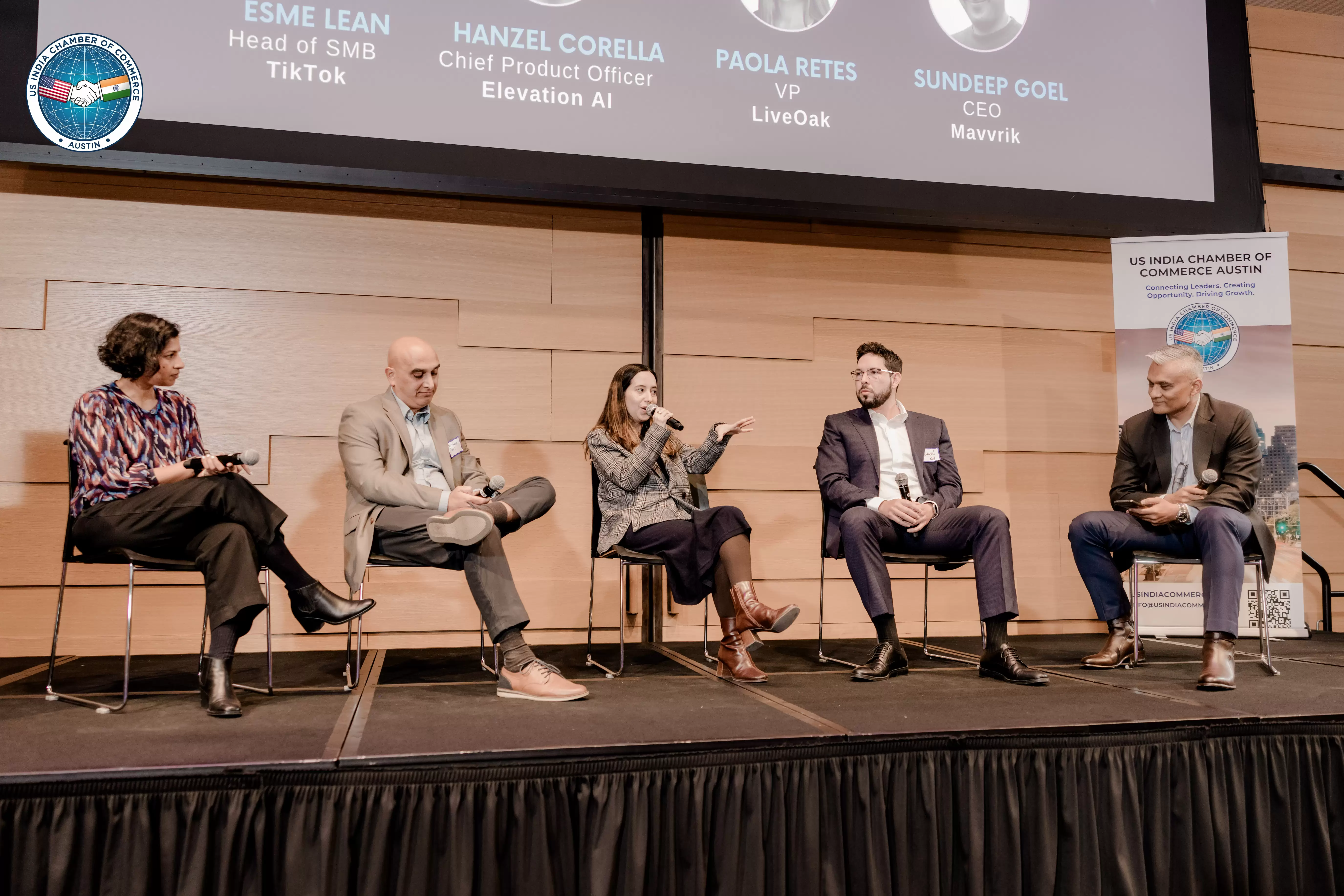
III. Why Texas Is the “Factory Floor”
While the intellectual “birthplace” of AI may be in the research labs of Silicon Valley, the summit participants were adamant that Texas has become the “ground zero” for its physical reality. The data tells a compelling story: while Virginia remains a leader, Texas has surged to 413 data centers, leaving California far behind.
Sunil Pal, head of AI GPU allocation at AMD, succinctly captured the geographical divide: “While we're looking at Bay Area for the lab for the AI, Texas is going to be the factory floor for the AI because of their expertise in manufacturing and deployment at scale.”
The reason for this migration is elemental: power, land and business-friendly regulation. Texas expects to need 40 gigawatts of additional power generation capacity by 2028 just to keep up with the demand of the AI industrial revolution. Vijay Reddy Pitta, founder and principal at Infrakey Capital, described the sheer scale of this build-out, noting that a single “AI factory” now requires 300 megawatts of power and billions in capital—infrastructure that Texas is uniquely positioned to provide due to its independent grid and abundance of space.
IV. Enterprise Reality: Out of the Lab
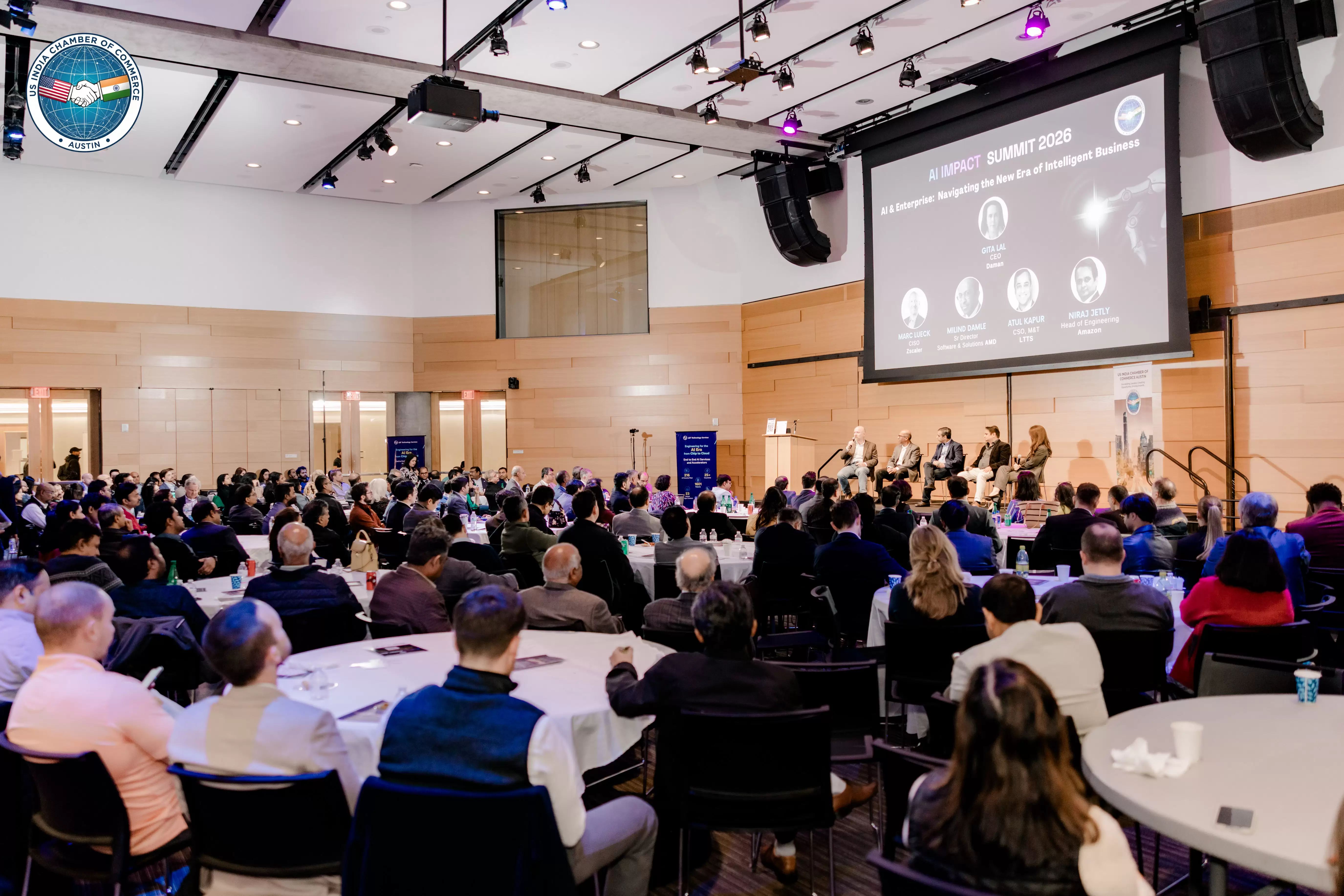
As the summit moved into its second panel, the focus shifted from infrastructure to implementation. The consensus among enterprise leaders like Neeraj Jetly of Amazon and Atul Kapoor of LTTS was that the “proof of concept” era is over. AI is no longer a “shiny ball” to be toyed with; it is a tool being integrated into the physical world, from predictive maintenance in manufacturing to digital twins for medical procedures.
However, this transition brings “nightmare scenarios” for security. Mark Lueck, CISO-in-residence at Zscaler, argued that security must now move at the speed of AI, shifting from protecting “systems” to governing a “workforce” of autonomous agents. “You should not be harming the business, your employees, your consumers, or society,” Lueck emphasized, stressing that guardrails must be embedded in the organizational DNA from day one.
The challenge for these legacy giants isn't necessarily the technology, but the “human element.” Leaders found that while technical debt can be solved with “wrappers,” the “risk aversion” of a workforce used to control rather than autonomous output remains a significant hurdle to reaching the goal of the “autonomous enterprise” by 2028.
V. The $1.4 Billion Benchmark
The summit’s narrative culminated in a fireside chat with Jeff Cotten, president and CEO of PROS, a Houston-based company that recently commanded a 41 percent premium in a $1.4 billion acquisition by Thoma Bravo. PROS, which began by developing neural networks for airline pricing in the 1990s, serves as a blueprint for what a “durable” AI company looks like.
Cotten’s advice for the entrepreneurs in the room was surgical. He didn't focus on broad AI hype but on specific, internal ROI. He overhauled PROS by deploying agents in four key areas: HR, IT infrastructure, customer support and code generation. The results were staggering—by the fourth quarter of 2025, 40 percent of all product code pushed by the company was generated by automated bots, allowing the firm to reach the “Rule of 40” profitability standards demanded by private equity.
“Private equity has learned the lesson the hard way... they are very much going after vertical solutions,” Cotten explained, noting that the “defensive moats” of the future are built on vertical domain expertise that general-purpose models cannot replicate.
ALSO READ: Seattle University hosts briefing on India AI Summit
VI. Conclusion: Building the Fuselage
The U.S.-India Chamber of Commerce’s summit made one thing undeniable: the bridge between global tech talent and Texas capital is stronger than ever. With a network of 5,000 members in Texas alone, the chamber is positioning the state not just as a participant, but as the primary builder of the AI era.
As the sun set over the Austin skyline, Anupam Govil closed the event with a final, resonant metaphor for the state’s role in the national conversation.
“While AI may have had its birthplace in Silicon Valley, I think Texas is where it's going to find its real-world use,” Govil concluded. “AI is the jet engine, the infrastructure, and the models. But you need the fuselage—the actual body that takes it somewhere. And that’s going to be built here in Texas.”
For the leaders at the AI Impact Summit, the message was clear: the engine is roaring, the fuel is being poured, and Texas is ready for takeoff.
Discover more on NewIndiaAbroad
Related





ADVERTISEMENT

ADVERTISEMENT
E Paper
Video

Comments
Start the conversation
Become a member of New India Abroad to start commenting.
Sign Up Now
Already have an account? Login