ADVERTISEMENT
ADVERTISEMENT



The story of Barak Morag: From survival to resilience
Barak describes himself as a father, a refugee, and a storyteller whose stories of resilience and survival brought him to the U.S. from Israel.
-
 Avatans Kumar
 - Tue, 05, May 2026
- 01:04 EDT
- 20
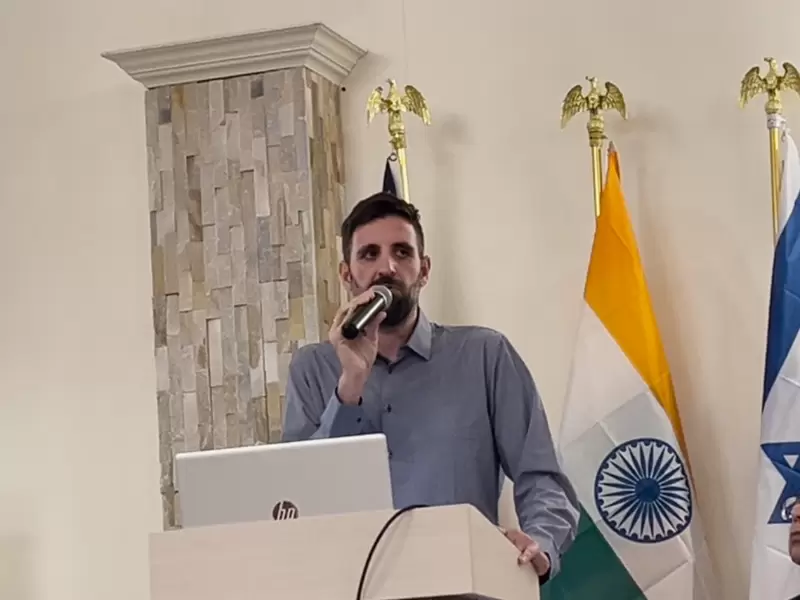 Barak Morag at the event / Avatans Kumar
The resilience of the Jewish community is not just admirable; it is remarkable. It is worth emulating.
Barak Morag is one such Jew. His resilience in the face of death, devastation, and horrors is awe-inspiring. He also exemplifies, par excellence, the adage: “When life gives you lemons, make lemonade.”
I met Barak Morag last December at Kibbutz Nir Oz in Israel, where he had built a joyful life with his wife Ziv and their two children, Gaya and Itamar. On October 7, 2023, Hamas terrorists shattered that normalcy, storming the kibbutz and killing and abducting residents—women, children, and senior citizens. Now, two years later, Barak stood amid the rubble of what was once his home, his voice flat as he recounted the nightmare to a group of strangers.
As Barak calmly shared his story with a U.S. delegation, his poise contrasted sharply with the sadness in his eyes.
On October 7, at 6:30 am, terrorists stormed the fence of Barak’s kibbutz. It was a coordinated attack. Sirens wailed. Barak, Ziv, and their children raced to their safe room and locked themselves inside. For hours, they clung to each other in darkness. Hamas gunmen killed residents and torched homes. Smoke crept under their door as flames consumed nearby houses. Through the walls, they heard voices. Some spoke flawless Hebrew, trying to coax terrified families into the open.
ALSO READ: Israel rejects international diktats on Palestinian statehood
Nir Oz suffered deeply that day. Nearly a third of residents were killed or taken hostage, and homes were destroyed. But Barak decided not to play a victim but inspire people with his story. Barak began sharing his family's story in his talk, “Choosing Life: From Survival to Resilience,” which explores loss and grief while also highlighting hope and the community's determination to rebuild.
“How do you do it?” I asked him. “How do you live through the trauma of retelling your story?” Barak stared in the blank and then looked down at me (he is a tall, about 6’ guy), and said to me that retelling his story is therapeutic to him. He does not go to therapist for counselling.
Barak and his family joined healing initiatives, such as Hug for Hope, seeking solace while mourning their loss. Welcomed by Canadian host families, they found a sense of safety. Now, as he travels widely, Barak shares their journey—his voice trembling with emotion as he honors cherished loved ones and inspires resilience through his firsthand account.
Today, Barak calls himself a father, a refugee, and a storyteller. Stories of resilience and survival brought him to the U.S.. He was sharing his stories in may cities, including in Chicago, where he was a guest of the Global Indian Diaspora Foundation, a Chicago-based nonprofit dedicated to fostering stronger ties between the Indian diaspora and the global community through cultural exchange, dialogue, and collaborative initiatives. According to founding president Rakesh Malhotra, the Foundation “remains committed to advancing understanding, promoting shared values, and creating platforms for meaningful engagement.”
A multi-faith gathering in Chicago welcomed Barak. People from many community came to hear Barak’s story.
The evening began with remarks from Somnath Ghosh, Consul General of India in Chicago.
Ghosh reminded the audience of Swami Vivekananda’s historic 1893 address at the Parliament of Religions. There, Swamiji highlighted India’s long-standing tradition of offering refuge and acceptance to persecuted communities, including Jewish populations over the centuries. He emphasized that this enduring ethos continues to unite communities today.
Delphine Gamburg, Deputy Consul General of Israel, shared reflections from her visit to Kibbutz Nir Oz with Indian community leaders. She described the devastation witnessed firsthand. She also spoke about the importance of global solidarity.
Many delegation members who had visited Israel were present, adding to the sense of shared experience.
(The author is a recipient of the California New Publishers Association and the San Francisco Press Club’s journalism awards)
(The views and opinions expressed in this article are those of the author and do not necessarily reflect the official policy or position of New India Abroad.)
Discover more stories on New India Abroad.
Related







ADVERTISEMENT

ADVERTISEMENT
E Paper
Video

Comments
Start the conversation
Become a member of New India Abroad to start commenting.
Sign Up Now
Already have an account? Login