ADVERTISEMENT
ADVERTISEMENT


The significance of authentic historical knowledge
Authentic knowledge about India helps Americans of all backgrounds
-
 Amitabh Sharma
 - Wed, 05, Aug 2026
- 12:33 EDT
- 27
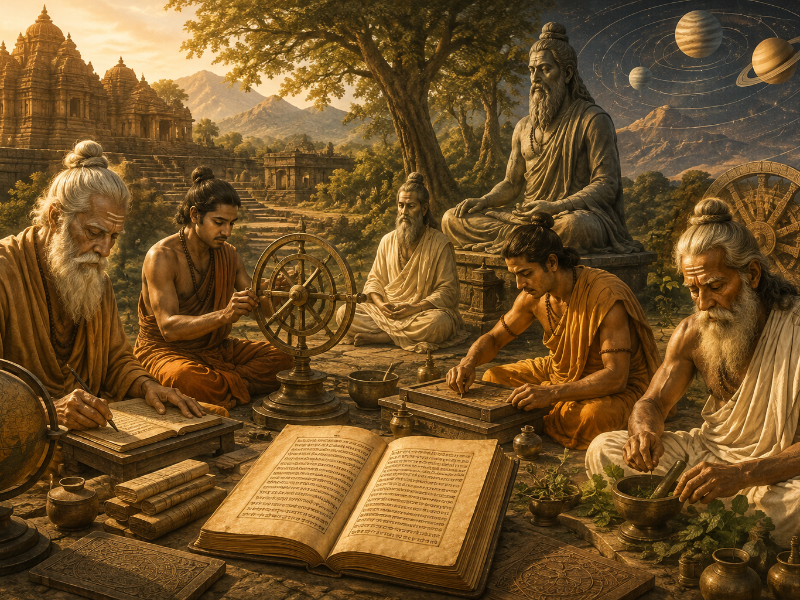 Representative Image / Generated using AI
Authentic historical knowledge is not just about remembering dates, kings, or battles. It’s about heritage, identity, dignity, pride and the ability to participate confidently in a multicultural society without being misunderstood or misrepresented.
For Indian Americans—especially second-generation youth—and for the broader American community that interacts with them, understanding India’s real civilizational story is essential to preventing stereotypes, miseducation, and the rise of dismissive attitudes sometimes labeled as “India-phobia” or “wokeism against Indian traditions.”
This isn’t about politics. It’s about cultural literacy, historical accuracy, and mutual respect.
India’s Civilizational Depth Is Often Underrepresented
India is one of the world’s oldest continuous civilizations, with contributions spanning mathematics, astronomy, medicine, philosophy, linguistics, architecture, and governance. Yet, mainstream narratives, even school text books, in the West often compress India’s history into a few centuries of colonial rule or portray it through oversimplified stereotypes.
When young Indian Americans grow up hearing only fragments of their heritage—sometimes filtered through outdated colonial lenses—they may internalize a sense of cultural inferiority or confusion about their roots. Meanwhile, non-Indian peers may form opinions based on incomplete or inaccurate portrayals.
Authentic history restores balance.
Why Accurate Knowledge Matters for the Second Generation
Second-generation Indian Americans often navigate dual identities. Without a clear understanding of India’s civilizational achievements and cultural philosophies, they may:
-
Feel disconnected from their heritage
-
Become vulnerable to misinformed narratives about India
-
Struggle to explain their traditions to peers
-
Experience cultural shame or hesitation
-
Lose access to the confidence that comes from knowing one’s roots
Authentic history empowers them to speak with clarity, pride, and nuance.
Why It Matters for the Indian Diaspora
The diaspora plays a crucial role in shaping global perceptions of India. When diaspora communities themselves lack historical grounding, they may unintentionally reinforce stereotypes or fail to challenge misinformation.
Accurate historical knowledge helps the diaspora:
-
Represent India responsibly
-
Correct misconceptions in academic or social spaces
-
Preserve traditions without feeling defensive
-
Engage confidently in multicultural dialogues
-
Pass on a strong cultural foundation to future generations
Why It Matters for America’s Multiethnic Community
The United States thrives on diversity. But diversity without understanding can lead to friction, caricatures, or cultural misunderstandings.
Authentic knowledge about India helps Americans of all backgrounds:
-
Appreciate India’s contributions to global civilization
-
Understand the philosophical roots of yoga, meditation, Ayurveda, and classical arts
-
Recognize the diversity within India itself—languages, religions, cuisines, and regional cultures
-
Avoid unintentionally disrespectful interpretations of Indian traditions
-
Build healthier cross-cultural relationships
When people know better, they do better….and interact with respect and amity
How Misrepresentation Leads to “India-phobia” or Cultural Dismissal
Misunderstanding breeds fear, mockery, or dismissal. Examples include:
-
Treating Indian traditions as “exotic,” “primitive,” or “superstitious”
-
Oversimplifying complex philosophies like dharma, karma, or yoga
-
Viewing Indian culture only through caste stereotypes
-
Assuming India’s modern identity is defined solely by poverty or politics
-
Using “woke” frameworks that flatten Indian traditions into caricatures
-
Misinterpretation of Indian religious and traditional symbols like Swastika
Authentic history counters these tendencies by showing India’s intellectual sophistication, pluralism, and resilience.
What Authentic Historical Education Should Include
A balanced, respectful understanding of India should highlight:
-
India’s ancient universities (Takshashila, Nalanda)
-
Contributions to mathematics (zero, binary, algebra, trigonometry)
-
Advances in surgery and medicine (Sushruta, Charaka)
-
Philosophical schools (Vedanta, Buddhism, Jainism, Yoga)
-
Linguistic achievements (Sanskrit grammar, Panini)
-
Architectural marvels (temples, stepwells, forts)
-
India’s pluralistic inclusive ethos across millennia
-
The impact of colonial distortions on historical narratives
-
India’s modern scientific, economic, and cultural achievements
This is not about glorification…it’s about accuracy.
Building Bridges Through Knowledge
Authentic historical education creates:
-
Confidence for Indian youth
-
Respect from non-Indian peers
-
Nuanced dialogue in multicultural spaces
-
Protection against stereotypes and cultural erasure
-
A shared foundation for cross-community understanding
-
Empathy amongst policy makers, media, academia
-
Strong Indo-American strategic relationship based on equality and mutual faith
When communities understand each other’s histories, they build stronger, more empathetic societies.
A Final Thought
India’s story is vast, complex, and beautiful. When it is told truthfully, it enriches everyone—Indians and non-Indians alike. Authentic historical knowledge is not a luxury; it is a necessity for cultural harmony, identity formation, and mutual respect in America’s multiethnic landscape.
(The views and opinions expressed in this article are those of the author and do not necessarily reflect the official policy or position of New India Abroad.)
Discover more at New India Abroad
Leave A Comment
Related






ADVERTISEMENT

ADVERTISEMENT
E Paper
Video

Comments
Start the conversation
Become a member of New India Abroad to start commenting.
Sign Up Now
Already have an account? Login