ADVERTISEMENT

ADVERTISEMENT



The Persian cycle: A scientific and philosophical look at the limits of progress
Understanding the cyclical nature of civilizations is more than an academic exercise; it is a necessity for modern policymaking.
-
 Pradeep B. Deshpande
 - Tue, 24, Mar 2026
- 17:41 EDT
- 46
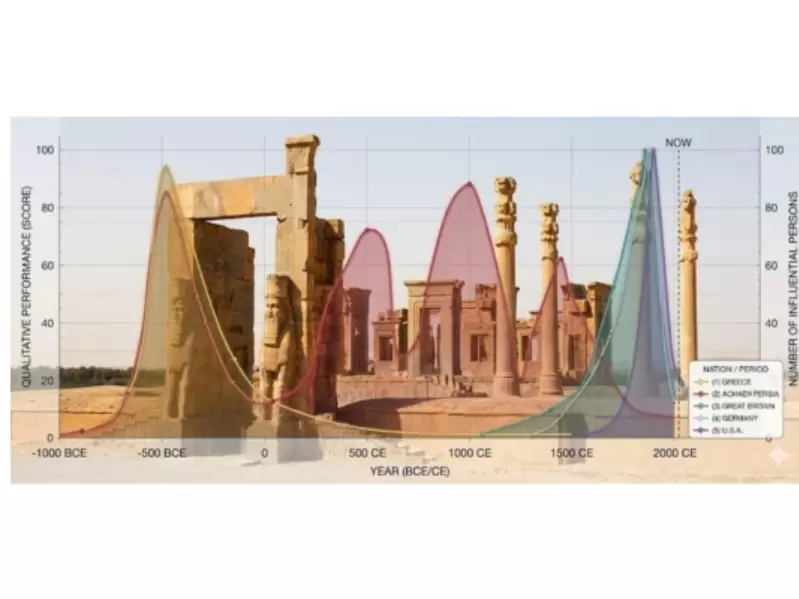 Rise and Decline of Civilizations / Generated using AI
The rise and decline of civilizations is one of the most persistent and haunting patterns in human history. From the towering heights of ancient Persia and Greece to the modern hegemony of global powers, societies appear to pass through inevitable cycles of growth, achievement, stagnation, and eventual decay.
While historians have long chronicled these shifts, surprisingly little effort has been made to examine whether this phenomenon can be studied through a scientific lens.
In the 1980s, my colleague the late Phoebus M. Christopher and I began exploring this question by searching for measurable evidence of civilizational cycles. We faced two primary challenges: first, to find empirical evidence of these fluctuations, and second, to demonstrate that the phenomenon is truly cyclical rather than a series of isolated events.
Measuring the Pulse of History
To address the first challenge, we turned to the biographical records of the Encyclopedia Britannica. We reasoned that the frequency of "influential persons" produced by a nation—individuals who made significant contributions to science, art, governance, philosophy, etc.—served as a reliable proxy for that nation’s qualitative performance.
Also Read: The legacy of H. Charles Grawemeyer: A scientific blueprint for world peace
Phoebus, being of Greek ancestry, chose to investigate Greece first using his 23-volume 1991 edition of the Britannica. By plotting the birth dates of listed individuals, a clear bell curve emerged, revealing the rise and decline of Greek influence.
With the assistance of graduate students Bharat Sanghavi and Sandeep Dronawat, we expanded this data to include Great Britain, Germany, and the United States. In each instance, the data revealed a distinct trajectory of ascent followed by a measurable decline in the production of influential figures. The plots in the article, On the Cyclical Nature of Excellence, provide additional details.
The second challenge—cyclicity—is perhaps best illustrated by the natural world. I often use the example of the hills surrounding San Francisco. In the summer, they are a parched, golden brown; however, when the December rains arrive, patches of green appear. Within months, the hills are lush, only for the cycle to reverse as summer returns.
I posit that civilizations operate on similar, albeit much longer, cycles. By the mid-1980s, I began to see "patches of green" returning to India and China—nations that had declined after making profound contributions thousands of years ago but were now clearly destined to reemerge.
The Case of Persia: Grandeur, Transition, and Modern Turmoil
The rise and decline of Persia serves as a poignant and critical example of this theory. As shown in the plot above, Persian civilization reached an extraordinary zenith during the Achaemenid Empire (c. 550–330 BCE). Under leaders like Cyrus the Great and Darius I, Persia was not merely a military superpower; it was a beacon of administrative and cultural excellence. It introduced the world to the first postal system, a standardized currency, and a model of governance that respected the diverse customs and religions of its conquered subjects.
However, the data reveals a subsequent decline in qualitative performance over the following centuries. This decline is not merely a matter of lost battles or changing borders; it represents a shift in the underlying societal "excellence".
In the ancient period, the "Sattva" (S) component—characterized by truthfulness, clarity, and equanimity—was high, allowing for the creation of stable, prosperous systems. As the cycle progressed, the "Rajas" (R) and "Tamas" (T) components—ambition, ego, greed, and deception—became more dominant.
This historical perspective is particularly relevant today as the world watches the ongoing tensions and conflicts involving modern-day Iran. When a nation is in a decline phase of its cycle, the R and T components are often predominant in the collective mindset. In such an environment, external attempts to introduce systems like democracy frequently fail to yield expected results.
Without a sufficiently high level of internal "Sattva" within the population, democratic institutions can become hollow shells, unable to guarantee peace or success. We have seen this play out not only in the Middle East but also in Vietnam and Afghanistan.
The Philosophical Framework: Sattva, Rajas, and Tamas
The scientific data we gathered eventually found a conceptual anchor in the ancient wisdom of the Bhagavad Gita. The scripture explains that the human mindset is composed of three Gunas or components:
-
Sattva (S): Truthfulness, honesty, clarity, and equanimity.
-
Rajas (R): Ambition, attachment, bravery, ego, and greed.
-
Tamas (T): Deception, inertia, ignorance, and the causing of injury.
The relative dominance of these three components within a population influences the repeated rise and decline of civilizations. During periods of rise, the S component is high, leading to innovation and social cohesion. When R and T become excessive, the society loses its internal excellence, and decline becomes inevitable.
This framework suggests that the "health" of a civilization is a direct reflection of the collective consciousness of its people. I explored this framework in my award-winning 2025 article, A Chemical Engineer Learns New Lessons from the Bhagavad Gita.
Toward a New Realism in Global Affairs
Understanding the cyclical nature of civilizations is more than an academic exercise; it is a necessity for modern policymaking. By recognizing that nations like Persia/Iran are currently navigating specific phases of a long-term cycle, we can become more realistic about the progress we expect to see.
We must remain vigilant, understanding that "internal excellence" cannot be imported or forced via external institutions; it must be cultivated from within as the cycle eventually turns toward a new "spring".
Ultimately, the study of these cycles offers a message of both caution and hope. While it warns us of the inevitable decline that follows excessive ego and greed, it also reminds us that no decline is permanent. Just as the hills of San Francisco inevitably turn green again, civilizations that have fallen into shadow possess the inherent potential for reemergence.
By integrating the empirical data of history with the timeless wisdom of human consciousness, we can work toward a more peaceful world, grounded in the pursuit of perfection and a deeper understanding of our shared human journey.
Discover more at New India Abroad.
Related











ADVERTISEMENT

ADVERTISEMENT
E Paper
Video

Comments
Start the conversation
Become a member of New India Abroad to start commenting.
Sign Up Now
Already have an account? Login