ADVERTISEMENT
ADVERTISEMENT



Silencing the sentinels: Bangladesh’s war on journalism that exposes Islamic terrorism
Much of this has to do with Bangladesh’s lack of a democratic setup, which created the preconditions for a weak free press after long decades of military rule.
-
1744362597.jpeg) Arun Anand
Arun Anand - Wed, 15, Jul 2026
- 17:42 EDT
- 20
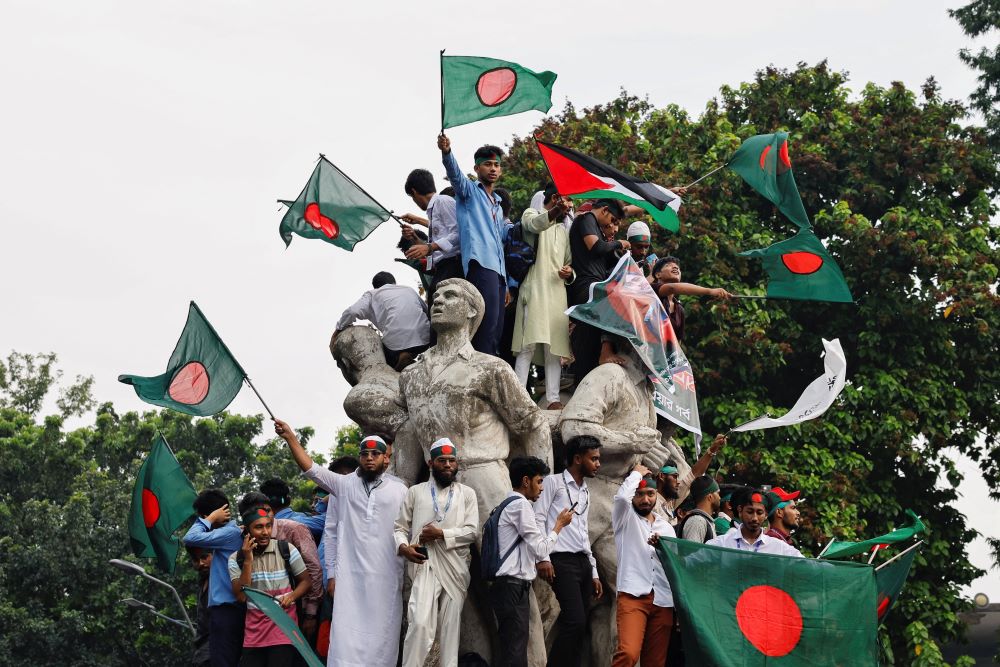 Students against discrimination wave flags by standing on top of Raju Memorial Sculpture as they join in a rally to mark one month of the end of Awami League regime, at the University of Dhaka, in Dhaka, Bangladesh, September 5, 2024. / REUTERS/Mohammad Ponir Hossain
Bangladesh’s journalism remains under a cycle of surveillance, censorship, legal harassment and repeated crackdowns on independent journalism.
Bangladesh is ranked 152 out of 180 countries in the World Press Freedom Index (2026) by Reporters Without Borders, slipping three places from the previous year and classified as “very serious”. Despite the dawn of “new democracy” in Bangladesh, the country’s press, a core component of a functioning democracy, seems to remain under continuous pressure.
Much of this has to do with Bangladesh’s lack of a democratic setup, which created the preconditions for a weak free press after long decades of military rule.
Historically, legal framing coupled with government control kept journalism under censorship and surveillance. The democratic transition after the 1990s anti-Ershad movement expanded journalism and loosened direct state control. The rise of independent journalism acted as a cognitive radar of democracy to detect early signs of radicalisation in the country.
Successive governments since the early 2000s, however, treated such reporting as a legitimate threat rather than a democratic sentinel. They reacted through containment—relying on censorship, increased surveillance, physical intimidation, and punitive measures such as revoking press credentials, arrests, and criminal defamation and sedition charges on journalists and editors.
The case of journalist Salah Uddin Shoaib Choudhury is significant, as his reporting on Islamic fundamentalism in Bangladesh, especially madrasa networks as centres of radicalisation, led to his arrest in 2003 under charges of sedition, treason and blasphemy, and he was sentenced to seven years of imprisonment in 2014.
Recently, prominent Bangladeshi journalist, editor, and publisher Salah Uddin Shoaib Choudhury, known for his investigative journalism, posted on his X account that, despite a U.S. congressional resolution calling for an end to the harassment and intimidation against him, he continues to face persecution from the Bangladeshi government. He wrote:
“While US House Resolution HR-64/2007 stated: ‘(3) the Government of Bangladesh should cease harassment and intimidation of Mr. Choudhury and take steps to protect Mr. Choudhury,’ why have the Bangladesh authorities been doing just the opposite?”
This underscores the persistent threats, harassment, and persecution he continues to face for exposing radicalism and extremism, despite international calls for his protection, and highlights the increasingly hostile environment confronting those who dare to speak the truth.
Targeted for Exposing Extremists
The harassment and intimidation against Choudhury intensified after his newspaper, Blitz, published an investigative report on July 28, 2025, titled “Terror Without Borders: Rising ISI-Backed Radicalisation in Nepal.”
The report detailed how Pakistan’s Inter-Services Intelligence (ISI) was expanding its influence and promoting radicalisation in Nepal through extremist-linked. Choudhury has played an important role in exposing the nefarious designs of organisations that portray themselves as NGOs engaged in humanitarian work and assistance to the needy but allegedly function as recruitment and indoctrination centres promoting extremism.
It is reported that, following the publication of this report, Engineer Nasir Uddin, Founder and Chairman of ASH Foundation, reportedly associated with controversial cleric Mufti Harun Izhar, who has been accused of links with the Pakistan-based terrorist group Lashkar-e-Taiba, telephoned Choudhury and allegedly used abusive language, accusing him of being “paid by Israel” to publish the story.
At present, he is also facing threats after recently writing an article, “Hamas Expands Footprint in Bangladesh and South Asia,” published on June 22, 2026, about the possibility of Hamas-linked networks expanding their influence into Bangladesh.
Following public remarks by Israel’s Ambassador to India, Reuven Azar, warning of Hamas’s growing footprint in South Asia, Choudhury urged the Bangladeshi authorities to take the threat seriously. However, what followed, according to Choudhury, was painfully familiar. An orchestrated social media campaign branded him a “Mossad agent,” and the digital intimidation soon assumed a physical dimension.
He has also reportedly been facing threats from Syed Ziaul Haque, alias Major Zia, a former Bangladeshi Army officer and now the leader of Ansar al-Islam, the Bangladesh wing of Al-Qaeda, which has connections with Jamaat-ul-Mujahideen Bangladesh (JMB), Al-Qaeda in the Indian Subcontinent (AQIS), and even ISIS.
Major Zia has been linked to the targeted killings of several secular writers and activists, including prominent writer Avijit Roy; publisher Faisal Arefin Dipan; blogger Niladri Chattopadhyay Niloy (Niloy Neel); LGBTQ+ rights activist and editor Xulhaz Mannan; and bloggers Ahmed Rajib Haider and Washiqur Rahman, who were systematically tracked and killed by sword- and machete-wielding hit squads allegedly operating under his direct operational command. He has also reportedly played a role in exporting terrorism and radicalisation to India.
Shoaib Choudhury has been instrumental in exposing such radical elements, their nefarious designs, and networks involved in promoting extremist financing across the region through his courageous journalism. Despite sustained intimidation and repeated threats, he has never bowed before such forces.
This has also been the experience of many journalists in Bangladesh who stand for the truth. Various labels have been used against Choudhury, such as “Mossad agent” and “enemy of Islam,” to orchestrate campaigns against him, brand and demonise him, and discredit his work. Radical Islamist elements have repeatedly employed these labels to target and intimidate him.
The Committee to Protect Journalists reports are important to understand this pattern. They noted the imprisonment and persecution of a Bangladeshi journalist for his coverage of anti-Hindu violence and the government’s harsh reaction to reports on sectarian violence and the influence of militant Islamists.
They also documented pressure from Islamic groups, which threatened and attacked secular journalists, accusing them of blasphemy for their coverage of religious extremism. The arrest of a cartoonist in 2008 for “hurting religious sentiment,” increasing arrests of secular bloggers in 2013 over the same allegation reflected the growing tussle between journalists and Islamists, with security forces often resorting to detention of bloggers on charges of “offending Muslims.”
The legal framework deepened impunity for press suppression. Section 57 of Bangladesh’s ICT Act of 2006 drew widespread criticism for stifling freedom of expression, as its vague wording allowed prosecution for criticism of the government, attacks on religious sentiment, and online content deemed defamatory, obscene, fake, or harmful to public order.
Human Rights Watch documented that after the law was amended in 2013, police used it to make arrests without warrants, and by April 2018 the cyber tribunal had received 1,271 charge sheets under Section 57. The Digital Security Act (2018) carried forward many of these problematic provisions, and CPJ documented its use to intimidate journalists such as Adhora Yeasmean, who exposed alleged crimes by a conservative Islamic organisation and one of its leaders.
Amnesty International said the CyberSecurity Act of 2023, likewise, retained repressive features of the DSA.
The interim government, despite promises of press freedom under Cyber Protection Ordinance, carried on the same tradition of cracking down on media reports on extremism, continuing press self-censorship and fear through revocation of press accreditations and arrests of journalists under the Anti-Terrorism Act.
The International Federation of Journalists (IFJ) reported on how the body of a journalist was recovered following threats and intimidation from the interim government for reporting on alleged extremist involvement in the July Uprising. Transparency International Bangladesh, too, noted the silence of the interim government during the extremists’ attacks on Bangladesh’s two leading media outlets—Prothom Alo and Daily Star last December.
The legal challenges inevitably create a civic ecosystem where Bangladesh state’s operational military success on counterterrorism (as noted after 2016) gets dismantled when independent scrutiny is destroyed.
The same counter militancy campaigns also showed a systemic curtailment of freedom of expression through persistent pressure on journalism, weaponizing security laws against journalists. The UNDP/UNESCO assessment (2025) report is significant in noting restrictive laws, weak institutional independence, and serious safety risks limiting media freedom and pluralism.
Diplomatic interventions on press freedom in South Asia, mainly in the form of international documentation and coalition pressure have formed a safety framework (and solidarity) for journalists and state accountability of press freedom stronger.
The IFJ, besides UNESCO, has been a crucial watchdog and advocacy network for Bangladesh’s journalists and press freedom, that made Bangladesh’s backsliding press freedom under international scrutiny and long-term demand for press reform in the state stronger.
Tactical victories against terrorism are not the same as durable security governance. When ideology dictates security posture, it leads to a long-term paralysis if not collapse of institutional judgment, as seen in case of Pakistan where security narratives have translated independent journalism into an existential security threat, paving way for shrinking press freedom, surveillance, censorship and legal coercion.
Independent journalists function as the state’s most effective early-warning system against radicalisation, terror financing and extremist recruitment. When the state allows these voices to be silenced to appease domestic political elements, it actively harms its own long-term counter-extremism victories. Indeed, extremism tends to thrive in an environment where criticisms are disallowed.
(The views and opinions expressed in this article are those of the author and do not necessarily reflect the official policy or position of New India Abroad.)
Discover more at New India Abroad.
Leave A Comment
Related






ADVERTISEMENT

ADVERTISEMENT
E Paper
Video

Comments
Start the conversation
Become a member of New India Abroad to start commenting.
Sign Up Now
Already have an account? Login