ADVERTISEMENT
ADVERTISEMENT



'Robust laws in place,' says MEA as White House report identifies India as biggest 'enabler of China'
The report comes even as India and the US are negotiating a bilateral trade deal
-
 Shikha Salaria
 - Fri, 14, Aug 2026
- 17:10 EDT
- 31
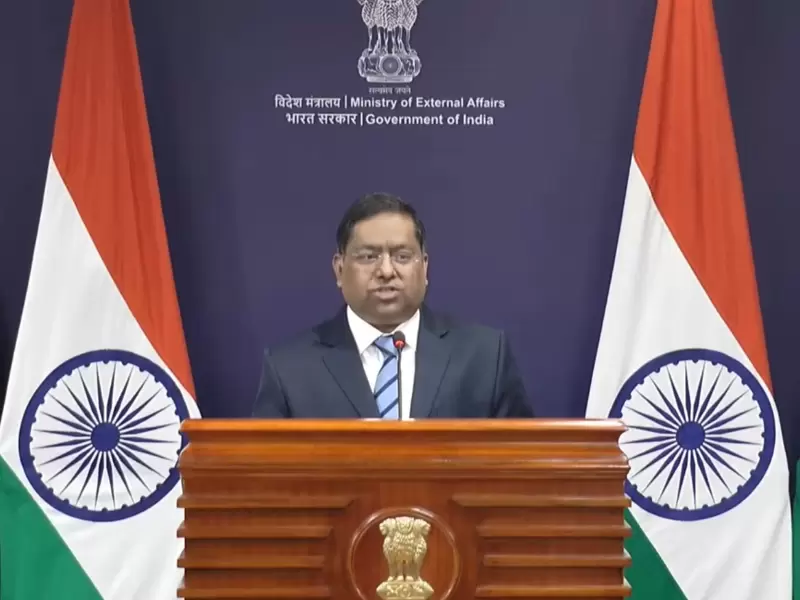 MEA Spokesperson Randhir Jaiswal / Video grab courtesy: MEA
India on Aug. 14 said that it is studying the latest White House report that accuses over 40 countries including India, of allegedly dodging US tariffs and helping China by transshipping goods through those countries.
The report "The Great Transshipment Scam," shared by Peter Navarro, senior counsellor for Trade and Manufacturing in the US administration accuses lower-tariff countries of helping provide Chinese products with access to the US market and benefiting from "serving as a production, processing, warehousing, or logistics intermediary for higher-tariff countries."
Also Read: Half of Americans have unfavorable view of India: Pew
"We have seen some reports on this particular matter, we would like to study the findings and methodology that has been adopted in detail. As you know, we have robust laws in place for procedures, rules of origin, exports of products and any instances of violation that may be there, are dealt with in accordance to law," Randhir Jaiswal, spokesperson for the Ministry of External Affairs said on Aug. 14 when asked about the report that specifically names India as "one of the major enablers of China."
The report comes even as India and the US are negotiating a bilateral trade deal for which the two countries have failed to sign despite discussions on the topic going on for the past one and half year and even as the ties between the two countries have gone through a rocky phase due to the tariffs imposed by the US President Donald Trump whose regime has kept changing ever since April 2, 2025 when Trump first announced that tariffs would be levied against India.
Chinese products subject to higher tariffs moving through lower-tariff countries: Report
According to the report prepared by Navarro's office, on July 6, 2018, President Trump "imposed historic tariffs under Section 301 of the Trade Act of 1974 to defend American jobs and factories against Chinese predation, force Beijing to reform its mercantilist system, and reverse this China Shock."
"These 301 tariffs covered nearly 70 per cent of Chinese exports to the US (roughly USD 370 billion in goods) and marked the first serious challenge in decades to China’s predatory trade model. While the Trump tariffs significantly reduced the direct US trade deficit with China, Beijing and its exporters quickly adapted to try to mitigate this. Many Chinese products subject to higher tariffs that once moved directly from Chinese ports to the US began to move through lower-tariff countries in a phenomenon known as the Great Reallocation," the report alleged.
Explaining what it meant by the 'Shadow Transshipment Network,' the report states that "China began using these third countries for minor processing, relabeling, repackaging, reinvoicing, or routing changes that created the appearance of a new national origin while leaving the underlying Chinese content largely intact. By routing around the tariffs, China and its state -supported manufacturers and trading firms could push goods into jurisdictions with cheap labour, weak customs oversight, permissive free zones, or preferential US trade access," it notes.
"Over time, these lower-tariff countries, which number more than 40 today, became the launchpads and hubs of a new evasion architecture: products made largely in China, lightly touched abroad, and exported to America under new identities. This Great Reallocation represents the creation of a new profit system. Tariff penalties redirected China-linked goods away from direct shipment and toward third-country channels where the gap between high US tariffs on China and lower US tariffs on third countries could be captured, divided, and reinvested. That spread became the financial engine of what would quickly emerge as a global Shadow Transshipment Network," the report alleges.
"Following the imposition of Section 301 tariffs in 2018, the direct US trade deficit with China fell in 2019 and 2020. Even today, imports of a number of Chinese products subject to these original duties, like electric vehicles, are much lower in the US than in places like the European Union. But the overall success of these tariffs co-exists with the abuse, by exporters, of the tariff differentials that they contribute to. After their imposition, Chinese exporters increasingly routed goods through third countries," the report states.
It adds that products that previously moved directly from China to the US were shipped through jurisdictions where limited assembly, finishing, repackaging, relabeling, or documentation changes could create the appearance of a different national origin.
"Over time, these practices contributed to the development of a global network of production hubs, logistics platforms, free trade zones, bonded warehouses, processing corridors, and re-export centers," it states.
Over 40 countries association with elevated risk
The report identifies "more than 40 countries associated with elevated illegal transshipment risk."
"These jurisdictions vary significantly in economic scale and function. Some are major trading partners with diversified industrial bases and large volumes of overall commerce. Others are closely integrated into China-linked production and supply networks. A third group consists of smaller jurisdictions that offer specific advantages, including low labour costs, permissive free-zone rules, strategic port access, bonded warehousing, limited customs capacity, niche assembly operations, or preferential access to the US market. The network operates through both production-side and logistics-side channels. Production-side nodes may perform light assembly, finishing, testing, packaging, labeling, inspection, or component integration before export to the US. Logistics-side nodes may primarily provide routing, consolidation, warehousing, re-invoicing, relabeling, or new export documentation. Effective enforcement therefore requires distinguishing legitimate manufacturing and substantial transformation from pass-through trade and origin shifting," the report notes.
The report further states that while US President Donald Trump’s "tariff actions have helped protect US workers and industry, his administration has taken stronger actions against countries that pose larger economic challenges. However, the expansion of differentiated tariffs in 2025 has significantly increased the importance of effective transshipment enforcement. Tariff differentials are necessary to address differences in trading practices and levels of reciprocity, but they also create opportunities for arbitrage and evasion," the report claims.
The report further stated that the 'Great Transshipment Scam' was not merely the speed and scale of this modern form of smuggling, "but the breadth, depth, and sophistication of the global Shadow Transshipment Network through which China’s tariff evasion now moves."
According to the report, the genesis of the scam dates to 2018, when President Donald Trump had imposed Section 301 tariffs to counter China’s unfair trade practices, forced technology transfer, intellectual property theft, and state-directed mercantilism.
"While the 2018 Section 301 duties generated benefits for the US and costs for China, Beijing and its exporters adapted to them by, among other things, quickly learning to route around tariffs. Goods that once moved directly from Chinese ports to the US increasingly moved through lower-tariff jurisdictions, where minor processing, relabeling, repackaging, re-invoicing, or paperwork changes could create the appearance of a new national origin. What began as smaller-scale tariff evasion became industrial-scale customs fraud and then a global business model. Other higher-tariff countries are now adopting the China model to evade the Trump tariffs," the report states.
Report identifies India among China's biggest enablers
The report states that while Trump's trade policy "has been highly effective at incentivizing fairer trade deals and imposing costs on offshoring, illegal transshipment schemes are costing America tens of billions of dollars annually and need to be policed."
Terming Mexico, Canada, European Union, India, Japan and South Korea as China's biggest enablers, the report states that "the countries that comprise China’s Shadow Transshipment Network include many of America’s largest trading partners."
"China’s biggest enablers range from Mexico and Canada on US land borders to the European Union, India, Japan, and South Korea. Given their proximity to China, it is hardly surprising that many Southeast Asian countries play an important role in the network, from Cambodia, Indonesia, and Malaysia to Thailand and Vietnam. More surprising is the sheer number of smaller countries scattered across the globe that also enable the Great Transshipment Scam. These countries—from Costa Rica and the Dominican Republic in Latin America, to Kenya and Morocco in Africa, to Kazakhstan in Central Asia, to Jordan and the United Arab Emirates in the Middle East—do not move the largest dollar volumes. But China-linked exporters gravitate to them because each offers a specialized comparative advantage: cheap labour, permissive free-trade zone rules, weak customs enforcement, strategic port access, bonded warehousing, niche assembly capacity, and/or preferential access to the US market relative to China," it adds.
It further states that the scale of potential tariff evasion and origin shifting is economically significant.
"Applying illustrative tariff differentials of 25, 35, and 45 per cent produces annual tariff-revenue loss estimates ranging from approximately USD 10 billion under the narrowest case to more than USD 100 billion under the broadest exposure case. The report’s central estimates indicate annual tariff losses in the tens of billions of dollars. These calculations understate losses in product categories subject to additional anti-dumping and countervailing duties, where the total avoided duty can substantially exceed ordinary tariff rates. The report also estimates broader economic effects associated with displaced domestic production. Under a central case of USD 75 billion in annual illegal transshipment, the report estimates approximately 450,000 jobs displaced; USD 113 billion to USD 150 billion in reduced annual gross domestic product; and USD 19 billion to USD 26 billion in associated federal revenue losses," it states adding that "the effects are concentrated in specific manufacturing sectors and communities."
Tariff arbitrage at core of illegal transshipment
The report further states that tariff arbitrage lay at the heart of modern illegal transshipment, the Great Reallocation, and the Shadow Transshipment Network.
"When a Chinese product facing a high US tariff can be routed through a country with a lower tariff rate, the difference becomes a profit pool. That spread is what turns transshipment from a marginal customs abuse into a global business model. For example, ship USD 1 billion of Chinese goods directly to the US, and the applicable China-specific tariffs can generate hundreds of millions of dollars in duties, depending on the product mix. Route those same goods through a lower-tariff country and falsely claim a new origin, and much of that duty can disappear. Route them through Mexico or Canada and improperly secure United States-Mexico-Canada Agreement (USMCA) treatment, and the China-specific duty can fall to zero. Such tariff arbitrage creates the financial engine behind the Great Transshipment Scam," the report alleges.
Leave A Comment
Related

.jpeg)

1.jpg)






ADVERTISEMENT

ADVERTISEMENT
E Paper
Video

Comments
Start the conversation
Become a member of New India Abroad to start commenting.
Sign Up Now
Already have an account? Login