ADVERTISEMENT

ADVERTISEMENT



Policy execution, grassroots funding vital for India’s future: Panel
Panel members highlighted the importance of funding at the grassroots level and of philanthropic capital toward leadership of young women.
-
 Shinjini Ghosh
 - Tue, 24, Mar 2026
- 23:02 EDT
- 16
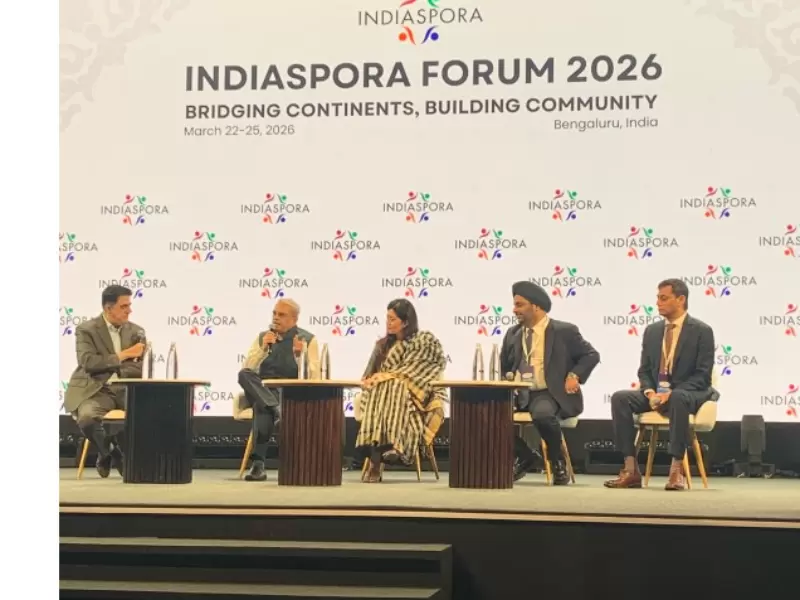 (from left to right) Kris Gopalakrishnan, Radhika Bharat Ram, Sandeep Batra, and Dr. Madhu Sasidhar at a panel discussion moderated by Rajan Navani/ / Shinjini Ghosh
In order to achieve the goals of “Viksit Bharat,” funding needs to begin at the grassroots level, said Radhika Bharat Ram, joint chairperson of The Shri Ram Schools.
Ram was speaking at a panel discussion on leading India forward at the Indiaspora Forum, which is being held in Bengaluru. From health care and education to banking and financial services, panelists said India has the potential to provide solutions to the world if existing gaps are addressed.
ALSO READ: PM Modi inaugurates Micron's facility in Gujarat's Sanand
Kris Gopalakrishnan, chairman of Axilor Ventures, said India can be “the U.S. of the 21st century” and will be driven by entrepreneurship and innovation. He added that India has the capability to “provide unique solutions” and “can address issues for the world.”
Speaking on education and the importance of policy implementation, Ram said, “Policy is on paper. The real challenge lies in executing it. We need to change how we look at schools, we need to consolidate schools, we need to build bigger, better schools with better facilities, and it is possible.”
Ram also shared how, by following the China model, Madhya Pradesh has consolidated 36,000 schools to build one big school.
“When schools are staffed well, you will have better results, better innovation, better collaboration, better critical thinking, and better resources. The shift requires intent,” Ram said.
Ram also emphasized the importance of funding at the grassroots level and of philanthropic capital toward leadership of young women.
“Nobody can understand their communities better than the people who live there. When you want Viksit Bharat, this cannot be an elite role. We have to take everybody along. So funding grassroots efforts is absolutely important and really urgent. Also, something about long-term philanthropy and trust-based philanthropy—we have to have more conversations about that. Have faith in NGOs to use your money well, and they will deliver,” Ram said.
Further, Ram added, “The leaky pipeline is real, and unless philanthropic capital steps in to support leadership of young women, it will continue to be so. Women are still brought up with a mindset that they are just born to take care of someone else or they are born to be taken care of. To change that mindset will take a very long time. So my philanthropic giving is about long-term leadership and investment in young women. I think that’s where the philanthropic capital really needs to go.”
On health care, Dr. Madhu Sasidhar highlighted how existing algorithms can screen mammograms and chest X-rays for tuberculosis at scale, and if layered with AI and emerging technologies, telehealth can be improved in remote locations across the country.
“This is where AI, coupled with some of the existing digital technologies, could have a transformational role. There is an incredible capability where we don’t have to have a physical radiologist in each location. How we combine this with telehealth is going to be how we solve for this,” Sasidhar said.
Discover more at New India Abroad.
Related



ADVERTISEMENT

ADVERTISEMENT
E Paper
Video

Comments
Start the conversation
Become a member of New India Abroad to start commenting.
Sign Up Now
Already have an account? Login