ADVERTISEMENT
ADVERTISEMENT



One Love, One World
The Echo of St. Francis of Assisi in the Mission of Sadguru Sri Madhusudan Sai
-
 Hiramalini Seshadri
 - Tue, 30, Jun 2026
- 16:52 EDT
- 32
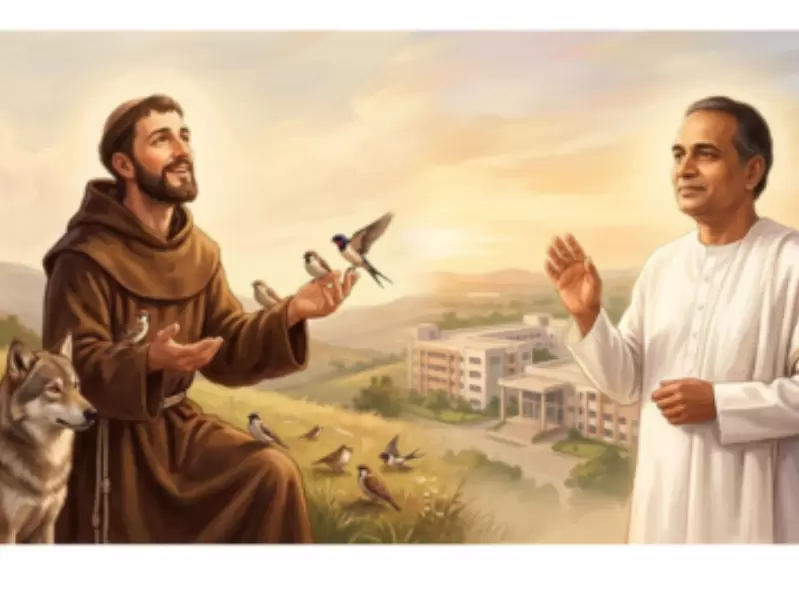 St. Francis and Sadguru Sri Sai / (Representational Image/Created by AI)
Across vast differences in time, culture, and geography, the essence of spiritual realization often sings a single, universal tune. Seven centuries and four thousand miles may separate St. Francis of Assisi from modern India’s Sadguru Sri Madhusudan Sai, yet their life’s work reveals a profound, shared tapestry. When we peel back the layers of dogma and ritual, we find two figures who discovered that the truest path to the Divine is paved with radical love and selfless service to humanity and nature.
The Poverello of Assisi
The world knows St. Francis as the 13th-century Poverello, or the “little poor man.” Born to a wealthy merchant family in Umbria, Italy, Francis abandoned all comfort after a series of divine visions and a dramatic renunciation. His pivotal moment came at the church of San Damiano, where he heard a crucifix speak to him:
“Francis, go and repair my church, which, as you can see, is falling into ruin.”
He took the call literally at first, physically rebuilding broken chapels, before realizing the message was metaphoric—a mission to revitalize the entire body of Christ, not with stone, but with love. Francis’s innovation was his renunciation and love for the poor. For him, poverty was not a lack, but a freedom; it stripped away earthly distractions and opened the heart to Monna Poverà (Lady Poverty).
This spirit of moving beyond the “me” to the “we” finds a powerful echo in the life of Sadguru Sai. Both men recognized that to serve the Divine, one must serve those whom the world has left behind. Their shared vision was that, rather than the “survival of the fittest,” prioritizing the survival—indeed, the thriving—of the weakest and meekest is the right path.
The Mission of Sadguru Sri Madhusudan Sai
Like Francis, Sadguru Sai was drawn not to the life of a typical professional, but to a profound inner calling. While Francis heard the call at San Damiano, Sadguru Sai found his foundation in the teachings and presence of the divine master, Bhagawan Sri Sathya Sai Baba.
The parallel “mission of repair” is striking. Francis was called to “repair” a church; Sadguru Madhusudan Sai has dedicated his life to “repairing” human lives. His “One World, One Family” movement, centered on the concept of Vasudhaiva Kutumbakam (The World is One Family), has launched some of the most significant initiatives in nutrition, healthcare, and education for the needy worldwide. From morning nutrition for children who would otherwise go to school hungry, to values-based education and seamlessly networked, world-class healthcare facilities, millions are finding healing and knowledge with compassion—all for free.
Where Francis emphasized humility and poverty as “repair” work, Sadguru Sai’s mission uses skill and compassion. Both are radical forms of giving. St. Francis had to overcome extreme poverty and early rejection; Sadguru Sai likewise started with only the capital of faith and had to survive opposition, ridicule, and skepticism to bring the mission to where it is today.
Radical Inclusivity: A Shared Universal Message
The core of their shared message is radical inclusivity. Francis is perhaps most famous for his Canticle of the Sun, in which he praises “Brother Sun” and “Sister Moon,” recognizing all creatures—from the fiercest wolf (which he tamed) to the lowliest bird—as his siblings. He saw no hierarchy in creation; a wildflower held as much of God’s signature as a cardinal. This was not a soft sentiment; it was a revolutionary, non-dual understanding that all existence is one.
This exact philosophy of non-dualism, or Advaita, is the heartbeat of Sadguru Sai’s service. His work stems from the realization that we are not separate entities, but one consciousness expressing itself. When one feeds a hungry child or cures a sick patient, they are not “helping someone else”; they are serving their own self.
Love All, Serve All
“Love all, serve all” is no casual feeling, but a deep realization.
Just as St. Francis saw a brother in a bird, Sadguru Sai sees divinity in every child and every patient. Their approach is identical: I am that, and that is me.
One Love for a Divided World
In today’s polarized world, this message of unity is more critical than ever. It challenges the notion that religion must divide, demonstrating instead that all authentic faith flows from the same infinite, divine ocean.
St. Francis revitalized medieval spirituality by turning it outward, prioritizing action and service over theoretical dogma. Today, Sadguru Madhusudan Sai is doing much the same, putting the ancient non-dual philosophy of the Vedas into practice in our modern lives. He isn’t just preaching Advaita (oneness); he is building hospitals and schools that prove it.
Ultimately, their common language is love. Whether sung in Latin in Assisi or chanted in Sanskrit across the campuses of the Sri Sathya Sai Loka Seva Gurukulam, the message is clear: Love is the foundation of the universe, and we find our highest self when we offer that love unconditionally.
Both men are role models who help us see beyond our differences. When we see our own divine self in every plant, animal, and fellow human, that sense of oneness brings forth compassion. Service rendered with that love, seeing oneself in all, seems the secret to real happiness. Both St. Francis of Assisi and Sadguru Sri Madhusudan Sai exemplify that path of oneness and love. Perhaps we should all try it, too; for it is that one love that can repair our world.
The writer is a physician and teaches at the Sri Madhusudan Sai Institute of Medical Sciences and Research, Chikkaballapur, Karnataka, India.
(The views and opinions expressed in this article are those of the author and do not necessarily reflect the official policy or position of New India Abroad.)
Discover more at New India Abroad
Leave A Comment
Related





ADVERTISEMENT

ADVERTISEMENT
E Paper
Video

Comments
Start the conversation
Become a member of New India Abroad to start commenting.
Sign Up Now
Already have an account? Login