ADVERTISEMENT

ADVERTISEMENT



Indian American to lead NSF-backed neuromorphic computing hub
She will lead THOR, a new National Science Foundation–funded national hub for energy-efficient, brain-inspired computing.
-
 Malvika Choudhary
 - Mon, 16, Feb 2026
- 16:51 EST
- 14
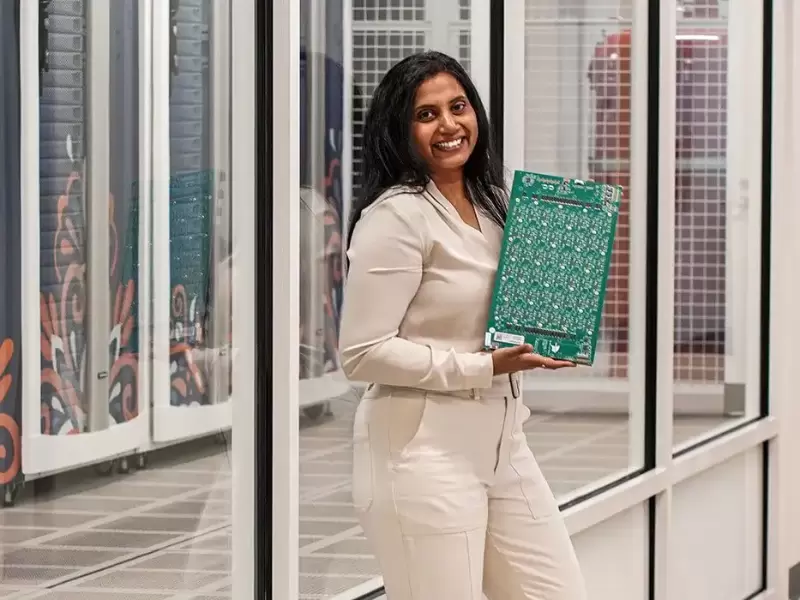 Dhireesha Kudithipudi, PhD, is the founding director of MATRIX AI Consortium and lead scientific PI for THOR. / news.utsa.edu
Indian American computer engineer Dhireesha Kudithipudi will lead a new National Science Foundation–funded hub aimed at advancing energy-efficient artificial intelligence through neuromorphic computing.
The new facility, called THOR: The Neuromorphic Commons is said to be the country’s first public-use hub for neuromorphic computing that will be based at University of Texas at San Antonio (UTSA).
Also Read: onPhase appoints Sudarshan Ranganath as chief product officer
The hub aims to provide researchers across the United States with access to large-scale computing systems that operate using a fraction of the energy required by conventional AI hardware.
Neuromorphic computing mimics the structure and function of the human brain by using event-based processing, in which computing elements activate only when new information is present. This approach contrasts with traditional processors that consume power continuously and allows for significant gains in energy efficiency.
According to the university, the project responds to growing concerns that the rapid expansion of artificial intelligence is driving unsustainable demand for electricity and natural resources, as increasingly large models rely on power-intensive data centers.
Kudithipudi, who is the principal investigator of the project and the founding director of the university’s MATRIX AI Consortium for Human Well-Being which is developing the hub, said, “We are democratizing the technology, expanding industry-academia partnerships and serving as a catalyst for bringing neuromorphic computing closer to real-world applications.”
Under Kudithipudi’s leadership, THOR will operate as the largest full-stack neuromorphic computing platform open to public researchers, UTSA said. Access to large-scale neuromorphic hardware has historically been restricted to a small number of industry laboratories and elite research institutions.
The hub will bring together a nationwide collaboration of researchers, including partners from the University of Tennessee, Knoxville, and the University of California, San Diego, with additional contributions from Harvard University and UTSA.
A global scientific advisory board and community leaders will support training, outreach and broader adoption of neuromorphic systems.
At the center of the platform is the SpiNNaker2 system, developed in partnership with SpiNNcloud. The system uses roughly 400,000 highly parallel ARM-based processing elements designed to simulate neurons and synapses, enabling the development of spiking neural networks that process information in pulses similar to biological neural activity.
UTSA said the platform could enable research into applications such as low-power medical devices, adaptive wearables, autonomous systems and mobile technologies constrained by battery life.
Researchers also plan to study how neuromorphic systems could help address “catastrophic forgetting,” a long-standing challenge in artificial intelligence in which models lose previously learned information when trained on new tasks.
The official launch of THOR is scheduled for Feb. 23 at UTSA’s San Pedro I building, where the university plans to demonstrate the system’s capabilities.
Discover more at New India Abroad.
Related










ADVERTISEMENT

ADVERTISEMENT
E Paper
Video

Comments
Start the conversation
Become a member of New India Abroad to start commenting.
Sign Up Now
Already have an account? Login