ADVERTISEMENT
ADVERTISEMENT



India–South Korea Relations: A Strategic Partnership for the Indo-Pacific
Economic cooperation remains one of the strongest pillars of India–South Korea relations.
-
 Amit Deshmukh
 - Tue, 21, Apr 2026
- 17:33 EDT
- 20
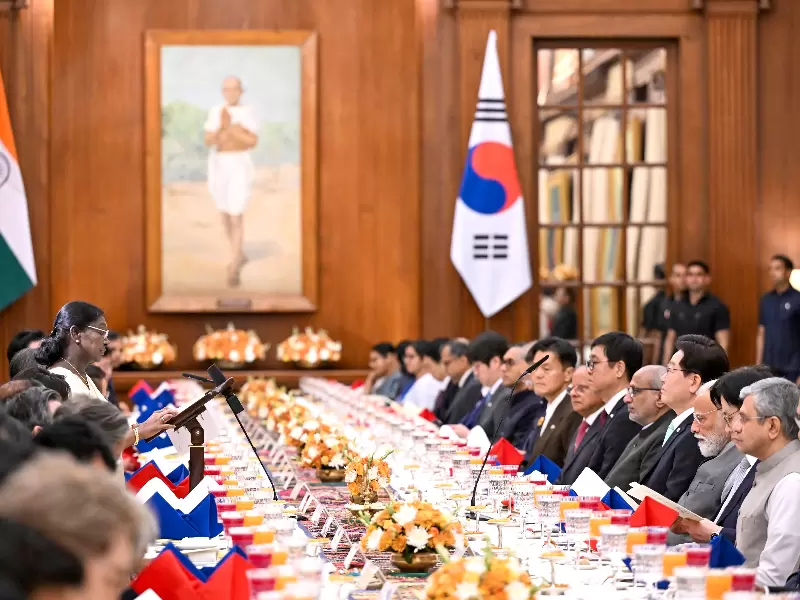 President Droupadi Murmu with President of South Korea Lee Jae Myung during a banquet hosted by her in his honour at Rashtrapati Bhavan in New Delhi on Monday, April 20, 2026 / IANS/X/@rashtrapatibhvn
The visit of the President of South Korea to India marks a significant moment in the growing strategic partnership between the two Asian democracies. In a world increasingly shaped by geopolitical tensions, technological competition, and shifting global supply chains, closer cooperation between India and South Korea carries importance not only for bilateral relations but also for the broader stability of the Indo-Pacific region.
India and South Korea established diplomatic relations in 1973, but their engagement has deepened significantly over the past two decades. In 2010, both countries elevated their ties to a Strategic Partnership, opening the door for greater collaboration in trade, technology, defence, and cultural exchanges. The current presidential visit offers an opportunity to expand this cooperation and chart a new roadmap for the future.
Glad to have welcomed President Lee on his first visit to India. His life and work are inspiring examples of service and dedication. Making this visit more special is the fact that this is the first visit by a President of the Republic of Korea in 8 years. Our nations are bound… pic.twitter.com/bo0Dwsw6sW
— Narendra Modi (@narendramodi) April 20, 2026
Economic cooperation remains one of the strongest pillars of India–South Korea relations. South Korean companies have become an integral part of India’s industrial landscape. Major corporations such as Samsung, Hyundai Motor Company, LG Electronics and Kia Corporation have invested heavily in India, creating jobs, strengthening manufacturing capacity, and contributing to technological advancement. India’s expanding market and initiatives such as “Make in India” provide new opportunities for Korean industries looking to diversify their global operations.
Beyond economics, the strategic dimension of the partnership is gaining momentum. Both India and South Korea share a common interest in ensuring peace, stability, and freedom of navigation in the Indo-Pacific. India’s Act East Policy and South Korea’s New Southern Policy have created a natural convergence in their regional outlook. As two vibrant democracies with strong maritime interests, cooperation between them is increasingly important in maintaining a balanced and rules-based regional order.
Also read: PM Modi holds bilateral talks with Austrian Chancellor at Hyderabad House
Defence collaboration has also been expanding. Joint military exercises, maritime cooperation, and discussions on defence technology have strengthened mutual trust between the two nations. South Korea’s advanced defence manufacturing capabilities complement India’s efforts to strengthen its indigenous defence production under the “Atmanirbhar Bharat” initiative.
Technology and innovation represent another promising frontier for the partnership. South Korea is a global leader in semiconductors, electronics, and advanced manufacturing, while India has established itself as a hub for information technology and digital innovation. Greater cooperation in areas such as artificial intelligence, semiconductor supply chains, green energy, and electric mobility can shape the next phase of the bilateral relationship.
Cultural ties add a unique and historic dimension to India–South Korea relations. According to Korean historical traditions, Queen Heo Hwang-ok of the ancient Korean kingdom of Gaya is believed to have come from the Indian city of Ayodhya. This shared cultural heritage continues to inspire people-to-people exchanges and strengthen the emotional bond between the two societies.
Despite the progress made, the potential of India–South Korea relations remains far greater. Bilateral trade, currently around $20 billion, is still modest compared to the economic size of both nations. Upgrading the Comprehensive Economic Partnership Agreement (CEPA) and encouraging greater investment flows can help unlock new economic opportunities.
As the global order undergoes rapid transformation, partnerships between like-minded nations are becoming increasingly important. The visit of the South Korean President to India underscores a shared commitment to building a stronger partnership grounded in democratic values, technological cooperation, and economic growth.
With sustained political will and strategic vision, India and South Korea can transform their relationship into one of the most influential partnerships in Asia—contributing not only to mutual prosperity but also to peace and stability across the Indo-Pacific region.
Discover more at New India Abroad.
Related






.png)

ADVERTISEMENT

ADVERTISEMENT
E Paper
Video

Comments
Start the conversation
Become a member of New India Abroad to start commenting.
Sign Up Now
Already have an account? Login