ADVERTISEMENT
ADVERTISEMENT



How Indians abroad build a home through friendship
This Friendship Day, a look at how friendships help Indians abroad turn unfamiliar places into home.
-
 Malvika Choudhary
 - Sun, 02, Aug 2026
- 05:36 EDT
- 32
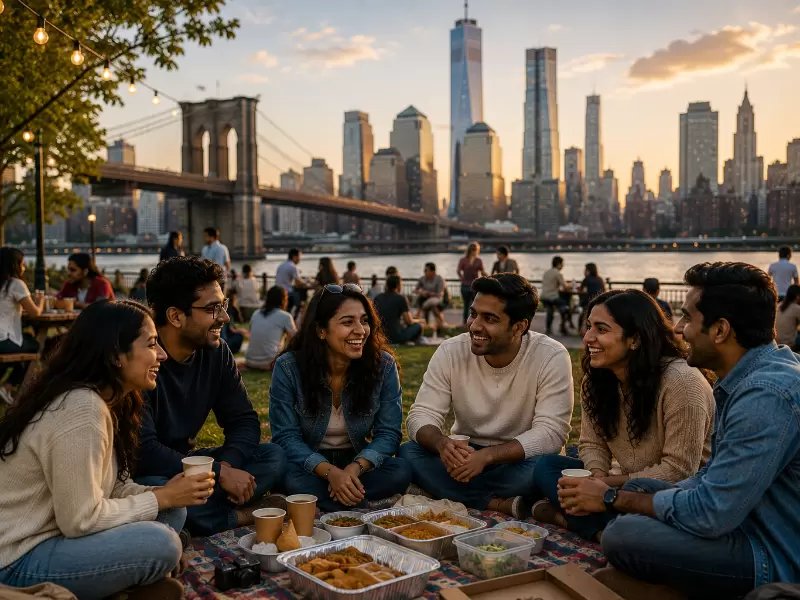 Representative image / AI generated
Every immigrant has a story about paperwork, visas and airports. Ask them about friendship, however, and you'll hear a different story altogether.
It is about the senior who waited outside Terminal 4 after a 16-hour flight with a homemade meal. The stranger from a WhatsApp group who helped move a mattress into an empty apartment. The colleague who insisted that no one should spend their first Diwali alone. The cricket teammate who eventually became the emergency contact.
Also Read: Jain Connect hosts Bay Area singles weekend
These stories rarely make headlines, yet they are woven into the everyday experience of the Indian diaspora.
Today, more than 35 million people of Indian origin live across the world, making it the largest diaspora globally. While its success is often measured in CEOs, elected officials, entrepreneurs and billion-dollar businesses, another achievement is far less visible: the extraordinary web of friendships and community networks that has helped generations of Indians build lives thousands of miles from home.
Migration has quietly changed the meaning of friendship. It is no longer just about companionship; it is about survival, belonging and continuity.
Unlike earlier generations, who often migrated through family networks, today's students and professionals frequently arrive in cities where they know no one. Their first support system is rarely an institution.
It is a WhatsApp group for Indians in Seattle, a Reddit thread for housing in Boston, an alumni network in London or a Telegram community for newcomers in Toronto. What begins as a request for a roommate or an airport pickup often becomes the foundation of a lifelong friendship.
That need for connection is perhaps why Indian communities overseas invest so heavily in gathering together.
Look closely at an India Day parade in New York or Toronto, a Navratri celebration hosted by a Gujarati Samaj in London, an Onam feast organized by a Kerala association in Melbourne or a Jagannath Rath Yatra in New Jersey.
Beneath the music, food and cultural performances is another purpose altogether. These are places where first-name introductions become friendships, where recent arrivals meet future roommates and mentors, where children find playmates and parents discover support systems.
The same spirit is visible in Indian Student Associations that welcome nervous freshmen with Holi festivals and mentorship programmes, and in weekend cricket leagues across the United States, Britain, Canada and Australia, where rival teams become extended families long after the final over.
These institutions preserve culture, but perhaps their greatest contribution is something less tangible: they create community.
Research has repeatedly shown that loneliness is one of the biggest challenges faced by international students and new immigrants. Many describe missing not only family but the ease of friendship back home–the unplanned chai breaks, neighbours dropping in without notice and conversations that did not require scheduling weeks in advance.
The diaspora has responded in its own way. It has recreated those spaces abroad.
Not through policy or government programmes, but through festivals, volunteerism, sport, faith and shared meals.
Every Friendship Day, social media celebrates school friends and college memories. For Indians abroad, however, friendship often tells a larger story. It is the invisible thread connecting a newcomer to a city, an immigrant to a community and, ultimately, a foreign country to the feeling of home.
Perhaps that is the Indian diaspora's quietest achievement. It has not simply built successful communities across the world–it has built places where strangers arrive alone and leave with families they chose.
Discover more at New India Abroad.
Leave A Comment
Related




ADVERTISEMENT

ADVERTISEMENT
E Paper
Video

Comments
Start the conversation
Become a member of New India Abroad to start commenting.
Sign Up Now
Already have an account? Login