ADVERTISEMENT
ADVERTISEMENT



From the Gulf to the kitchen: The oil shock India can’t escape
If current conditions persist, with oil prices hovering in the $90-$100 range, growth is likely to stabilize around 6 percent to 6.5 percent rather than accelerate.
-
 Badri Narayanan Gopalakrishnan
 -
 Anshita Sachan
 - Thu, 21, May 2026
- 05:12 EDT
- 21
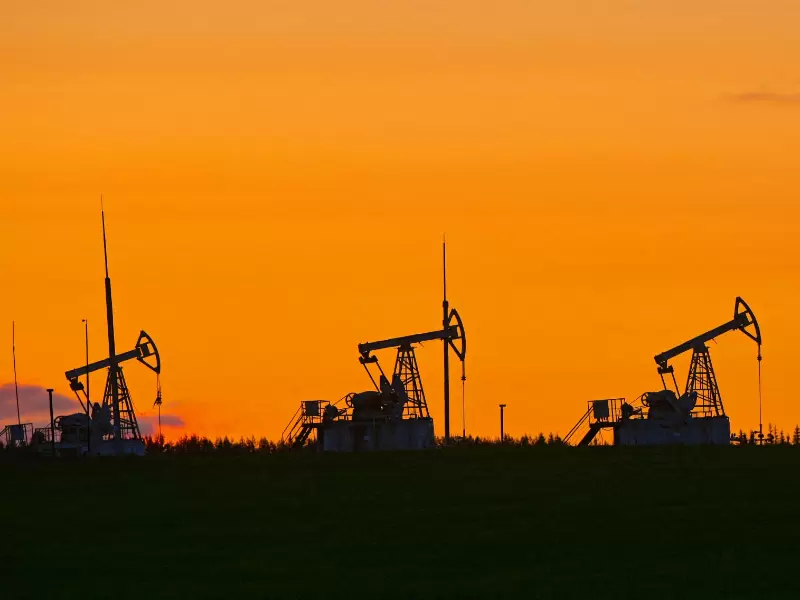 A view shows oil pump jacks outside Almetyevsk in the Republic of Tatarstan, Russia June 4, 2023. / REUTERS/Alexander Manzyuk/File Photo
As geopolitical tensions intensify, particularly the ongoing U.S.-Iran conflict, global oil markets have entered yet another phase of uncertainty. For India, this is not merely an external disturbance but a forward-looking macroeconomic risk that is likely to shape growth in the coming years. The challenge is no longer simply understanding oil shocks, but forecasting how their volatility transmits into the domestic economy.
India’s dependence on imported crude ensures that fluctuations in global oil prices are quickly reflected in domestic inflation. As fuel costs rise, price pressures spread across sectors, forcing the Reserve Bank of India to maintain a cautious monetary stance. Elevated interest rates are necessary to anchor inflation expectations but tend to dampen consumption and investment, creating the first layer of growth moderation. However, volatility introduces a deeper constraint. When firms are unable to predict future energy costs, they delay investment decisions, weakening capital formation and making growth structurally fragile.
ALSO READ: Academic pressure, isolation, and identity conflicts on campus
This relationship becomes clearer when one examines the co-movement of oil prices and economic growth. Periods of sharp increases in crude prices have consistently coincided with moderation in India’s GDP growth. The surge in 2022, when Brent crude crossed $100 per barrel, was accompanied by a visible easing in growth momentum, and a similar pattern is emerging again in 2026. The first chart illustrates that it is not merely the level of oil prices but the uncertainty surrounding them that dampens economic activity and complicates growth forecasting.
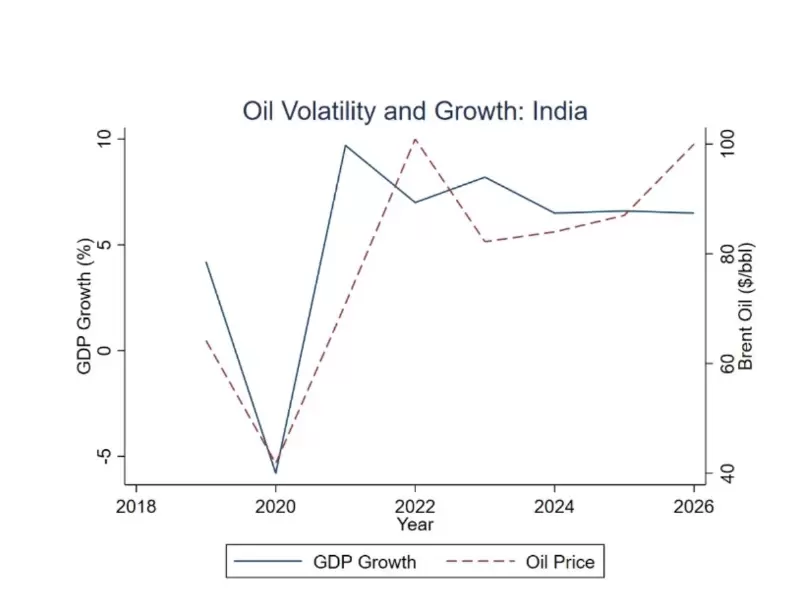 Figure 1: Oil Volatility and Growth - India’s GDP vs. Brent Crude. Periods of sharp increases in crude prices coincide with moderation in GDP growth, reflecting the macroeconomic cost of energy shocks. / Courtesy Photo
While crude oil dominates macroeconomic discussions, LPG prices represent a more immediate and politically sensitive transmission channel. With the expansion of clean cooking access under Pradhan Mantri Ujjwala Yojana, LPG has become central to household consumption. As its pricing increasingly reflects global trends, households are directly exposed to international energy shocks.
The impact of this transmission is visible in household demand patterns. As LPG prices surged sharply in 2022, crossing ₹1,000 per cylinder, there was a noticeable moderation in private consumption growth. The second chart highlights this inverse relationship. As cooking fuel becomes more expensive, households reallocate spending toward essentials, cutting back on discretionary expenditure. Given that private consumption accounts for nearly 60% of India’s GDP, this channel plays a critical role in shaping growth outcomes.
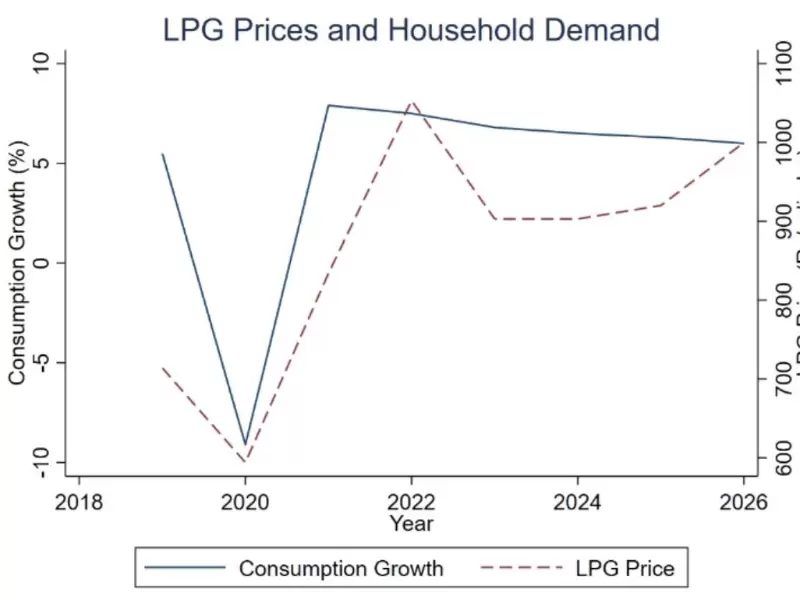 Figure 2: LPG Prices and Household Demand in India. Rising LPG prices are associated with moderation in private consumption, indicating demand compression at the household level. / Courtesy Photo
The inflationary transmission further reinforces this dynamic. Periods of higher crude prices have tended to align with elevated inflation, reflecting the pass-through of fuel costs into the broader economy. This constrains the ability of the Reserve Bank of India to ease monetary policy, thereby prolonging the growth slowdown.
From a forecasting perspective, these relationships are not incidental. Empirical approaches such as cross-sectional autoregressive distributed lag models increasingly highlight the long-run sensitivity of growth to energy price dynamics in emerging economies. In the Indian context, both oil volatility and LPG price movements act as leading indicators of consumption behavior and macroeconomic stability.
If current conditions persist, with oil prices hovering in the $90-$100 range, growth is likely to stabilize around 6% to 6.5% rather than accelerate. However, a further escalation pushing prices above $110 could lead to sharper moderation, driven by inflationary pressures and weakened household demand. Conversely, a decline in prices would ease inflation and support stronger consumption-led growth.
The policy response so far has largely focused on cushioning households from rising LPG prices through subsidies. While such measures provide immediate relief, they also impose fiscal costs that can constrain long-term public investment. A more efficient approach would involve targeted transfers enabled by digital systems, ensuring that support reaches vulnerable households without creating excessive fiscal strain. At the same time, reducing long-term exposure to oil shocks requires accelerating the transition toward renewable energy, not only as an environmental priority but as a macroeconomic stabilization strategy.
The broader lesson is that volatility, rather than price levels alone, has become the defining feature of global oil markets. For India, this implies that GDP forecasting must increasingly incorporate energy risk as a central variable. Traditional models that treat oil prices as external disturbances are no longer sufficient in a world where geopolitical tensions can rapidly reshape economic outcomes.
India’s growth story remains resilient, but it is not insulated. As the U.S.-Iran conflict continues to shape global energy markets, the challenge is not only to manage inflation but to anticipate its impact on growth. In today’s context, the distance between a geopolitical flashpoint and a slowdown in GDP is shorter than it appears, and often runs through something as basic as the price of an LPG cylinder.
The author is an assistant professor of economics at Fortune Institute of International Business, New Delhi.
(The views and opinions expressed in this article are those of the author and do not necessarily reflect the official policy or position of New India Abroad.)
Discover more at New India Abroad.
Related











ADVERTISEMENT

ADVERTISEMENT
E Paper
Video

Comments
Start the conversation
Become a member of New India Abroad to start commenting.
Sign Up Now
Already have an account? Login