ADVERTISEMENT
ADVERTISEMENT



Erasing the Black Vote in the Deep South - Five Voting Rights Activists Fight Back
For decades, Section 2 of the Voting Rights Act allowed communities to challenge maps that diluted the voting power of Black, Latino, Native American, and other minority voters.
-
 Ritu Marwah
 - Thu, 28, May 2026
- 04:02 EDT
- 17
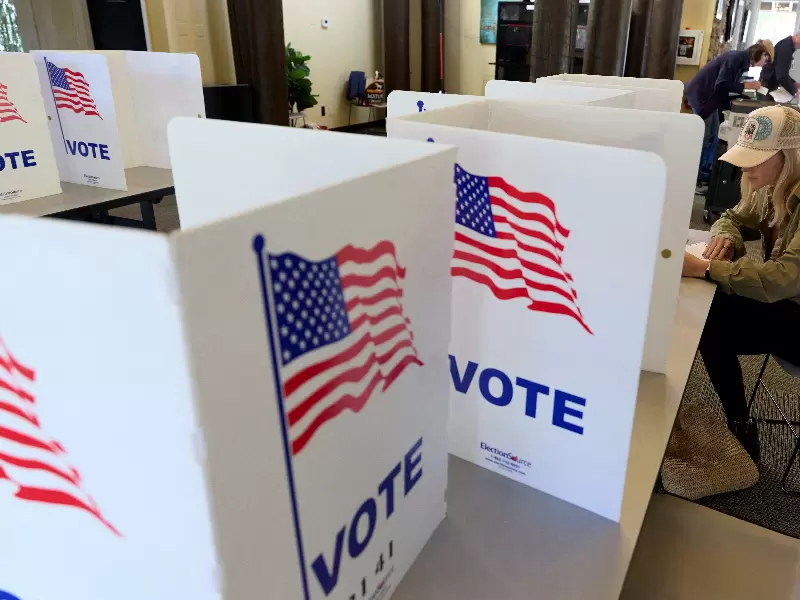 FILE PHOTO: A voter fills out a ballot at an El Dorado County polling station during California’s special election on Proposition 50, a measure that would temporarily redraw congressional districts, in El Dorado Hills, California, U.S., November 4, 2025. / REUTERS/Fred Greaves/File Photo
Real tangible outcomes of the war on redistricting that will impact people's day-to-day lives
The Supreme Court’s recent decision in Louisiana v. Callais is seen by voting rights advocates, across the Deep South, as one of the most serious threats to Black political representation since the dismantling of key protections in the Voting Rights Act over the last decade.
Within hours of the ruling, legislators in several Southern states began moving to redraw congressional and legislative maps. What is unfolding now, activists say, is not simply a legal debate over district lines. It is a struggle over who gets heard, who gets represented, and whose communities can still shape the future of their schools, courts, neighborhoods, and daily lives.
At an American Community Media briefing titled Erasing the Black Vote in the Deep South and Five Voting Rights Activists Fight Back, attorneys, organizers, and elected officials from Louisiana, Alabama, Tennessee, Mississippi, and Georgia
“This is not new,” said voting rights attorney Mitchell Brown of the Southern Coalition for Social Justice. “When there are periods of increased voter participation and opportunity for voters of color, there’s this white retrenchment that seeks to take it away.”
We have to now prove intentional discrimination.
For decades, Section 2 of the Voting Rights Act allowed communities to challenge maps that diluted the voting power of Black, Latino, Native American, and other minority voters. Previously, communities only needed to show that a map had the effect of weakening minority representation. The Callais ruling, advocates say, effectively raises the burden dramatically. Now, plaintiffs may have to prove intentional discrimination, the equivalent of finding a lawmaker openly admitting they drew maps to disenfranchise Black voters.
“The legislators are not going to say the quiet part out loud,” Brown noted.
And yet, the impact may soon become impossible to ignore.
Real tangible outcomes that will impact people's day-to-day lives
The consequences of redistricting are often invisible until they show up in ordinary life. A district line shifts quietly on a map, and suddenly a community that once elected a representative advocating for public school funding or voting access finds itself politically submerged into a larger district where its concerns no longer carry weight.
One of the clearest warnings from the briefing was that these changes will not stop at congressional races.
“This is going to make its way down to the local level,” Brown warned.
That means school boards. City councils. County commissions. Judgeships. Election boards.
Imagine a school board that once included members pushing to reduce racial disparities in suspensions and expulsions. A redrawn district could remove enough Black voting power that those voices disappear entirely. The result could shape whether certain books remain in libraries, whether Black history is taught honestly, or whether students of color continue to face disproportionate punishment.
Voting rights attorney Amir Badat of Fair Fight Action urged people to understand that these are not abstract legal questions.
“These are real tangible outcomes that will impact people’s day-to-day lives,” he said.
The decisions affected by local representation touch everything from potholes and policing to flood protection, public hospitals, school discipline, and criminal justice reform. When representation changes, policy priorities often change with it.
In Louisiana, residents are already watching the chaos unfold in real time
Louisiana Public Service Commissioner Devante Lewis described a situation that sounded less like orderly democracy and more like civic whiplash.
After the Callais ruling, Louisiana’s governor suspended congressional elections even though 42,000 people had already cast absentee ballots. Voters were told their congressional votes would not count. Meanwhile, lawmakers rushed through new maps that would reduce Black congressional representation from two districts down to one.
Then came another extraordinary step: racial demographic data traditionally included in redistricting analysis was removed.
“We can’t even say what the racial breakdown of our congressional districts is,” Lewis said.
For ordinary voters, the confusion is staggering. People do not know whether their ballots count. Candidates who already qualified for races are being told the rules may change. District lines are moving while elections are already underway.
“The only time we’ve ever suspended elections before was during hurricanes,” Lewis explained. “We have never suspended an election, changed the rules of the election, and then redrawn the lines in the middle of voting.”
The comparison to the Jim Crow South surfaced repeatedly throughout the briefing.
Speakers pointed to a familiar historical pattern: whenever Black political participation expands, new systems emerge to contain it. After Reconstruction came literacy tests and poll taxes. After the Voting Rights Act came waves of voter ID laws, polling place closures, and aggressive gerrymandering.
Now, advocates say, race-neutral legal language is being used to produce racially unequal outcomes once again.
“This is the exact same move that was made in the late 1800s,” said Badat. “They won’t say they are discriminating against Black voters. They’ll just create systems that have that effect.”
In Alabama, organizers say the uncertainty itself has become a form of disenfranchisement.
Jerome Dees of the Southern Poverty Law Center described widespread misinformation about whether elections are still happening, whether districts have changed, and whether voters need to return to the polls again later in the year.
“People need to show up and vote from the top of the ballot all the way down,” Dees emphasized.
Communities are responding not with surrender, but with mobilization
Meanwhile, organizers like Rhyane Wagner say communities are responding not with surrender, but with mobilization.
In Louisiana, citizens packed legislative hearings until four in the morning protesting discriminatory maps. In Alabama and Mississippi, activists are organizing statewide marches and mass demonstrations. Across the South, community groups are launching voter education campaigns to counter confusion and misinformation.
“You’ve pissed us off,” Wagner said bluntly, speaking about the ruling’s effect on Black communities. “I don’t think these folks realize what they’ve done.”
That response may become one of the defining stories of this moment.
Because beneath the legal rulings and procedural jargon lies something deeply human: the refusal of communities to disappear quietly from democracy.
The Callais decision may reshape the mechanics of voting rights law for years to come. But the speakers at the briefing repeatedly stressed that representation has never been handed over willingly in America. It has always been demanded, organized for, marched for, litigated for, and defended.
And for many communities across the South, that fight is entering a new chapter now, not just in courtrooms, but in churches, school board meetings, legislative hearings, and neighborhoods where people are beginning to realize that a line drawn on a map can determine whose voice counts when decisions about everyday life are made.
Discover more at New India Abroad.
Related
.jpg)
ADVERTISEMENT

ADVERTISEMENT
E Paper
Video

Comments
Start the conversation
Become a member of New India Abroad to start commenting.
Sign Up Now
Already have an account? Login