ADVERTISEMENT

ADVERTISEMENT



Culture and the Olympics are inseparable
A day after the opening ceremony, Casa Paralimpica Italiana opened its doors to accompany the Milano Cortina 2026 Paralympic Winter Games as a symbolic space celebrating inclusion and Italian excellence.
-
 Prabhjot Paul Singh
 - Wed, 11, Mar 2026
- 22:44 EDT
- 22
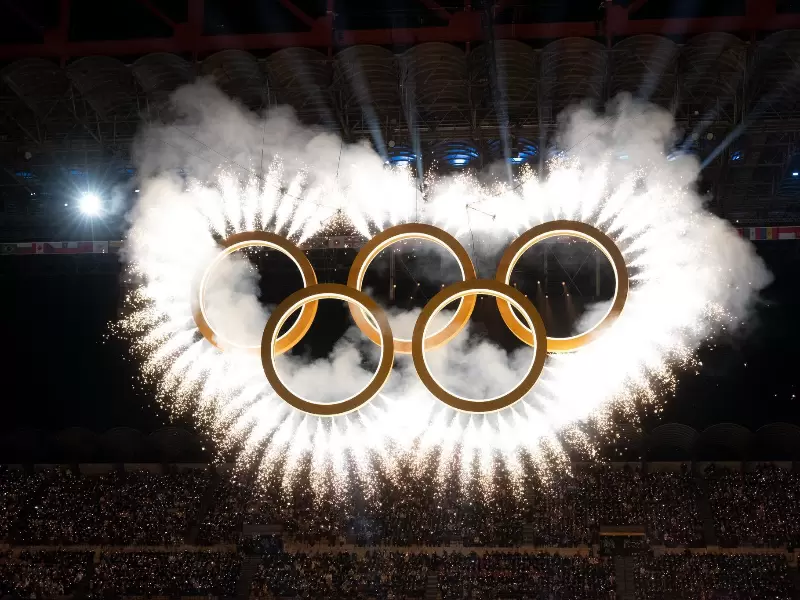 A scene from the opening ceremony; the unveiling of the Olympic rings / Wikimedia commons
Culture and the Olympics are inseparable. Whenever and wherever the Olympics are held, a cultural Olympiad follows. Milano and Cortina are no different. Besides the cultural component of both the opening and closing ceremonies, the host cities also organise special events to showcase their rich cultural heritage, besides inviting artists and cultural troupes from participating nations to satiate the appetite of art lovers of the great assemblies the games bring with them.
Milan and Cortina d’Ampezzo have been hosting a meeting space celebrating sport, art, and the values of inclusion during the Milano Cortina 2026 Paralympic Winter Games.
A day after the opening ceremony, Casa Paralimpica Italiana opened its doors to accompany the Milano Cortina 2026 Paralympic Winter Games as a symbolic space celebrating inclusion and Italian excellence.
It was an initiative promoted by the Italian Paralympic Committee to celebrate Paralympic sport in two iconic locations: Milano and Cortina d’Ampezzo, two cities united by a single spirit.
The initiative’s claim, “Italia IN Gioco,” reflects a country ready to step forward as both host nation and key protagonist: IN stands for integration and innovation.
The tangram pictogram becomes a visual metaphor for different elements coming together to create value, reflected in a rich programme of events ranging from meetings with medal-winning athletes to symbolic moments dedicated to inclusion.
ALSO READ: Milano has been hawking media headlines
On March 10, Casa Paralimpica Italiana in Cortina d’Ampezzo hosted the presentation of the Manifesto against discrimination in sport, signed by Fondazione Milano Cortina 2026 together with the Italian Paralympic Committee and the Observatory for Security Against Discriminatory Acts (OSCAD).
The event, promoted by OSCAD, featured Valentina Marchei, Olympic figure skater and Head of the Ambassador Programme at Milano Cortina 2026, and Martina Caironi, Paralympic champion and Milano Cortina 2026 Ambassador, who presented the “Parità in Campo” toolkit developed by Fondazione Milano Cortina 2026.
In Milano, host city of the Para Ice Hockey competitions, Allianz Tower became the institutional and relational hub of the committee, hosting networking opportunities, events, hospitality and the culinary excellence of “Da Vittorio.”
In Cortina d’Ampezzo, Galleria Farsettiarte and Casa Esselunga are transformed into immersive experiential spaces where art, technology, and sport become a universal language of inclusion.
The experiential journey has been engaging visitors through interactive installations, VR experiences, touch quizzes, and a Wall of Emotions, turning every guest into an active participant in the Paralympic narrative and its values.
Art also took centre stage with an exhibition by the Scuola Romana del Fumetto, reinterpreting Paralympic sports through the tangram concept, alongside an exhibition curated by Farsettiarte featuring works by masters of modern and informal abstraction such as Tancredi, Castellani, Dorazio, Bonalumi, and Perilli. Their works create a dialogue between colour, the decomposition of forms and three-dimensionality, in harmony with the immersive experience offered.
Inside the House, a dedicated RAI broadcast station provides live connections and the opportunity for guests to watch the competitions, strengthening the role of the venue as a meeting point for media, athletes, institutions and partners.
Casa Paralimpica Italiana was designed by architect Francesco Zanon / Anfibio in collaboration with the Italian Paralympic Committee.
Galleria Farsetti Arte curated and installed the exhibition dedicated to the masters of Italian abstraction, helping create a dialogue between art, form and movement in perfect harmony with the spirit of Italia IN Gioco.
Running commentary vs audio description at Milano Cortina
Dominance of social media notwithstanding, there are traditional channels of communication that continue to enjoy acceptability, though in diminishing numbers. Audio or even running commentary are some of the traditional channels that have been finding acceptance here.
The audio description has been working well with the Winter Olympic enthusiasts.
It has been making the sporting experience accessible to blind and partially sighted people, thanks to a dedicated system and a team of professionals.
Audio description has been one of the most powerful tools for making sport truly accessible. At these games, this service enabled blind and partially sighted people to experience every competition, every emotion and every detail, thanks to the Audiodescrizione26 app. The app provides access to event-by-event and city-by-city descriptions, using a unique code provided by the Istituto dei Ciechi di Milano to ensure confidential and protected use.
"The system broadcasts the event live with a minimum delay of around a quarter of a second.’ ‘The most complex technical challenge was to ensure continuous, stable coverage throughout the Games, while maintaining the quality of the service at all venues", says Tony D’Angelo, the project manager.
Audio describers generally work from the press box, in a central position that allows them to capture every movement on the field and every reaction in the stands. The guiding principle is simple: never leave a silence, because silence is like leaving the listener ‘in the dark’. The service is provided both in person at the venues and remotely via feeds supplied by the IBC (International Broadcasting Centre).
There was significant use of the audio description service, which varied across the Olympic and Paralympic disciplines and the Ceremonies.
For the Olympic Opening and Closing Ceremonies, there were 48 listeners in Italian and 22 in English, and 30 listeners in Italian and 11 in English, respectively. For the Paralympic Opening Ceremony, there were a total of 31 listeners in Italian and 12 in English.
Among the sports venues, Curling at the Cortina Curling Stadium recorded 181 listeners in Italian, the highest number overall, while Figure skating at the Assago Ice Skating Arena also had a strong following in English, with a total of 62 listeners. For Para ice hockey at the Milano Santa Giulia Ice Hockey Arena, the Italian audio description received over one hundred listens, while for events such as cross-country skiing at the Tesero Cross-Country Skiing Stadium in Val di Fiemme and Biathlon at the Anterselva Biathlon Arena, the audience was more evenly divided between the different languages: 49 in Italian and 42 in English for cross-country skiing, and 75 in Italian and 26 in English for Biathlon. There was also a strong German audience, with a total of 52 listens.
Tony D’Angelo explained that the selection of audio describers for the Milano Cortina 2026 Olympic and Paralympic Games was based on very specific criteria: a passion for sport, the ability to provide vivid and engaging commentary, experience in journalism or radio, excellent communication skills, preferably knowledge of winter sports, and a strong commitment to inclusion. A total of 57 professionals are involved, aged between 19 and 61.
To help them prepare, Fondazione Milano Cortina 2026 then provided technical manuals for the sports, divided into ice and snow disciplines.
"The difference compared to a traditional radio commentary is substantial," says Tony D’Angelo. In a radio commentary, what the viewer sees is taken for granted; in audio description, you have to reconstruct every detail, as if the listener were completely in the dark. You describe shapes, colours, spaces, postures, snow conditions, split times, and the athletes’ emotions. Even during breaks, we provide technical information because it cannot be assumed that everyone knows the rules. It’s like describing the match to a blind friend who’s watching it with us”.
Enrico Boiani, an audio descriptor at the Games, explains why preparation is so important: ‘Knowing the competitors, the venues and the dynamics of the competition allows you to describe everything you see and convey the emotion.’ Nothing can be taken for granted. Every extra detail helps the listener feel involved.” Being honest with the audience is also crucial: in very fast sports like hockey or para ice hockey, you can get confused, and if that happens, you have to correct yourself immediately, just like a fan in the stands would do.” Putting yourself on the same level as the listener makes audio description even more immersive ”.
He mentions hockey and para ice hockey as some of the most challenging sports to commentate on, whereas curling allows for a more relaxed and detailed commentary. Skiing, on the other hand, has provided some unforgettable moments, especially with Federica Brignone ’s victories: "Describing her tears to visually impaired fans was something indescribable".
Discover more stories on NewIndiaAbroad
Related







ADVERTISEMENT

ADVERTISEMENT

ADVERTISEMENT
E Paper
Video

Comments
Start the conversation
Become a member of New India Abroad to start commenting.
Sign Up Now
Already have an account? Login