ADVERTISEMENT
ADVERTISEMENT



Bhramar Mukherjee to deliver Hansen Lecture April 29
The lecture will outline how statisticians can address bias in data and expand their role in community-driven research and public communication.
-
 Malvika Choudhary
 - Mon, 27, Apr 2026
- 15:45 EDT
- 20
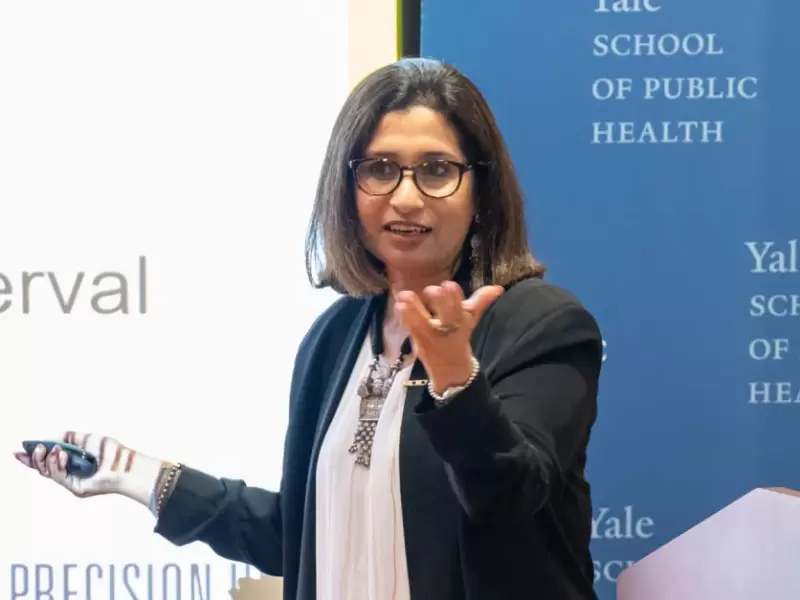 Bhramar Mukherjee / Yale News
Bhramar Mukherjee, an Indian-origin biostatistician and data scientist, will deliver the Hansen Distinguished Lecture on April 29, focusing on ethics, community engagement, communication, and capacity building in public health statistics.
Mukherjee, the Anna M.R. Lauder Professor of Biostatistics and Professor of Chronic Disease Epidemiology at Yale School of Public Health, will present “Ethics, Community, Communication, and Capacity Building: The Four Quadrants of Being a Public Health Statistician.”
Also Read: MIT biological engineering alumna wins Gates Scholarship for Cambridge PhD
The lecture will examine how artificial intelligence systems developed on exclusionary datasets can produce biased outcomes and reinforce disparities. Mukherjee will outline the role of statisticians in addressing selection, information, and confounding bias to improve equity in data science and AI.
She will also call on statisticians to move beyond analytical roles and lead efforts in data collection and community-based research, drawing on her experience building partnerships and conducting field studies.
Mukherjee will further reflect on lessons from modeling the trajectory of SARS-CoV-2 in India and engaging with global media, emphasizing the importance of scientific communication.
The session will conclude with a focus on capacity building, including her work leading long-running summer health data science programs in the United States and developing similar initiatives for early-career researchers in India.
Mukherjee joined Yale University in 2024 as the inaugural Senior Associate Dean of Public Health Data Science and Data Equity. Prior to that, she spent nearly two decades at the University of Michigan, where she served as the John D. Kalbfleisch Distinguished University Professor of Biostatistics and chaired the Department of Biostatistics from 2018 to 2024, becoming the first woman to lead the department.
Earlier in her career, she was on the faculty at the University of Florida. At Michigan, she also held leadership roles at the Rogel Cancer Center, including associate director of cancer control and population studies and associate director for Quantitative Data Sciences.
Her research focuses on the development and application of statistical methods in epidemiology, environmental health, and disease risk assessment, including the integration of genetic, environmental, and clinical data.
Her work has examined gene-environment interactions in cancer risk and the use of polygenic risk scores to stratify disease risk. During the COVID-19 pandemic, she led efforts to model SARS-CoV-2 transmission in India.
Mukherjee is a fellow of the American Statistical Association, the Institute of Mathematical Statistics, and the American Association for the Advancement of Science, and an elected member of the International Statistical Institute and the U.S. National Academy of Medicine.
She has authored more than 425 research articles and supervised 22 PhD and five postdoctoral scholars. She is also serving as the 2026 president of ENAR, the Eastern North American Region of the International Biometric Society.
Mukherjee was born and raised in Kolkata, India. She earned a bachelor’s in science. in statistics from Presidency College, Kolkata, in 1994 and an M.Stat from the Indian Statistical Institute in 1996. She later moved to the United States, completing a master’s in science in mathematical statistics in 1999 and a Ph.D. in statistics in 2001 from Purdue University.
The lecture is scheduled from 12:30 p.m. to 1:20 p.m. at Callaghan Auditorium in the College of Public Health Building.
Discover More At New India Abroad
Related







ADVERTISEMENT

ADVERTISEMENT
E Paper
Video

Comments
Start the conversation
Become a member of New India Abroad to start commenting.
Sign Up Now
Already have an account? Login