ADVERTISEMENT
ADVERTISEMENT



Beyond Left and Right: Why Colombia's Election Matters for Democracy Across the Americas
Columbia has just elected a president, but the controversy is just beginning
-
 Ritu Marwah
 - Wed, 24, Jun 2026
- 18:06 EDT
- 15
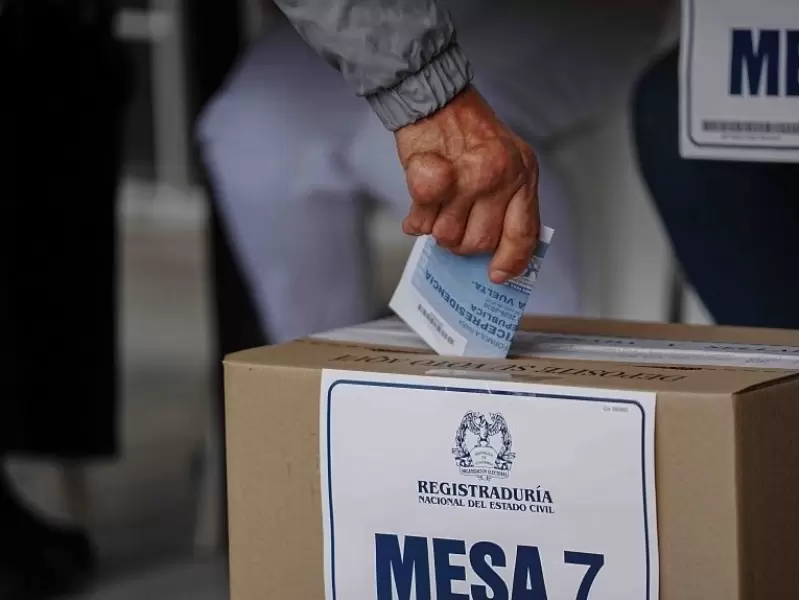 Colombia's razor-close presidential race sparks dispute over vote count / (Photo: Xinhua)
Far right lawyer and political outsider Abelardo de la Espriella has declared victory after a razor-thin presidential runoff against left wing Senator Iván Cepeda who took 48.70% of the votes, in a highly polarized race marked by U.S. President Donald Trump's endorsement of De la Espriella.
De la Espriella edged out Cepeda by just over 250,000 votes (less than 1% of the votes), leading to claims of voting irregularities.
The contest between Iván Cepeda of Pacto Histórico and Abelardo de la Espriella of Salvación Nacional has sparked intense debate over the future of Colombian democracy, the implementation of peace agreements, land rights, migration, and the country’s role in Latin America.
“In Colombia’s cities and semi-urban areas,” speaking at a ACoM news conference Beatriz Magaloni, a political scientist and senior fellow at Stanford University, said, residents “suffer crime, they suffer extortion, they suffer insecurity,” and see in de la Espriella’s tough-on-crime message “a really interesting solution.”
Who is the new president of Colombia?
De la Espriella, nicknamed "The Tiger" (El Tigre), the business owner and political newcomer, contested the election on the promise that if he won, he would launch intense military operations for 90 days against armed groups in the country. He promised a strict "law and order" agenda, which includes ending peace negotiations with armed groups and constructing mega-prisons.
“These criminal organizations live from drug trafficking, extracting oil,” said Magaloni, adding, “they live from extorting populations” that de la Espriella repeatedly demeaned in campaign statements widely condemned as racist.
The supporters argue that Columbia needs a tougher approach to crime. De la Espriella has blamed Gustavo Petro, Colombia’s president from 2022 until 2026, left-wing/progressive, for Colombia’s economic and security troubles, including increased violence linked to armed groups.
Espriella has promised to boost the oil and gas sector, lower taxes and reduce the size of the state by up to 40 percent. He has said, however, that he will preserve Petro’s 23 percent increase in the minimum wage, along with other popular social measures.
What does this mean for US Colombia relations?
After his win was announced, de la Espriella received a congratulatory call from Trump, who wrote on his Truth Social platform on Sunday: “He Won, BIG!” Trump said that the results of Sunday’s race are “very important to the future of Colombia and its relationship to the United States”.
Espriella, a US citizen who lived in Miami for years and was explicitly endorsed by Trump, enters office with a policy agenda, including military crackdowns, closer security cooperation and a harder line on migration, that maps neatly onto Washington’s regional priorities.
“The Trump Administration looks forward to working closely with your incoming administration to advance regional security cooperation, end illegal immigration to the United States, and strengthen our economic ties,” wrote US Secretary of State Marco Rubio.
De la Espriella, himself a naturalized U.S. citizen, has said he would welcome U.S. military support in taking on the groups.
More than 57 armed groups with “war-fighting capability” already control territory across Colombia, a situation that threatens “a dramatic spiral of new violence,” warned Alex Sierra, an anthropologist with the Bogotá-based Centro de Estudios Sociojurídicos Latinoamericanos (CESJUL).
Foreign Policy and Security:
The outcome directly redefines Colombia’s foreign policy, dictating its geopolitical balancing act between the United States (including U.S. counternarcotics and migration cooperation) and global powers like China, as well as relations with neighboring Venezuela.
Colombia has been the largest host country for Venezuelan migrants, absorbing nearly 3 million fleeing rampant violence, economic collapse and political repression, said Beatriz Magaloni, professor of political science and senior fellow, Stanford University.
De la Espriella’s apparent win follows a pattern of a rightward shift in South American countries. Voters in Chile, Argentina, Costa Rica, Bolivia and Ecuador have elected right-wing presidents in their most recent elections.
Espriella will also reverse the previous president’s policy against Israel by restoring ties with Israel and moving the embassy back to Jerusalem.
Related









ADVERTISEMENT

ADVERTISEMENT
E Paper
Video

Comments
Start the conversation
Become a member of New India Abroad to start commenting.
Sign Up Now
Already have an account? Login