ADVERTISEMENT

ADVERTISEMENT



Ayush Ministry takes Indian traditional medicines to global stage
The Ayush Ministry signed an agreement with WHO to establish WHO-Global Traditional Medicine Centre (GTMC) in Jamnagar, Gujarat.
-
 IANS
IANS - Sun, 28, Dec 2025
- 21:42 EST
- 14
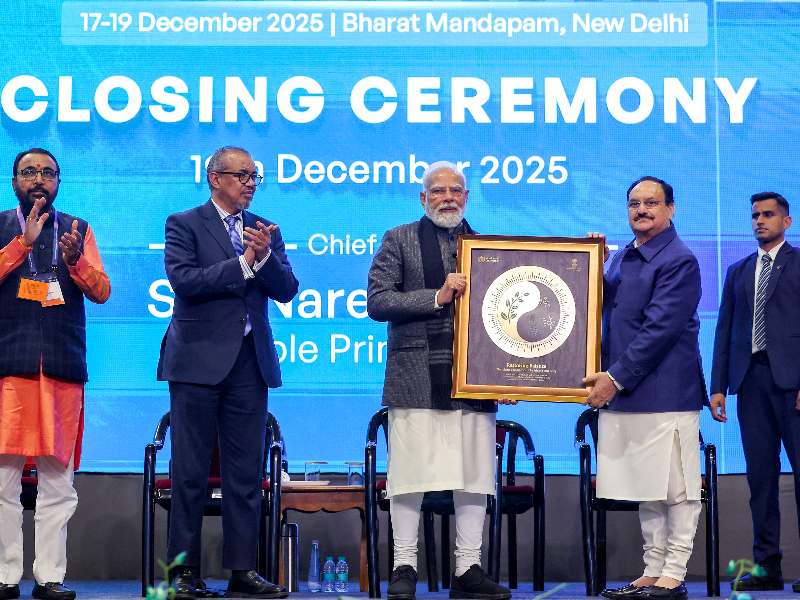 Prime Minister Narendra Modi participates in the second WHO Global Summit on Traditional Medicine, as Union Minister J. P. Nadda and Minister of State for Health and Family Welfare Prataprao Jadhav look on. / IANS/PMO
The Ministry of Ayush has signed 25 country-to-country level MoUs for cooperation in the field of Traditional Medicine and homoeopathy, 15 MoUs with international institutes for setting up of Ayush Academic Chairs in foreign nations, 52 institute-to-institute level MoUs for undertaking collaborative research/academic collaboration and supported the establishment of 43 Ayush Information Cells in 39 foreign nations for propagation and promotion of Ayush at global stage.
In a statement on Dec. 28, the ministry said it has developed a Central Sector Scheme for the Promotion of International Co-operation in Ayush.
The ministry provides support to Indian Ayush drug manufacturers/Ayush service providers to give boost to the export of Ayush products and services, along with facilitating international promotion and development and recognition of Ayush system of medicine.
ALSO READ: FTA with India means more jobs, exports, higher incomes: New Zealand PM
The Ayush Ministry signed an agreement with WHO to establish WHO-Global Traditional Medicine Centre (GTMC) in Jamnagar, Gujarat.
This Centre aims to provide support to implement WHO's traditional medicine strategy (2014-23) and to support nations in developing policies and action plans to strengthen the role of traditional medicine as part of their journey to universal health coverage.
An agreement was signed between the Ministry of Ayush and the WHO on May 24, 2025, towards developing Traditional Medicine intervention categories and index for the International Classification of Health Interventions (ICHI), with a holistic approach and focus on Traditional Medicine systems of Ayurveda, Siddha and Unani.
The agreement marks the beginning of work on a dedicated Traditional Medicine module under the International Classification of Health Interventions (ICHI). This development aligns with India’s vision of bringing its rich heritage of traditional wisdom into the global healthcare mainstream, backed by scientific classification and international standards, according to the ministry.
Related


.png)

ADVERTISEMENT
ADVERTISEMENT
E Paper
Video

Comments
Start the conversation
Become a member of New India Abroad to start commenting.
Sign Up Now
Already have an account? Login