ADVERTISEMENT
ADVERTISEMENT



Birthright citizenship case tests stakes for Indian immigrants
At a recent briefing by American Community Media the fate of birthright citizenship in the United States, long considered a cornerstone of the nation’s identity, was a cause for concern.
-
 Ritu Marwah
 - Tue, 28, Apr 2026
- 01:14 EDT
- 422
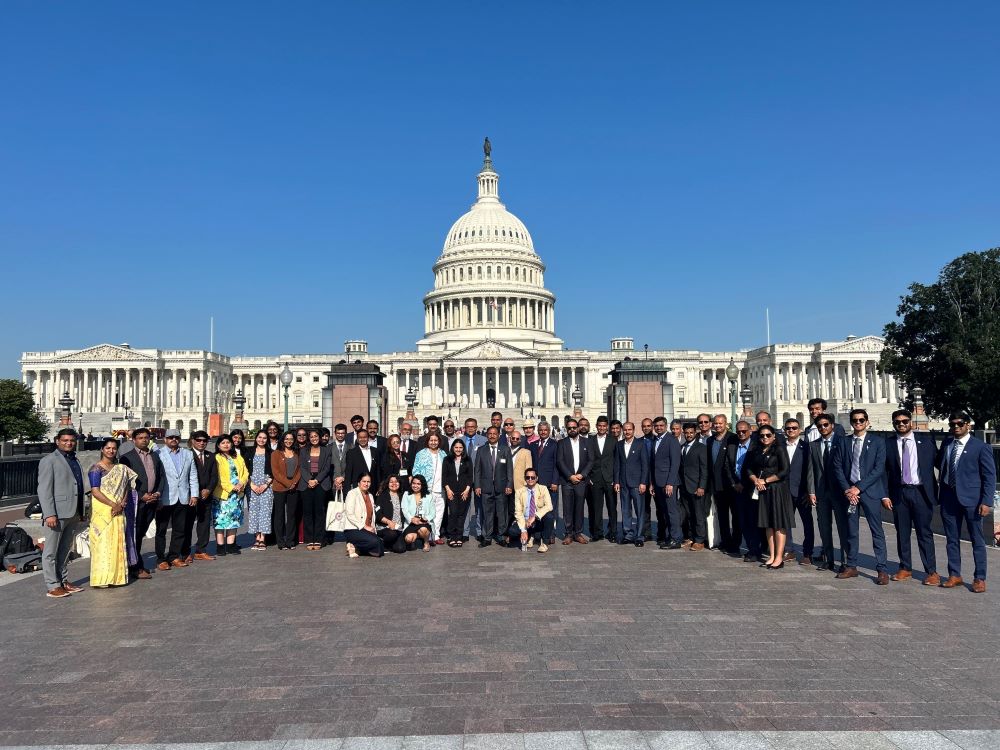 Indian diaspora / FIIDS
In April 2026, U.S. President Donald Trump reposted a controversial message on his Truth Social platform that alleged that immigrants from India abuse American birthright citizenship The text alleged that immigrants "come here and drop a baby in the ninth month," allowing the child to become an instant U.S. citizen.
The remarks were made in the context of Trump’s campaign to end birthright citizenship for children born in the US to non-citizen parents. At a recent briefing by American Community Media the fate of birthright citizenship in the United States, long considered a cornerstone of the nation’s identity, was a cause for concern.
ALSO READ: Row erupts over Trump post on citizenship
Supreme Court will weigh in June
Birthright citizenship is now at the center of one of the most consequential legal battles in decades. As the Supreme Court weighs a challenge to former President Donald Trump’s executive order seeking to end automatic citizenship for children born to undocumented immigrants and temporary visa holders, the implications are reverberating far beyond the courtroom.
At stake is not only a constitutional question rooted in the 14th Amendment, but also the future of millions of immigrant families, including a large and highly skilled Indian diaspora, whose lives and long-term plans are deeply tied to the promise of citizenship by birth.
Signed on January 20, 2025, the executive order attempts to redefine who qualifies as “subject to the jurisdiction” of the United States, a phrase central to the 14th Amendment’s guarantee of citizenship to those born on U.S. soil. The case, argued before the Supreme Court on April 1, is widely expected to yield a decision by late June or early July.
Domestic fallout
While the legal debate has focused on constitutional interpretation, the discussion highlighted a broader set of concerns, economic, demographic, and societal, that experts say have been largely overlooked.
For Indian immigrants, the potential impact is particularly acute. Many live and work in the United States on temporary visas such as H-1B, often for years or even decades due to green card backlogs. Under current law, their U.S.-born children are citizens at birth. If the executive order is upheld, that pathway disappears.
This would fundamentally alter the calculus for thousands of Indian professionals. As immigration policy analysts note, families already grappling with long waits for permanent residency could face a new layer of uncertainty: children born in the United States might not have the right to stay permanently in the only country they have known.
The issue is not hypothetical. Even today, children of Indian H-1B visa holders often “age out” of dependent status at 21, forcing them to secure their own visas or leave the country. Ending birthright citizenship would expand this precarity dramatically, potentially creating a generation of young people raised in the U.S. but legally treated as foreigners.
At the American Community Media briefing, experts emphasized that such a shift could ripple across the U.S. economy.
Dr. Phillip Connor, Research Fellow, Center for Migration and Development, Princeton University estimated that individuals who have benefited, or would benefit, from birthright citizenship contribute trillions to the U.S. economy over time. His analysis suggests that ending the policy could mean a loss of at least $7.7 trillion in economic output over a century.
The impact would not be abstract. Roughly two-thirds of these individuals go on to work in professions requiring higher education, including healthcare, education, and management, sectors already facing labor shortages.
“If you remove millions of future workers,” Connor said, “you’re shrinking the workforce at a time when the U.S. is already aging.”
Research presented by economists suggests that individuals who benefited from birthright citizenship, children of undocumented or temporary immigrants, have contributed trillions of dollars to the economy over time. Removing that pipeline, they argue, would shrink the future workforce, particularly in high-skill sectors.
Wider implications
Speakers also emphasized how the policy could reshape global perceptions of the United States.
Xiao Wang, CEO of Boundless Immigration, said the change could deter highly skilled workers from choosing the U.S., particularly those on temporary visas such as H-1B.
“For many families, the question is not just about jobs,” Wang said. “It’s whether their children will have a secure future.”
He warned that countries like Canada, the U.K., and Australia are actively expanding pathways for skilled migrants, potentially benefiting from any decline in U.S. attractiveness.
For Indian immigrants, who are heavily represented in technology, healthcare, and research, the implications extend to global competitiveness. Analysts warn that restricting birthright citizenship could discourage highly skilled workers from choosing the United States altogether, especially when countries like Canada, the United Kingdom, and Australia offer clearer pathways for families.
Healthcare may be one of the first sectors to feel the strain. Immigrants already make up a significant share of physicians in the United States, particularly in underserved rural areas. If fewer international professionals are willing to relocate due to uncertainty about their children’s status, staffing shortages , already severe, could worsen.
Social and legal impact of the Supreme Court’s decision
Beyond economics, the briefing underscored the social consequences of creating a population of children born in the U.S. without citizenship. Experts warned of the emergence of a “shadow population” lacking access to federal benefits, facing barriers to higher education, and unable to legally work as adults.
Demographic projections presented at the briefing suggest that ending birthright citizenship could paradoxically increase the unauthorized population by millions over time, as children born without status grow up and remain in the country.
There are also legal ripple effects. Several states are considering measures that would restrict access to public education for undocumented children, potentially setting up a direct challenge to the Supreme Court’s 1982 ruling guaranteeing schooling regardless of immigration status. If both protections were weakened, the result could be a generation of children excluded from both citizenship and education.
Yet, as legal scholars pointed out, the debate is ultimately about more than policy. It raises a fundamental question about national identity: whether the United States will continue to define itself as a nation where belonging is rooted in birth and inclusion, or shift toward a more restrictive model tied to parental status.
For Indian immigrants, and indeed for millions of others, the outcome of this case will determine not just legal status, but the viability of long-term settlement in the United States. For the country itself, experts argue, the decision may shape its economic trajectory, global appeal, and social fabric for decades to come.
As the Supreme Court prepares to rule, the uncertainty is already having an impact. Families are reconsidering plans, employers are weighing recruitment strategies, and policymakers are bracing for far-reaching consequences, regardless of which way the decision goes.
Discover more at New India Abroad.
Leave A Comment
Related



ADVERTISEMENT

ADVERTISEMENT
E Paper
Video

Comments
Start the conversation
Become a member of New India Abroad to start commenting.
Sign Up Now
Already have an account? Login