ADVERTISEMENT
ADVERTISEMENT



Are Our Votes Safe? Voting Rights, Voter ID, and the 2026 Election
Voting Rights Advocates Warn of Growing Barriers Ahead of Critical 2026 Midterm Elections
-
 Ritu Marwah
 - Wed, 01, Jul 2026
- 17:44 EDT
- 21
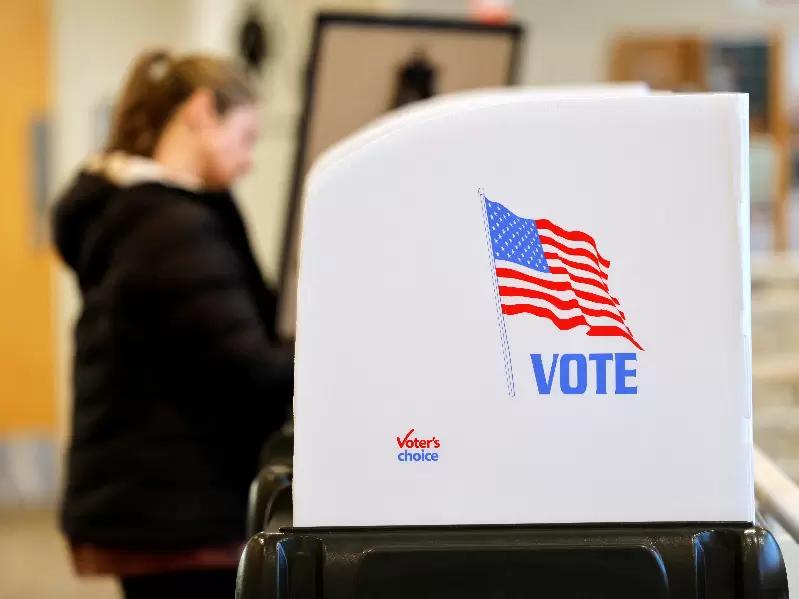 A woman votes during the state’s primary election to choose candidates for the November midterm elections, in Chapel Hill, North Carolina, U.S., March 3, 2026. / REUTERS/Jonathan Drake
With control of Congress hanging in the balance, voting rights advocates say the 2026 midterm elections could prove to be among the most consequential in recent history, as battles over redistricting, voter identification laws and election administration reshape access to the ballot.
Speaking during an American Community Media briefing on June 26, voting rights experts warned that while debates over election integrity dominate political discourse, the more immediate concern is ensuring that eligible voters are able to cast ballots that are counted.
“There are essentially two major issues,” said Thomas A. Saenz, president and general counsel of the Mexican American Legal Defense and Educational Fund (MALDEF). “One is redistricting. The second is restrictions on the right to cast a ballot and to have that ballot counted.”
Redistricting could reshape political representation.
Saenz said redrawing congressional and legislative district boundaries will have significant implications for representation, particularly for Black and Latino communities.
He noted that several Southern states have redrawn district lines in ways that could weaken the voting strength of majority-minority districts. While voters in those districts will still be able to vote, he said, they may lose the ability to elect candidates of their choice if communities are divided across multiple districts.
At the same time, Saenz observed that demographic changes could produce unexpected political outcomes. In Texas, where Latino and Black populations continue to grow, creating additional Republican-leaning districts has required Republican voters to be spread more thinly across multiple districts. Under certain election scenarios, he said, this could create opportunities for candidates favored by minority communities to prevail in more districts than before.
State laws, not federal executive orders, pose the greater challenge
Saenz emphasized that states, rather than the federal executive branch, hold primary authority over administering elections.
He argued that executive orders issued without congressional authorization cannot independently impose nationwide voter identification requirements for federal elections. Because federal, state and local elections are generally conducted simultaneously, any congressional changes to federal election law would likely affect all elections held on the same ballot.
“The greater danger is from state laws and local administration,” Saenz said.
He stressed that the federal Voting Rights Act remains an important legal tool for challenging state and local laws that disproportionately burden voters of color. Courts can also review voter identification requirements if they effectively prevent eligible voters from obtaining acceptable identification.
Several such legal challenges are already underway across the country.
Explosion of voter ID laws
DaHae Kim, policy advocacy manager for VoteRiders, said stricter voter identification laws continue to spread across the United States.
“We have seen an explosion of voter ID laws,” Kim said. “New bills are popping up at an alarming rate each year.”
According to VoteRiders, nearly 21 million voting-age Americans do not possess a current, unexpired driver’s license, while another 29 million have licenses that no longer reflect their current name or address.
Kim said people of color are approximately four times more likely than white voters to lack valid government-issued identification. Young voters also face challenges, with roughly 35 percent of Californians between the ages of 18 and 24 not possessing a driver’s license.
She also pointed to proposed proof-of-citizenship requirements, including provisions contained in the Safeguard American Voter Eligibility (SAVE) Act, saying millions of eligible citizens may struggle to produce the required documentation.
VoteRiders assists eligible voters by helping them obtain acceptable identification, covering transportation costs and document fees, and providing volunteers to guide applicants through the process.
Prepare well before Election Day
Both speakers urged voters to determine well in advance what identification their state requires.
Because identification rules differ from state to state—and frequently change—Kim encouraged voters to verify requirements early rather than waiting until Election Day.
“It may take weeks to obtain the identification you need,” Saenz cautioned.
He also warned that misinformation campaigns typically intensify as elections approach, with false claims circulating about who is eligible to vote, polling place locations, voting dates and identification requirements.
Instead of relying on social media, voters should obtain election information directly from their county registrar or local election officials, he said.
Concerns over election administration
Saenz also expressed concern about the role local election administrators could play in disputed elections.
He said election officials have significant authority over ballot counting and certification, making transparency and public oversight essential.
He encouraged trained election observers to monitor the voting process, noting that ballots can sometimes be rejected because officials question whether signatures match voter registration records. Language differences and unfamiliarity with Latino surnames or signatures, he said, can sometimes contribute to legitimate ballots being challenged.
“Being there as a watchdog can help prevent legitimate votes from being declared ineligible,” he said.
Local concerns in Northern California
Annelise Pierce, founder and managing editor of the Shasta Scout, discussed election administration issues in Shasta County, California, where election procedures have become the subject of public debate.
Pierce said the county, with approximately 116,000 registered voters, had to abandon hand-counting ballots after voting machines were reintroduced. She also noted that voter turnout in the June 2 primary election was low and that county officials were preparing to certify the election results on July 2.
Voter fraud remains rare
Both Saenz and Kim said documented cases of voter fraud remain exceedingly uncommon.
Instead, they argued that the larger challenge facing American elections is ensuring that every eligible voter can successfully navigate changing election rules.
Saenz pointed to states including Arizona, Wyoming and New Hampshire as having some of the nation’s stricter voter identification requirements, while noting that states retain broad authority over election procedures.
He contrasted California’s universal vote-by-mail system with Texas, where lawmakers have tightened mail voting rules in recent years.
“Texas is on the cusp of major demographic change,” Saenz said. “Those in power are very afraid. If they had robust participation they would lose. They are taking every step to restrict the ability to participate.”
As legal battles continue and election laws evolve, voting rights organizations urged Americans to stay informed, obtain any necessary identification well before Election Day, and rely on official election sources for accurate information.
Leave A Comment
Related






ADVERTISEMENT

ADVERTISEMENT
E Paper
Video

Comments
Start the conversation
Become a member of New India Abroad to start commenting.
Sign Up Now
Already have an account? Login