ADVERTISEMENT
ADVERTISEMENT



7 in 10 Indian Americans disapprove of Donald Trump: Carnegie survey
Findings indicate that one year into Trump’s second term, anxieties about discrimination and the shifting political environment coexist with continued belief in opportunity in the United States.
-
1759953093.png) Staff Reporter
Staff Reporter - Thu, 19, Feb 2026
- 09:00 EST
- 517
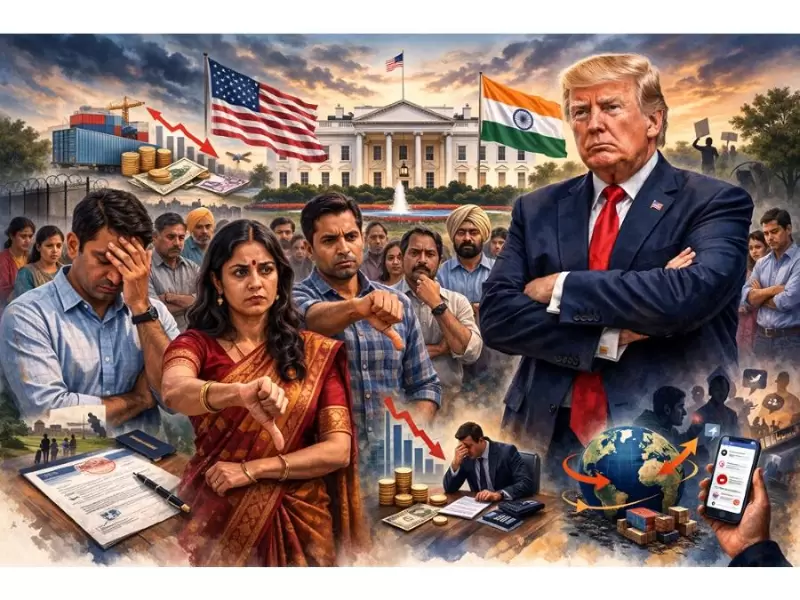 Representative image / Courtesy: AI-generated
A new Carnegie survey finds 71 percent of Indian Americans disapprove of how Donald Trump is handling his overall job as president in his second term.
The 2026 Indian American Attitudes Survey (IAAS), conducted in partnership with YouGov, found that only 29 percent of the 1,000 Indian American adults surveyed strongly or somewhat approve of how Trump is handling his job as president.
ALSO READ: Why is anti-Indian hate rising - and what should we do about it?
The findings, when compared to data from a nationwide YouGov poll from Dec. 2025, notably reveal that Indian Americans are substantially more critical of Trump than the overall U.S. population.
The report comes one year into President Donald Trump’s second term; the report finds that the community is reassessing their political and social position amid tensions in U.S.-India relations, domestic policy shifts, and rising reports of online hate speech targeting the community.
Large majorities also disapprove of Trump’s handling of key policy areas. The survey found that 64 percent disapprove of his immigration policy, 68 percent disapprove of his handling of the domestic economy, and 70 percent disapprove of his international economic policy, including trade and tariffs. In many cases, respondents expressed strong disapproval rather than mild opposition.
Evaluations of his management of U.S.-India relations are also negative. Fifty-five percent disapprove of Trump’s approach to relations with India, 20 percent approve, and roughly one-quarter report no opinion, suggesting limited foreign policy salience in electoral decision-making.
Indian Americans continue to identify disproportionately with the Democratic Party, but attachment has weakened since 2020. Democratic identification has declined to 46 percent, while Republican affiliation has increased modestly to 19 percent. Independents now account for 29 percent of respondents. Ideologically, 32 percent identify as moderates, the largest single bloc, placing the community largely at the center of the political spectrum.
Economic issues dominate policy priorities. Twenty-one percent cite inflation and prices as their most important issue, followed by jobs and the economy at 17 percent. Health care and immigration are the only other issues registering in double digits, while foreign policy concerns remain comparatively low.
Experiences of bias remain widespread. Twenty-seven percent believe Indian Americans face “a lot” of discrimination in the United States. About half report having personally experienced discrimination in recent years, most commonly based on skin color, country of origin, or religion. Since the start of 2025, one in four respondents report being called a slur.
Respondents also report frequent exposure to online racism, with nearly half saying they encounter anti-Indian content on social media regularly. Nearly one-third say discrimination concerns have led them to avoid political discussions online, and roughly one-fifth report modifying travel, public expression, or civic participation out of fear of harassment. However, the share reporting direct, personal experiences of discrimination has not significantly changed compared to prior survey waves.
Many respondents say discrimination has altered how they speak, live, or participate in public life, though most do not plan to leave the United States. While 14 percent say they frequently consider relocating abroad, a majority continue to recommend the country for employment, reflecting continued belief in economic opportunity.
The survey also finds that reactions to symbolic political events reflect ideological divides more than identity-based solidarity. Sixty-eight percent express enthusiasm for New York City Mayor Zohran Mamdani’s election, largely on ideological grounds. Public remarks by Vice President JD Vance regarding religion and marriage drew negative responses linked to concerns about religious inclusion and representation.
Collectively, the findings indicate that one year into Trump’s second term, anxieties about discrimination and the shifting political environment coexist with continued belief in opportunity in the United States.
The full study, available here, was fielded between Nov. 25, 2025, and Jan. 6, 2026, and has a margin of error of ±3.6 percent.
The report, authored by Sumitra Badrinathan of American University, Devesh Kapur of Johns Hopkins-SAIS, Andy Robaina of Carnegie Endowment for International Peace, and Milan Vaishnav of Carnegie Endowment for International Peace, builds on earlier IAAS waves conducted in 2020 and 2024 and examines partisan identity, vote preferences, policy priorities, evaluations of political leaders, and experiences with discrimination.
Discover more at New India Abroad.
Related





ADVERTISEMENT

ADVERTISEMENT
E Paper
Video

Comments
Zafar Iqbal
2026-02-20 00:00:00
While the published survey reports that more than 70% of Indians disapprove of President Trump’s ongoing policies, that broad dissatisfaction does not necessarily reflect uniform sentiment across socioeconomic strata. A non-scientific counter-reading suggests that, much like other affluent constituencies, well-off segments of the Indian community tend to view his economic agenda more favorably—particularly policies centered on substantial income tax reductions and deregulation that disproportionately benefit higher earners.
The divergence in perception underscores a deeper structural issue present in both of the world’s largest democracies: the steady erosion of the middle class. As wealth becomes increasingly concentrated and upward mobility narrows, societies risk hardening into economically polarized tiers. Persistent unemployment and underemployment further suppress wage growth and weaken collective bargaining power, muting demands for equitable living standards. Simultaneously, the weakening of regulatory and judicial institutions—especially those overseeing environmental protection, market accountability, and rule of law—reduces the systemic safeguards that temper concentrated economic and political power.
Viewed through this lens, the survey’s findings reflect not merely partisan disagreement but a broader anxiety about institutional erosion, economic stratification, and the long-term resilience of democratic systems.
JAMES DURAISWAMY
2026-02-20 00:00:00
The Carnegie Institution is a left‑leaning organization, so it’s no surprise that people who dislike Trump turn to left‑leaning think tanks for support. For many Indian Americans, immigration seems to be the biggest issue. Trump’s approach focuses on enforcing existing immigration laws, whether that involves people who entered illegally or overstayed their visas.
The article claims that 68% disapprove of his domestic policies, yet it doesn’t specify which policies they’re referring to. It’s also worth asking why there wasn’t the same level of criticism during Biden’s presidency, especially when many of today’s issues began under his administration.
If the U.S. restricts entry from certain countries for legal or security reasons, it’s often labeled as discrimination — a familiar talking point in Democratic politics. But realistically, would any country, including India, accept two million people from another nation all at once?
Supporters argue that Trump has reshaped American politics by focusing on voter‑roll accuracy and immigration enforcement. And for naturalized citizens, it’s important to remember the oath to uphold U.S. laws. At some point, you have to decide which policies you stand behind — you can’t balance on two sides forever.