ADVERTISEMENT
ADVERTISEMENT


Knicks and a walk down memory lane from a consummate fan
This year's playoff run had all the elements that make sports unforgettable—the drama, adversity, the improbable comebacks, and, ultimately, the ecstasy of victory.
-
 George Abraham
 - Sun, 21, Jun 2026
- 01:25 EDT
- 516
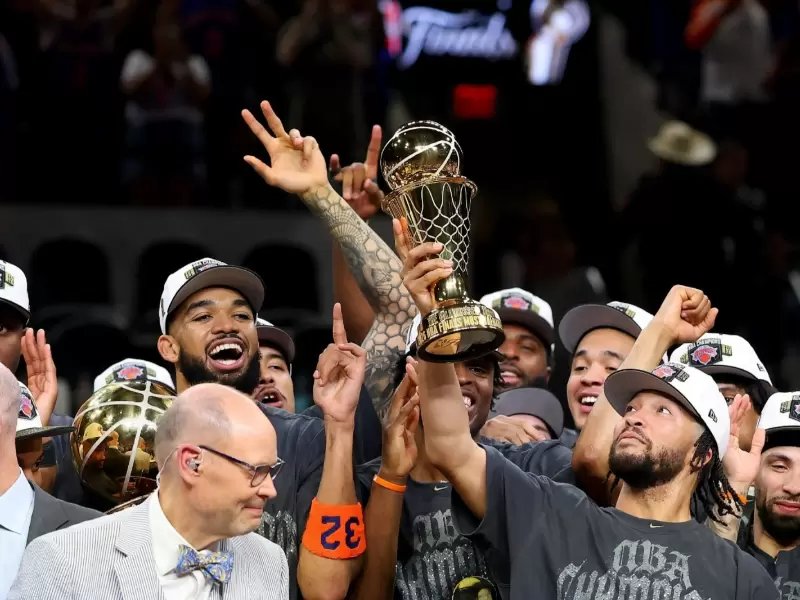 New York Knicks / Credit: New York Knicks/X
I arrived on these shores in 1968 and began the process of acquainting myself with the customs, traditions, and language of this great nation. I quickly discovered that sports were one of America's great institutions, and New York was already regarded as the Mecca of sports. That reputation was fully justified when, within less than two years of my arrival, New York celebrated an extraordinary run of championships. In January 1969, the New York Jets captured Super Bowl III behind the bold leadership of quarterback Joe Namath. Later that year, the "Miracle Mets" stunned the heavily favored Baltimore Orioles to win the World Series, powered by the magnificent pitching of Tom Seaver, Jerry Koosman, and a young Nolan Ryan. Then, in 1970, the New York Knicks brought home the NBA championship under the leadership of Willis Reed and Walt "Clyde" Frazier. For a newcomer to America, there could not have been a more exciting introduction to the world of sports and to a city that truly lived and breathed its teams.
For me, it was a fascinating learning experience. Baseball and football were totally unfamiliar games, and I had to learn their rules from scratch. I vividly remember writing an article for Kerala Sandhesam, a handwritten magazine produced with the late Thiruvalla Baby's help, explaining the basic rules of baseball to early immigrants from Kerala. Basketball, however, was familiar territory. Before leaving India for higher studies in the United States, I had watched many games at Christian College, Chengannur, where I was a pre-degree student. Naturally, I gravitated toward the Knicks.
Also Read: Indian American voices join the celebration as Knicks end 53-year title drought
New York had a remarkable team in the 1969–70 season. Although I was a struggling student, scraping together every dollar to pay tuition and make ends meet, the Knicks fascinated me. I managed to save enough money to attend a game at Madison Square Garden. To this day, I can still remember the majestic setting of the Garden and the festive atmosphere created by thousands of enthusiastic fans. That experience remains etched in my memory.
I can still vividly recall Dave DeBusschere's long-range shooting. In those days, there was no three-point line. Every basket, regardless of distance, counted for only two points. It was not until the 1979–80 season that the NBA introduced the three-point shot. Looking back, one cannot help but wonder how many additional points DeBusschere and some of his contemporaries might have accumulated had the three-point line existed during their era.
The Knicks were led by their captain, Willis Reed, with Dave DeBusschere at power forward, Bill Bradley—who would later become a United States Senator from New Jersey—at small forward, Walt "Clyde" Frazier at point guard, and Dick Barnett at shooting guard. Key reserves included Cazzie Russell and Phil Jackson, who would later become the legendary coach of the Chicago Bulls and Los Angeles Lakers.
The Knicks met the Los Angeles Lakers in the NBA Finals that year. The Lakers were a formidable team. We watched the games on a black-and-white television set. They featured the legendary Wilt Chamberlain, who still holds the NBA record for scoring 100 points in a game, the great clutch shooter Jerry West, and Hall of Famer Elgin Baylor. Pat Riley, who would later become one of the greatest coaches in NBA history, was among the reserves.
The seventh game of the 1970 NBA Finals, played on May 8, 1970, remains one of the most dramatic moments in sports history. The series was tied three games apiece, and Knicks captain Willis Reed had suffered a severe muscle tear in his right thigh during Game Five. He missed Game Six, which the Lakers won convincingly, and most observers believed he would be unable to play in the decisive game.
With Wilt Chamberlain, Jerry West, and Elgin Baylor leading the Lakers, New York entered Game Seven as the underdog. About fifteen minutes before tipoff, the anxious crowd inside Madison Square Garden still did not know whether Reed would play. Then, suddenly, he emerged from the tunnel, visibly limping. The Garden erupted. Legendary broadcaster Howard Cosell captured the moment forever with his famous words: "Here comes Willis!"
The emotional impact was enormous. Reed could barely run, but his mere presence inspired the Knicks and energized the crowd. On New York's first possession, he hit a jump shot over Chamberlain. Moments later, he sank another jumper. Those were his only baskets of the evening. Reed played just 27 minutes and scored only 4 points, but his courage transformed the game's atmosphere.
While Reed provided the inspiration, Walt Frazier delivered one of the greatest performances in NBA history. He finished with 36 points, 19 assists, and 7 rebounds. His dazzling ball-handling, passing, and shooting completely controlled the game as the Knicks captured their first NBA championship.
The Knicks would win again in 1973. By then, Earl "The Pearl" Monroe had replaced Dick Barnett at shooting guard. Monroe's twisting and weaving style made him one of the most exciting scorers in the league. Once again, the Knicks defeated the Lakers, winning the series in five games to claim their second NBA title. A special tribute to William ‘Red’ Holzman, who was the inspiring coach for those two championship runs. `
Now, as we celebrate the Knicks' championship this year after a wait of more than half a century, under the leadership of Jalen Brunson, who has authored his own remarkable performances and dramatic comebacks, I cannot help but be transported back to those glorious days.
This year's playoff run had all the elements that make sports unforgettable—the drama, adversity, the improbable comebacks, and, ultimately, the ecstasy of victory. For generations of New York fans who endured a long drought, the celebration was especially sweet.
Congratulations to Jalen Brunson and the entire team. For an old fan who has been following the Knicks since 1969, the memories have come full circle.
(George Abraham is a former Chief Technology Officer at the United Nations and current Vice-Chair of the Indian Overseas Congress, USA)
(The views and opinions expressed in this article are those of the author and do not necessarily reflect the official policy or position of New India Abroad.)
Discover more at New India Abroad
Leave A Comment
Related







ADVERTISEMENT

ADVERTISEMENT
E Paper
Video

Comments
Start the conversation
Become a member of New India Abroad to start commenting.
Sign Up Now
Already have an account? Login