ADVERTISEMENT
ADVERTISEMENT


Vinod Daniel’s journey from IIT to Australia’s famous cultural ambassador
Daniel bridges science and culture, shaping museums worldwide and advancing vision care access in India
-
1747754650.png) Ishani Duttagupta
Ishani Duttagupta - Tue, 07, Apr 2026
- 05:20 EDT
- 572
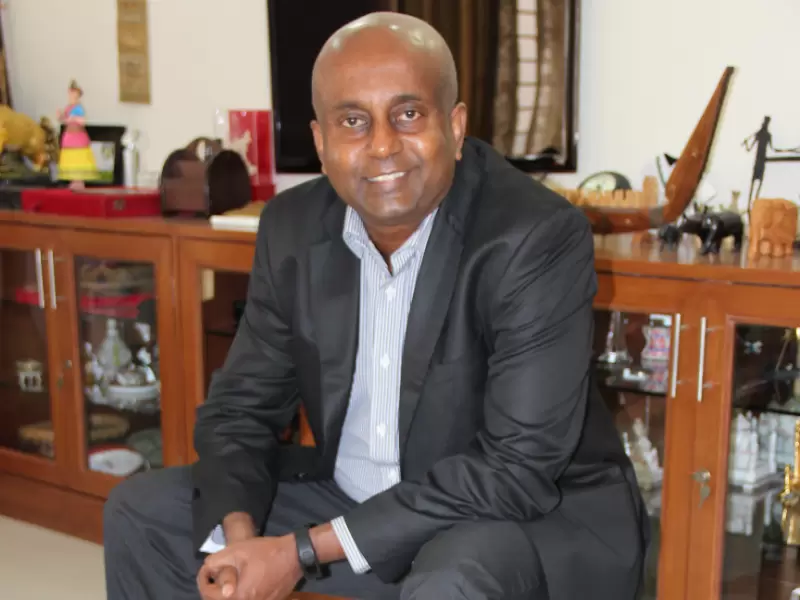 Vinod Daniel / Ishani Duttagupta
Despite describing himself as a ‘Chennai boy’ at heart, Vinod Daniel’s journey has been anything but local. Following the well-trodden path of his fellow IIT alumni in the 1980s, Daniel went for further studies to the United States after his chemical engineering degrees from IIT Delhi and IIT Madras.
However, his career took a sharp turn from the norm of Indian technology students when he spotted a unique opening at the Getty Trust. The organization was seeking a chemical engineer to tackle the scientific challenges of cultural preservation. “I applied because it looked interesting and unique,” Daniel recollects. “I was lucky to get it.”
ALSO READ: Curiosity, code, and the cosmos: Priyamvada Natarajan’s journey
And that kick-started a distinguished four-decade career in museum conservation. His first assignment at the Getty in Los Angeles was designing specialized display cases for the royal mummies of Egypt. “It was an interesting start for a chemical engineer. The reason why they wanted somebody with an engineering background in conservation science was that most deterioration that happens is chemical, and anything that one can do to minimize that could help in prolonging the life expectancy of an object,” Daniel said in an exclusive interview.
His first project was a challenging one — finding ways to decrease bacterial growth in human remains. The science behind the new display cases was that they had no oxygen, but nitrogen, an inert gas, with the humidity being kept low. “Insects also pose a big problem for cultural collections. But using toxic chemicals to treat them was having a reaction that would impact the objects. So, we looked at newer non-toxic alternatives for dealing with insects, and that was where my career started with museums,” Daniel said.
Over the past decades, he has served as a strategic adviser to museums in more than 60 countries, helping to raise standards in conservation, collection management, digitization and visitor engagement. As vice chair of the International Council of Museums (ICOM) committee for conservation (2008–2014), he played a leading role in developing global guidelines on risk management, preventive conservation and collection care, influencing professional practice worldwide.
“The world of museums is a very interesting community of a small number of people with a strong passion. I have had an opportunity to travel a lot doing training and workshops on conservation technologies because there is a lot of interest globally,” he said. It was a bigger opportunity which led his career from LA to Sydney, followed by extensive work in museum conservation in the Asia-Pacific region. It also broadened his horizon as he started delving into other aspects in museum covering education, scientific services, business services and all other aspects. He now works professionally with museums, especially new ones, to put them together because most architects and project managers are not aware about different aspects of conservation.
Since 2016, he is the chair of AusHeritage, actively promoting Australian heritage expertise across the Indo-Pacific, leading delegations, workshops and collaborative projects that showcase innovation in conservation, museology and cultural policy. “Australia is receptive to people coming in, that has been my experience. I have never faced any barriers to taking on senior management roles,” says Daniel, who is among the best-recognized knowledge leaders in culture and heritage.
He feels that migration to Australia from India is increasingly of younger people. “The numbers of young second- and third-generation people of Indian origin in Australia too are increasing. These people are doing very well, in diverse fields from foreign affairs to contesting elections. Increasingly, many Indian-origin people are getting elected to various positions and having an impact on different aspects of government,” he said. Daniel was himself recognized for his service with the prestigious Medal of the Order of Australia in 2017.
He has also played a leadership role in philanthropic work and giving back in India, his country of birth, through India Vision Institute (IVI) as CEO, managing trustee and co-founder. “A colleague on one of the boards that I was on was doing a lot of work on eye care around the world. And at a stage in life, I wanted to do something pro bono socially back in India. That’s where my roots are. And I was looking at trying to find a niche where an intervention can make a difference,” he recollected.
He got connected to the founder-chair of the LV Prasad Eye Institute, Dr. G.N. Rao, and in the discussions that followed, it became quite clear to Daniel there were probably more than 200 million people in India who can’t see well because they don’t have access to a pair of glasses. It was a very simple intervention, he realized, through which he could make a sustained and measurable contribution to social development. Under his leadership, IVI has vision screened more than two million people from low-income communities across 25 states in India, including one million schoolchildren, workers, and people from vulnerable groups. IVI’s programs provide free spectacles to those who need them and referrals to tertiary-care hospitals for those requiring further medical or surgical treatment.
ALSO READ: How Devi Parikh turned curiosity into a career
From its humble beginnings, the organization has expanded into a national powerhouse with a presence in Delhi, Mumbai, Kolkata, Chennai, and Bengaluru. For Daniel, the mission is centered on a simple pair of spectacles. The impact of vision correction is measured in more than just clarity — it is measured in livelihoods. Daniel highlights a critical threshold in adult life where the lack of reading glasses becomes a systemic barrier. “After a certain age, everyone needs reading glasses; if they don’t have a pair, the productivity goes down, especially if they’re doing manual work. Productivity goes down about 30% and their income capacity also goes down about 30%. Which might be the difference between them being above the poverty line to being below the poverty line. So, there is a financial impact.”
The crisis is equally acute for India’s youth. Studies on distance vision reveal that 7% of Indian schoolchildren require corrective lenses, yet many remain underserved. “Children in government and tribal schools often lack access,” Daniel notes. “With a simple pair of spectacles, these kids can see the blackboard and study effectively. Research suggests the chances of them achieving better grades increase by more than 50%.”
To ensure these interventions aren't just temporary fixes, IVI has also integrated its programs with a long-term strategy including training a new generation of eye health professionals and community workers. With support from Australia’s Department of Foreign Affairs and Trade (DFAT), Australian state governments, universities and companies, Daniel has positioned IVI as a vehicle for Australian development impact too, to address a public health challenge in India.
He is active within his IIT alumni networks in Australia and has received the IIT Delhi Global Alumni Recognition Award, recognizing his leadership and achievements as an alumnus. “The IIT network is strong and global and there is a deep interest among IITians to give something back either to their local communities or to India,” he said. Daniel has also worked on high-profile museum and conservation projects in India. At Getty, he was part of the team that supported a project in preserving the original Constitution of India. “I worked on the project to preserve the remnants of the original kurta-pyjama worn by India’s former Prime Minister Rajiv Gandhi when he was assassinated. It is on display at the Indira Gandhi Memorial Museum in New Delhi and is a cultural relic of a tragic historical event,” he said.
Daniel has also contributed to other prestigious museum projects in India including the Government Museum (Chennai), Victoria Memorial (Kolkata), E.K. Nayanar Museum (Kannur) and the St. Chavara Kuriakose Elias Museum.
Discover more stories on New India Abroad
Leave A Comment
Related

ADVERTISEMENT

ADVERTISEMENT
E Paper
Video

Comments
Start the conversation
Become a member of New India Abroad to start commenting.
Sign Up Now
Already have an account? Login