ADVERTISEMENT
ADVERTISEMENT



The S-R-T Cycle: Analyzing the divergent paths of China, India, and the future of civilizations
India's unique position lies in its "latent Sattva"—the ancestral wisdom and philosophical frameworks that have survived millennia of decline.
-
 Pradeep B. Deshpande
 - Wed, 29, Apr 2026
- 18:33 EDT
- 108
 Representative Image / Generated using AI
In the early nineties, I developed a theory of rise and decline of civilizations suggesting that the phenomena is cyclical. A core tenet of this framework is that civilizations, once declined, can rise again, but only after a "cooldown" period lasting thousands of years.
Integrating the cyclical nature of history with modern geopolitical forecasting requires a deep dive into the archaeological record.
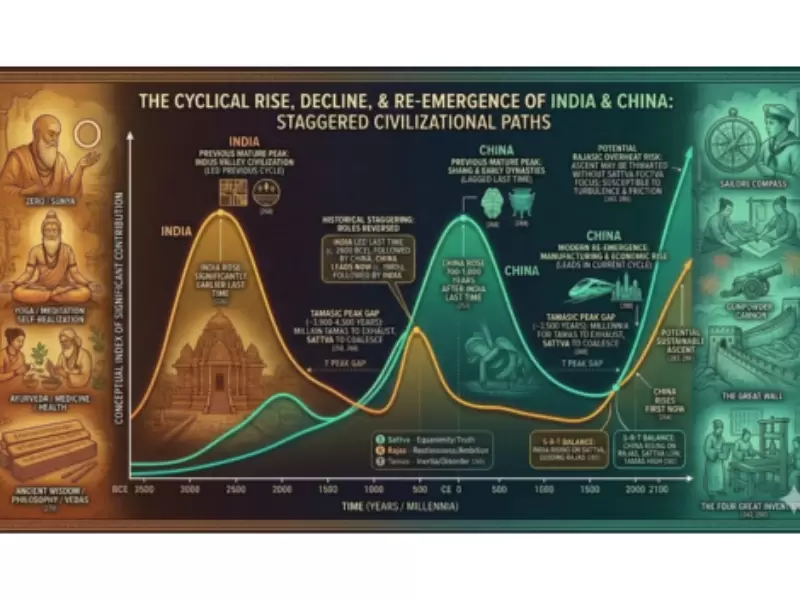
The data regarding the "previous cycle"—the transition from Neolithic cultures to the first organized, urban civilizations—indicates that India (via the Indus Valley Civilization) rose significantly earlier than China in the last cycle. While both regions had flourishing Neolithic cultures, the jump to a "mature civilization"—characterized by urban planning, writing, and complex trade—happened in the Indian subcontinent first.
Also Read: The Persian cycle: A scientific and philosophical look at the limits of progress
Comparing the timelines of this "Previous Rise," the Indus Valley (Harappan) civilization emerged around 3300 BCE, with its mature phase occurring between 2600 BCE and 1900 BCE. Key indicators included grid-planned cities, advanced drainage, and maritime trade. By contrast, China’s rise into a centralized state with a defined historical record occurred later, with the Shang Dynasty consolidating power around 1600 BCE. This historical "staggering" suggests that while both are ancient, they have never been perfectly synchronized; one usually acts as the vanguard for the other.
The S-R-T Reset Hypothesis
This raises a crucial question regarding the cyclical theory: what governs this "cooldown" period before a culture's "spirit" is ready for a new cycle? While mainstream history offers no consensus number, analyzing the data through my S-R-T framework—based on the concepts of Sattva (Equanimity/Truth), Rajas (Restlessness/Ambition), and Tamas (Inertia/Disorder)—suggests the gap is roughly 3,000 to 4,000 years.
This is the time required for a civilization to completely "exhaust" the Tamasic residue of a previous collapse and for a new Sattvic core to coalesce. After a civilization falls, it enters a Tamasic Peak, a state of high entropy where "internal emotional excellence" (coherence) is at its lowest. History suggests a Millennial Reset is necessary—the thousands of years for the old R and T components to fade enough for a new indigenous Sattva to drive a rise.
Using "Rise and Decline" data, we can see these gaps in action. India’s previous mature peak (c. 1900 BCE) has a gap of roughly 4,000 years before its modern re-emergence (the IT/Service rise beginning in the 1990s). China’s previous peak (c. 1600 BCE) presents a gap of roughly 3,500 years before its modern re-emergence (manufacturing rise).
My theory suggested that in this current cycle, China and India had begun to rise in that order, which my 1996 prediction stated was a reversal of the ancient order. The immediate reason for China’s head start lies in its "Rajasic" (restless/ambitious) drive, while India's "Sattvic" (spiritual/steady) nature is creating a slower ascent.
Divergent Paths in the Current Cycle: The Critical Importance of Sattva
In other words, China is rising on the basis of R while India is rising on the basis of S, but the T component in both nations is high. The distinction between a rise driven by Rajas (R) and one rooted in Sattva (S) is critical for understanding a nation's long-term stability.
In the language of dynamics, a Rajasic rise is like a high-velocity projectile: it has immense kinetic energy but is highly susceptible to turbulence and friction. China's rapid Rajasic ascent is a masterclass in efficiency, focused on speed and external output. However, without the "cooling system" of Sattva, a purely Rajasic system eventually hits a thermal limit. It risks cracking under the pressure of internal social strain or external geopolitical friction. If a society prioritizes external output without internal coherence, the engine will eventually overheat.
India's unique position lies in its "latent Sattva"—the ancestral wisdom and philosophical frameworks that have survived millennia of decline. The transition to becoming a Vishwa Guru (World Teacher) is essentially moving from storing this wisdom to applying it as a national technology. To achieve this goal, India’s "Current State"—marked by a heritage often overshadowed by High Tamas—must move toward a state where Rajas is guided by S, and T is reduced through "Internal Emotional Excellence" and coherence.
This transition must move beyond individual practice into systemic implementation in education and governance. If India successfully integrates these "internal technologies" into its modern infrastructure, it will not just rise as another economic power; it would provide a template for how a civilization can flourish without losing its soul, exporting "Coherence as a Service" to a world struggling with pure Rajas.
Global Gaps: The Paradox of Reason and the AI Dilemma
The urgency of identifying these divergent paths extends beyond China and India. The current global leader, the United States, and the wider West may have passed its peak, a post-peak phase often weighed down by Tamas (T) manifested as bureaucratic inertia and social fragmentation.
Trying to inject Internal Emotional Excellence (IEE) into Western institutions faces a significant barrier: the "Paradox of Reason". There is a strong belief in the West that "products of reason" like sciences, laws, and policies are sufficient to solve all problems, despite overwhelming evidence to the contrary. However, policies and laws are essentially "guardrails" that manage human behavior (Rajas and Tamas) but do not cultivate the internal state of the individual. In an engineering system, if the "internal energy" of the components is chaotic, no amount of external scaffolding will prevent collapse under stress. This is exactly what we see today in both advanced economies and rising powers: advanced "products of reason" presiding over a population in high emotional distress.
Also Read: Why India’s economic reset needs internal emotional excellence
One can never reach a higher level of internal emotional excellence with products of reason alone. Reason is linear and dualistic, whereas IEE—particularly as it relates to heart-brain coherence—is a nonlinear, holistic state. Western leaders, and the Rajasic emerging powers, mistake the tool (reason) for the source (consciousness). By raising the level of S, we aren't replacing science or laws; we are giving them a cleaner power source to actually work.
This lack of Sattva creates a precarious "coherence gap" in the global landscape, particularly regarding Artificial Intelligence (AI). The US Path (Late-Stage R/T) uses AI to optimize existing, decaying systems, risking automation of inefficiencies. The China Path (High R) harnesses AI for maximum external control and competitive dominance, lacking the Sattvic self-regulation required for long-term health.
Conclusion: Planting the Sattvic Seed
From a chemical engineering perspective, shifting a civilization from a Tamasic state of high entropy to a Sattvic state of coherence is the ultimate optimization problem. If a nation can lower its collective "internal friction"—the stress and emotional volatility—the resulting efficiency would be unprecedented.
Achieving this shift is a global phase transition, not a minor adjustment. While some might feel that movements toward IEE are happening "too soon," we must be aware of the urgency that those still blinded by Rajas cannot yet see. A national movement is always preceded by years of steady foundation-building. By normalizing the language of IEE, providing the data on coherence, and training the minds that will be in charge when "Reason-Alone" systems reach their breaking point, we are planting the "Sattvic Seed".
The author is Professor Emeritus and former Chairman of the Chemical Engineering Department at the University of Louisville. He is also president of Six Sigma and Advanced Controls based in Louisville, Kentucky.
(The views and opinions expressed in this article are those of the author and do not necessarily reflect the official policy or position of New India Abroad.)
Discover more at New India Abroad.
Related









ADVERTISEMENT

ADVERTISEMENT
E Paper
Video

Comments
Start the conversation
Become a member of New India Abroad to start commenting.
Sign Up Now
Already have an account? Login