ADVERTISEMENT

ADVERTISEMENT

The paradox of ancient genius

Cyclical Time, Epistemology, and the Dawn of Indian Science

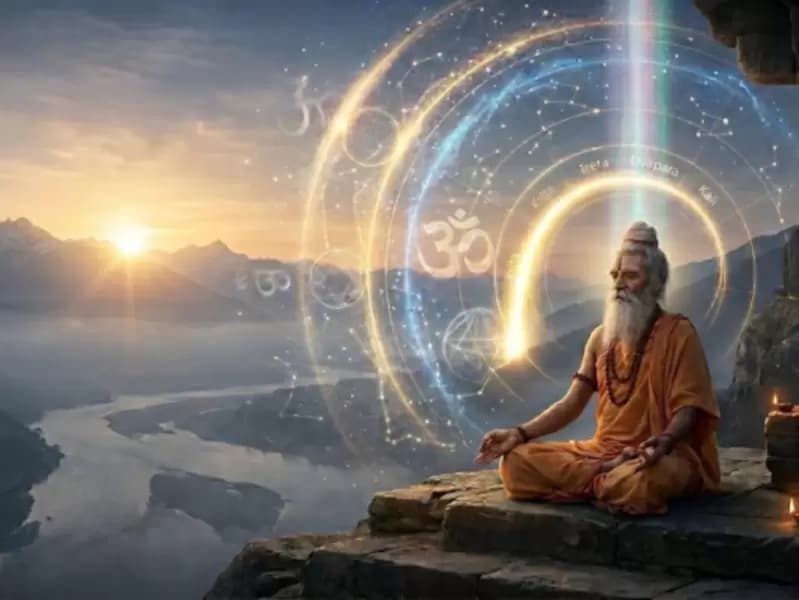
 Representative Image Representative Image / Generated using AI

If we strictly subscribe to the modern narrative of human evolution, history is a straight line sloping upward. The further back in time we travel, the more primitive human civilizations should theoretically become.

We expect to find societies consumed entirely by the brutal realities of survival: mastering fire, crafting rudimentary tools, hunting, and securing shelter against a hostile wilderness. Progression, in this view, is cumulative. We stand on the shoulders of giants, and therefore, the oldest ancestors must be standing on the ground.

Yet, when we examine the antiquities of the Indian subcontinent, this linear model fractures. Thousands of years ago, during epochs Western historiography often associates with the Bronze Age, the sages of India were producing the Vedas, the Upanishads, and the foundational texts of Yoga.

 These were not primitive survival manuals; they were dizzyingly complex treatises on consciousness, cosmology, psychology, and metaphysics.

How could a civilization supposedly in its infancy produce insights that modern quantum physics and psychology are only now beginning to validate? Did someone teach them? If so, who taught the teachers?

Defining the Epistemology: Type I vs. Type II Discoveries

To understand this anomaly, we must establish a framework for how humanity acquires knowledge. Discoveries can be broadly categorized into two distinct domains:

Type I Discoveries (The Realm of the Known): These occur within the boundaries of existing knowledge. An enquirer makes a Type I discovery by connecting existing dots in ingenious, logical, or mathematical ways. This is iterative science -- highly structured, rational, and cumulative. Crucially, this is the exact domain where Artificial Intelligence excels: processing vast swathes of existing data to find novel correlations.

Type II Discoveries (The Realm of the Unknown): These produce entirely new knowledge that does not yet exist in the cultural or scientific domain. These are paradigm shifts that seem to come from nowhere -- geniuses that break standard logical continuities.

In ancient India, the breakthroughs were overwhelmingly Type II. The sages did not arrive at the concept of Brahman (the singular, infinite cosmic consciousness) or the intricate psychological maps of the human mind through external laboratory experimentation or data compilation. They arrived at them through internal exploration -- specifically, through the technology of deep meditation (Dhyana) and Yoga.

But this simply kicks the question further down the road. If Type II discoveries require a highly refined methodology of meditation, who taught these ancient people to look inward while the rest of the world was looking outward?

The Yuga Cycle: The Rise and Fall of Collective Consciousness

The answer to this mystery does not lie in external intervention -- such as ancient astronauts or lost, physically advanced empires -- but rather in a completely different understanding of time and human capacity. The clue is preserved in the timeless wisdom of the Bhagavad Gita.

In the Gita, Sri Krishna expounds on a worldview where time is not linear, but cyclical. Human civilization does not infinitely progress upward; instead, it breathes in and out. The intellectual and emotional capacities of humanity undergo massive, macro-historical transformations over thousands of years.

According to this cyclical model, the trajectory of a civilization is determined by its collective emotional and intellectual excellence.

1. The Emotional Vector

When a society is tethered by a preponderance of positive emotions -- such as compassion, truthfulness, self-restraint, and harmony -- its collective consciousness rises. Under the influence of these higher emotional states, the mind becomes calm, clear, and capable of perception beyond the five senses.

However, this rise cannot continue indefinitely. When a civilization reaches its absolute peak of emotional excellence, complacency, ego, and luxury inevitably creep in, giving way to negative emotions (greed, anger, division). The society then enters a period of decay.

2. The Intellectual Vector

Parallel to this emotional wave is the transformation of the human intellect. The civilizational intellect itself expands and contracts over vast epochs. At the peak of the cycle, human beings possess an intuitive intellect capable of unmediated access to universal truths (Type II discoveries). As the cycle turns downward, this intuitive capacity atrophies, leaving humanity with only the gross, linear, sensory-based intellect we rely on today.

Solving the Paradox

This cyclical mechanism elegantly solves the paradox of the ancient rishis (sages). Nobody taught the first teachers to meditate, nor did they receive an external manual on how to access Type II discoveries.

Instead, thousands of years ago, the Indian civilization was sitting at the absolute apex of a grand intellectual and emotional cycle. Because their collective intellect was highly refined and unburdened by the dense negative stressors of a declining age, deep meditation was not an artificial skill they had to invent; it was a natural, spontaneous expression of their highly evolved state of consciousness.

They did not need to be taught to look inward because, at that level of civilizational excellence, the veil between the individual mind and the universal mind was naturally thin.

The Implications for Indian Antiquity: If the Indian civilization was actively codifying highly complex, peak-level metaphysical discoveries in 2,000 B.C.E. or earlier, it means they were already standing at the summit. For a society to reach such a peak of intellectual and emotional excellence, its upward climb must have begun many millennia prior. This strongly suggests that Indian civilization, and the history of human consciousness itself, is vastly older and far more sophisticated than modern linear anthropology currently acknowledges.

The Horizon Ahead

By reframing history through the lens of the Bhagavad Gita, we break free from the arrogance of modernity. We begin to realize that our ancestors were not primitive cave-dwellers slowly groping toward the light; rather, they were the keepers of a brilliant light that has since dimmed as the cosmic cycles turned.

As we navigate our current era -- flooded with Type I technological achievements like AI but desperately starving for Type II wisdom -- studying the remnants of India's golden age is no longer just an exercise in archaeology. It becomes a necessity.

By understanding how the ancient sages accessed the deeper realms of the mind, we might just find the roadmap required to elevate our own emotional and intellectual excellence, charting a course for the next great rise of human civilization.

Our ancestors were not primitive cave-dwellers slowly groping toward the light -- they were the keepers of a brilliant light that has since dimmed as the cosmic cycles turned.


The author is Professor Emeritus and former Chairman of the Chemical Engineering Department at the University of Louisville. He is also president of Six Sigma and Advanced Controls based in Louisville, Kentucky.


(The views and opinions expressed in this article are those of the author and do not necessarily reflect the official policy or position of  New India Abroad.)


Discover more at New India Abroad.


Comments

Related