ADVERTISEMENT

ADVERTISEMENT

Qatari Al Jazeera's India obsession is not journalism—it Is infoWar

If Qatar believes in the universal principles of transparency, accountability, and free expression, those standards should apply in Doha just as much as they are invoked in New Delhi.
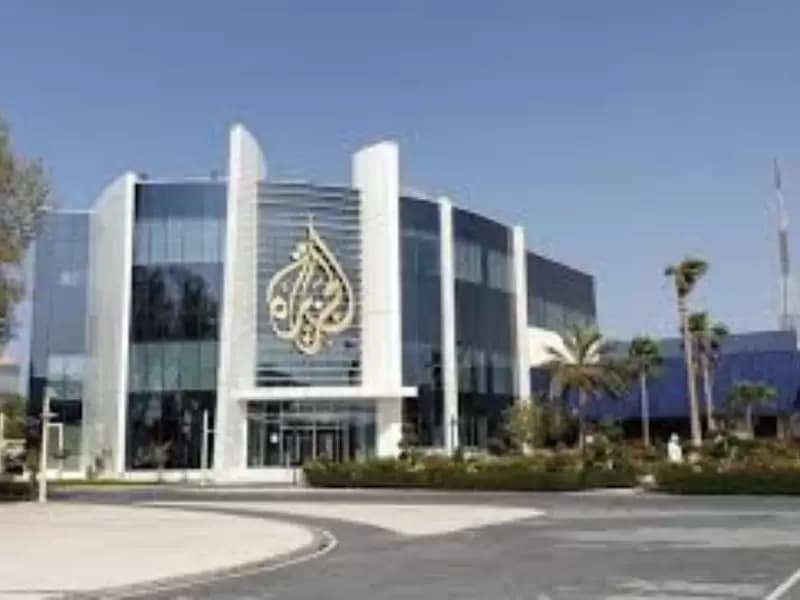
 The Al Jazeera Media Network logo is seen on its headquarters building in Doha, Qatar  The Al Jazeera Media Network logo is seen on its headquarters building in Doha, Qatar / [Showkat Shafi/Al Jazeera]

"Ask a Bahraini, ask a Saudi, ask a Kuwaiti—they will all tell you the same thing: Al Jazeera is a criminal outlet."

The quote above may sound provocative to audiences outside the Middle East, but it reflects a sentiment that exists across sections of the Arab world. Al Jazeera has long been a controversial actor, accused by governments and commentators in the region of amplifying unrest, glorifying protests when it suits Doha's interests, and intervening in the internal affairs of sovereign nations through selective narrative-building.

This is the same network that has faced severe criticism from Bahrain and other Gulf states over its coverage of regional conflicts and political movements. Yet in the West, Al Jazeera often continues to enjoy the image of an objective international broadcaster.

India has increasingly become one of its favorite targets.

The latest example came through an Al Jazeera article claiming that Indian Muslims were being denied public spaces for Eid prayers because of fear and Islamophobia. The article painted a picture of a country where Muslims struggle to publicly practice their faith. Within hours, the familiar ecosystem of activists, commentators and social media amplifiers had begun circulating the story as further proof of India's democratic decline.

The problem is not criticism. Every democracy should be open to criticism. The problem is the deliberate conversion of isolated incidents into sweeping civilizational indictments. There is a difference between reporting facts and constructing narratives.

This is where Qatari Al Jazeera's coverage of India becomes deeply problematic.

Manufacturing Perception Through Selective Storytelling

For years, India has been presented through a narrow framework by sections of international media. Isolated incidents from the population of 140 crore population, involving religion, communal tensions, caste conflicts or political controversies are routinely elevated into evidence of systemic collapse. By the time these stories reach global audiences, India is portrayed as a nation perpetually on the brink—either descending into authoritarianism, engulfed in communal violence, or denying minorities basic rights.

The reality is often far more complex.

I have personally offered Eid prayers in Saudi Arabia, Hyderabad and, most recently, Yogi-ruled Uttar Pradesh. I witnessed no ban on prayers, no widespread atmosphere of fear, and certainly nothing resembling the picture presented by Al Jazeera's article. Yet international readers were led to believe that Indian Muslims were being denied the ability to worship.

Why does this happen repeatedly?

Because the objective appears to be larger than reporting individual incidents. The objective is narrative construction. Every local dispute becomes a national crisis. Every administrative issue becomes evidence of persecution. Every controversy is amplified until it appears representative of the entire country.

For me, the issue is not religious. It is national. My country comes above my religion and my community. When international outlets attempt to portray India as a society in constant conflict, they are not merely criticizing a government. They are damaging India's image, undermining its social cohesion and distorting global understanding of one of the world's most diverse societies where every religion and their respective sects co-exist peacefully.

The Qatari Hypocrisy

Perhaps the most glaring contradiction in this entire debate is Qatar's own intolerance toward the kind of scrutiny it routinely encourages abroad. Doha has no hesitation in funding platforms, cultivating networks, and employing contributors across countries to shape narratives that align with its interests. Yet one must ask a simple question: how would the Qatari state react if the roles were reversed?

Imagine two Indian journalists operating inside Doha, publishing articles about labor rights abuses during the FIFA 2022 World Cup preparations, documenting allegations of migrant worker exploitation, or investigating claims of corruption and bribery surrounding Qatar's successful World Cup bid. Would Qatar celebrate such reporting as an exercise of freedom of expression? Would it defend the journalists' right to scrutinize the state's conduct? Or would the authorities move swiftly against them under the country's stringent laws governing speech, national security, and public order?

The answer is obvious. Qatar does not permit unrestricted political criticism of its ruling establishment, nor does it tolerate organized campaigns challenging state interests from within its borders. Yet the same state, through institutions such as Al Jazeera and its broader influence networks, expects complete freedom to intervene in the internal debates of other nations.

What makes the situation even more troubling is the aspiring writers and commentators in countries like India are recruited for peanuts, and the promise of international exposure to produce content that advances predetermined narratives. In such arrangements, local voices become instruments for external agendas, often without fully appreciating the long-term consequences.

If Qatar believes in the universal principles of transparency, accountability, and free expression, those standards should apply in Doha just as much as they are invoked in New Delhi. If not, then the world is entitled to view such activism not as a defense of press freedom, but as an exercise in geopolitical hypocrisy.

The Ecosystem Behind the Narrative

The question is not whether these narratives exist. The question is who benefits from them.

In my view, a large transnational ecosystem has emerged that includes sections of activist networks, ideological organizations, media platforms and advocacy groups. The nexus of Left and Muslim Brotherhood's international influence cannot be ignored in this discussion. Whether on Kashmir, communal issues or minority rights, many of the narratives that gain traction internationally often pass through overlapping networks of activists, organizations and commentators.

This ecosystem is sophisticated, coordinated and well-funded. A narrative can emerge from one corner of the world in the morning and be amplified across media outlets, social media platforms, academic circles and advocacy organizations by evening.

The same pattern can be observed repeatedly. A statement is taken out of context. An isolated incident is amplified. International organizations issue statements. Media outlets pick up the story. Activists circulate it globally. Before long, the narrative has acquired the appearance of unquestioned truth.

What concerns me further is the role played by certain Indian voices in this process. Figures who have built large international followings like Rana Ayub, Arfa Khanam, Dhruv Rathee, and now Abhijit Dipke, frequently become primary sources for foreign audiences seeking to understand India. Their commentary is then treated as representative of Indian reality, even when millions of Indians would strongly disagree with their biased assessments.

A strategic circular reporting is designed, a feedback loop is created where foreign media cites activists, activists cite foreign media, and both reinforce the same conclusions.

Information Warfare and India's Economic Rise

Many people dismiss these issues as mere media debates. That is a mistake.

Modern geopolitics is increasingly shaped by information warfare. Narratives influence investment decisions, diplomatic relationships and international perceptions. Countries no longer compete solely through military power or economic strength. They compete through stories.

India's rise as a major economic and geopolitical power has inevitably created competitors and critics. It would be naive to assume that narratives have no role in that competition.

When international media repeatedly portrays India as unstable, intolerant or internally fractured, the impact extends beyond headlines. Investors read those stories. Policymakers read those stories. International institutions read those stories. Perception becomes reality for audiences that have no direct experience of India.

This is why I have argued that India needs to treat information warfare as seriously as any other strategic challenge. The country requires a dedicated mechanism capable of rapidly identifying, analyzing and countering false or misleading narratives. When a questionable story appears in the morning, factual responses should not arrive days later. They should arrive within hours.

Technology has made misinformation faster. It must also make rebuttal faster.

The Need for National Confidence

Perhaps the most disappointing aspect of these debates is how readily some Indians amplify foreign narratives without scrutiny. Criticism is healthy. Self-criticism is necessary. But there is a difference between constructive criticism and uncritical acceptance of every allegation made by external actors.

Every nation defends its interests. Every nation challenges narratives it considers misleading. India should be no different.

The answer is not censorship. The answer is not silencing journalists. The answer is rigorous fact-checking, stronger institutions, better public communication and a citizenry willing to verify claims before accepting them.

India's story should not be written exclusively in foreign newsrooms, activist conferences or ideological echo chambers. It should be informed by realities on the ground, by facts rather than assumptions, and by the experiences of the people who actually live here.

Al Jazeera's latest article may eventually fade from public memory. The larger issue, however, will remain. The battle over India's image is not simply a media dispute. It is a contest over perception, legitimacy and influence in the twenty-first century.

And if we Indians do not challenge misleading narratives about our own country, disruptive powers will continue writing those narratives for them.


The writer is the founder and editor of Milli Chronicle Media (UK).


(The views and opinions expressed in this article are those of the author and do not necessarily reflect the official policy or position of New India Abroad.)

Discover more at New India Abroad.

Comments

Related