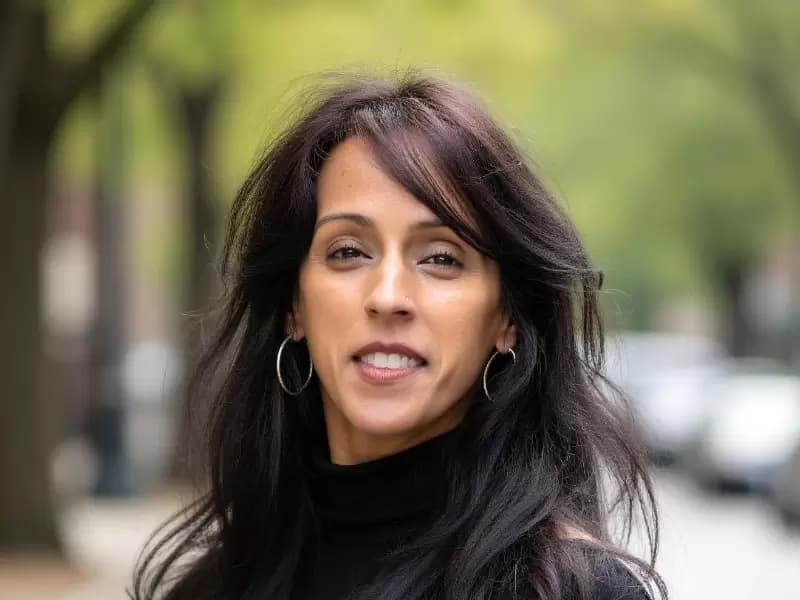
Rakhi Israni / File Photo
In 1969, Mahesh Mehta, an RSS pracharak, emigrated from Gujarat to New York, and almost immediately founded the Vishwa Hindu Parishad of America (VHPA) as the U.S. wing of the religious arm of India's RSS. He later helped establish the Hindu Swayamsevak Sangh (HSS) as the RSS's American arm, and then the Hindu Students Council, the Ekal Vidyalaya Foundation, and the Overseas Friends of the BJP (OFBJP).
In Houston, two relatives took up the work.
Ramesh Bhutada became HSS's national vice president; the city's first chapter met in his house. His cousin-in-law Vijay Pallod sat on VHPA's governing council. From 1986, they and allied families, the Isranis among them, built the Hindu Heritage Youth Camp under VHPA's banner.
Their ties to the organizational mother ship were no secret.
In December 2010, Bhutada and Pallod were photographed in the RSS's uniform at a Pune summit of its overseas volunteers, and in 2014 Pallod flew to India to campaign for Narendra Modi while Bhutada ran a phone bank of 700 in Houston to put him in power. Both were longtime activists with OFBJP, which later registered with the US government as a foreign agent.
Their camp raised a second generation. Among them were Rakhi Israni, who rose through the network as an officer of four of its organizations, including VHPA, and Kavita Pallod, who joined the board of the Hindu American Foundation (HAF) in 2024. In 2026, Israni is running for Congress in California, and more than a third of her outside money traces to the network.
This week, Kavita Pallod Sekhsaria published an essay explaining that none of this is what it looks like.
ALSO READ: A response to Pieter Friedrich's Smear-by-Association
Her essay calls my reporting a "smear by association." The charge is that I take Hindu families, Hindu friendships, Hindu institutions, and inflate them into a conspiracy until "ordinary" Hindu life looks "sinister." It's a serious accusation, and worth taking seriously, because misrepresentation is exactly what her essay runs on.
Three times she takes something small, specific, and documented, and answers a version that isn't — then argues with that instead. Exaggerate, minimize, strawman. She does this because the real version is true. The true version indicts the network her family built and she serves.
Each move pulls the reader one step further from a congressional candidate. That's the point.
I have written about this network for years. Kavita Pallod Sekhsaria appears in my work twice — as a named donor, a footnote really, most recently in my investigation of the Hindu supremacist movement's leadership funding Israni's congressional campaign. A board member of HAF, mentioned among the families funding Israni. That's the whole record of the "frequent target" — manufactured frequency.
The connections she cannot deny, so she makes them harmless: "Yes, we are connected," she writes — "that is what community looks like." Near her essay's end, a reassurance: "We are not a hive mind."
But a hive is close to how the movement self-describes.
Its founders fixed their aim as organizing "the entire Hindu society." Its own website sets the goal: every family, every profession, every school and temple "ultimately engulfed into its system," until each functions "just as in the body organs" — no longer itself, only a cell of the whole.
Engulfing social institutions is not "community," but a design for takeover.
She says her family is not a hive mind. Yet by the movement's own account, that is exactly what it wants to be.
The camp did this work. Rakhi Israni came up through it, camper to counselor. A generation grew up there and became the network's American officers — the candidate and her defender among them. The engulfing is not a metaphor. It is a childhood, and then a career.
There is a pattern, but not the one she demands. She recasts the charge as a claim that Hindus are violent in America, finds none, and calls the absence proof of prejudice — yet the charge was never that Hindus commit violence in America.
It was two things.
One, a murder-for-hire plot to kill a US citizen in New York, which a US court established was directed by an officer of the BJP-ruled Indian government that Pallod and Bhutada helped install. The other, an American network that supports and shields the movement behind a campaign a US federal commission warned targets Muslims, Christians, and Sikhs alike — mob violence tolerated with impunity, minorities' homes and houses of worship destroyed, the persecution reaching Sikhs on American soil. That commission named the RSS at the center of it, and recommended sanctions.
Two questions remain, and they're for the candidate. As an American seeking political office, will Rakhi Israni condemn the government her family's network helped install, and the assassination plot its officer directed here? And will she endorse the federal commission's recommendation to sanction the RSS?
Kavita Pallod Sekhsaria — her defender, her donor — wrote a thousand words to keep those two questions from reaching her.
The author is an investigative journalist.
(The views and opinions expressed in this article are those of the author and do not necessarily reflect the official policy or position of New India Abroad.)
Discover more at New India Abroad.
ADVERTISEMENT
ADVERTISEMENT
Comments
Start the conversation
Become a member of New India Abroad to start commenting.
Sign Up Now
Already have an account? Login